Facts
The Appellants (State of Chhattisgarh) challenged an order passed by a Single Judge on 19.02.2025 in WPS No. 4911 of 2023.
Source reference: p. 2The State filed the Writ Appeal with a delay of 299 days.
Source reference: p. 3The State attributed the delay to administrative processes, including seeking a legal opinion from the Advocate General (November 2025), obtaining sanction from the Law and Legislative Affairs Department (January 2026), and appointing an Officer-in-Charge.
Source reference: p. 2The State contended that as a multi-functional body, departmental formalities take time and the delay was bona fide.
Source reference: p. 3Issues
Whether the State provided "sufficient cause" under Section 5 of the Limitation Act to warrant the condonation of a 299-day delay in filing the appeal.
Source reference: p. 3, para. 4Whether the procedural "red-tape" and bureaucratic methodology of the State constitute a valid ground for overlooking the period of limitation.
Source reference: p. 4, para. 5Law Applied
The Court relied on Section 5 of the Limitation Act regarding the condonation of delay upon showing "sufficient cause".
Source reference: p. 3It applied the principle from Postmaster General v. Living Media India Ltd. (2012), which established that Government departments are not entitled to a separate or liberal period of limitation and must explain delays without resorting to the excuse of "procedural red-tape".
Source reference: p. 4-5It further cited State of Madhya Pradesh v. Ramkumar Choudhary (2024), holding that "sufficient cause" cannot be liberally interpreted if there is negligence or lack of bona fides.
Source reference: p. 5-6It further cited Shivamma v. Karnataka Housing Board (2025), which cautioned Courts against becoming "surrogates for State laxity".
Source reference: p. 11Reasoning
The Court examined the timeline provided by the State and found the explanation for the 299-day delay to be inadequate.
Source reference: p. 11It noted that the State is under a "special obligation" to perform duties with diligence and that condonation should be an exception rather than an anticipated benefit for government bodies.
Source reference: p. 5, 11Referencing Ajit Singh Thakur Singh v. State of Gujarat, the Court emphasized that a party must explain the circumstances that prevented filing within the limitation period; events occurring after the expiry of limitation are generally insufficient to establish "sufficient cause".
Source reference: p. 10The Court found that the sequence of events provided by the State lacked specificity and failed to demonstrate why the appeal could not have been initiated promptly after the 19.02.2025 order.
Source reference: p. 11-12Holding
The Court held that the State miserably failed to provide a cogent or acceptable explanation for the inordinate delay of 299 days.
The Court refused to exercise its discretionary power to condone the delay, noting that the law protects all litigants equally and cannot be distorted for State lethargy.
Source reference: p. 11Consequently, the Writ Appeal was dismissed on the grounds of delay and laches.
Source reference: p. 12Acts & Sections Cited
1 provisions across 1 statute referred to in this judgment. Linked provisions open on LawLens.
Limitation Act, 19081
Original Court PDF
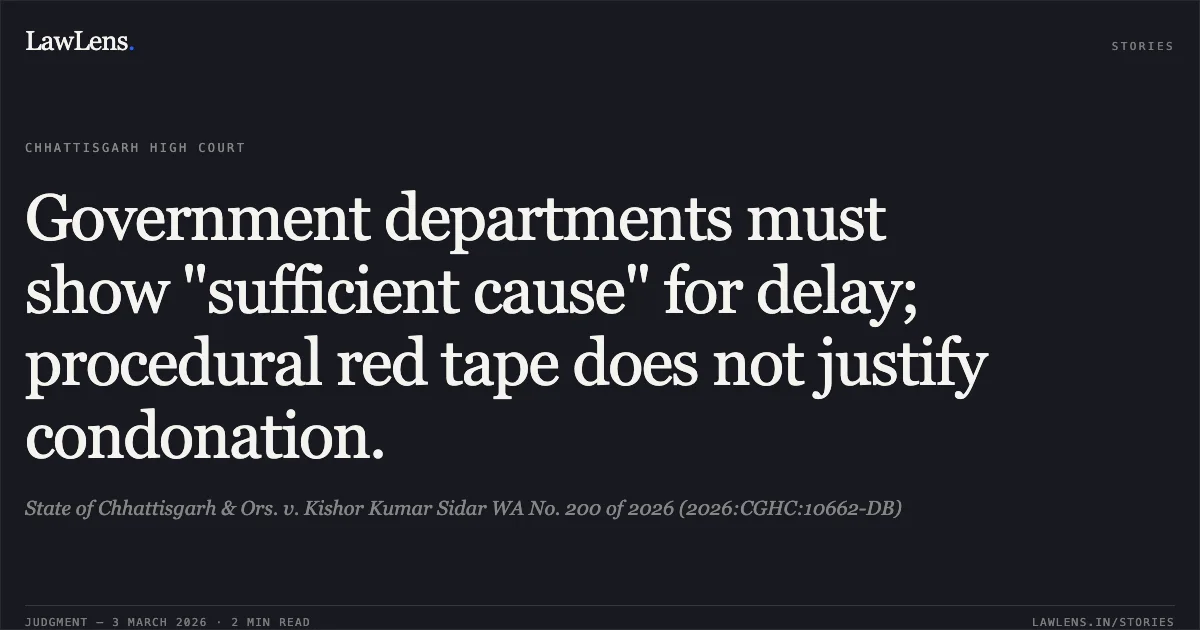
State of Chhattisgarh & Ors. v. Kishor Kumar Sidar WA No. 200 of 2026 (2026:CGHC:10662-DB)
Click to open original judgment
Original judgment, available to read, download and summarize on LawLens.in