Facts
The dispute involves the Union of India’s (Appellant) occupation of residential premises at Sujan Singh Park, New Delhi, based on a perpetual lease deed dated 26.04.1945 executed by the Governor General in Council
Source reference: p. 2, para. 3While the Respondent (successor-in-interest to the lessee) claimed the Appellant occupied the flats as a tenant subject to the Delhi Rent Control Act, 1958 (DRC Act), the Appellant contended its occupation was a sovereign grant governed by the Government Grants Act, 1895 (GG Act)
Source reference: p. 2, para. 5Following a dispute over rental arrears for 1989-1991, the Additional Rent Controller (ARC) passed an eviction order on 14.02.2005 under Section 14(1)(a) of the DRC Act
Source reference: p. 3, para. 8This was affirmed by the Rent Control Tribunal and the Delhi High Court, the latter holding that the GG Act did not provide immunity from rent control legislation
Source reference: p. 3-4, para. 9-11Issues
1. Whether the Appellant's occupation of the premises is governed exclusively by the terms of a perpetual lease deed under the Government Grants Act, 1895, or by the landlord-tenant relationship under the Delhi Rent Control Act, 1958
Source reference: p. 1-2, para. 22. Whether Section 3 of the Government Grants Act, 1895, should be interpreted narrowly (limiting its scope to the Transfer of Property Act) or broadly (as an overriding provision against any statute)
Source reference: p. 17, para. 46Law Applied
The Court applied Section 2 of the GG Act, which excludes the Transfer of Property Act, 1882, from applying to Government grants
Source reference: p. 10, para. 31It placed primary emphasis on Section 3 of the GG Act, which mandates that all provisions and conditions in a Government grant shall take effect according to their tenor, notwithstanding any "rule of law, statute or enactment of the Legislature to the contrary"
Source reference: p. 10, para. 31The Court relied on Pradip Oil Corporation v. MCD [(2011) 5 SCC 270], affirming that rights in a Government grant are regulated solely by the grant's terms
Source reference: p. 15-17, para. 44-45The Court relied on Azim Ahmad Kazmi v. State of U.P. [(2012) 7 SCC 278], which held that such grants are governed entirely by their own terms regardless of general law
Source reference: p. 18, para. 48Reasoning
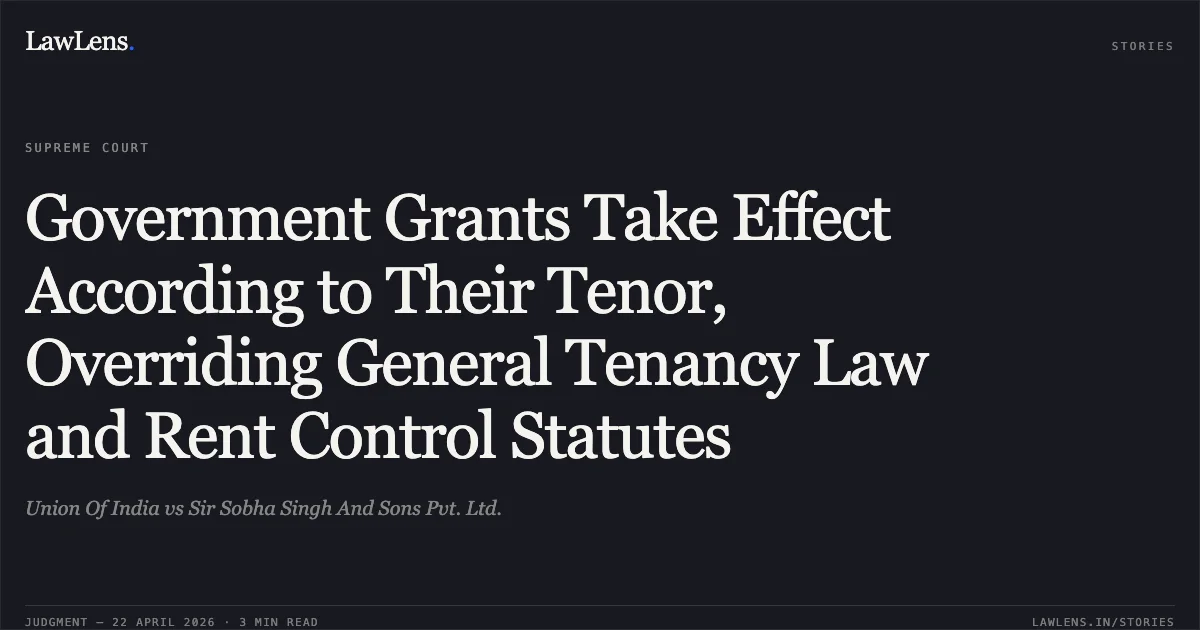
The Supreme Court determined that since the lease originated from a sovereign grant by the Governor General in Council, it is governed by the GG Act, not the DRC Act
Source reference: p. 8-9, para. 29-31The Court critiqued the lower courts for treating the matter as a conventional landlord-tenant dispute without addressing the foundational nature of the Government grant
Source reference: p. 11, para. 34-35It rejected the High Court’s narrow interpretation of Section 3 of the GG Act—which had relied on Collector of Bombay v. Nusserwanji Rattanji Mistri—clarifying that Section 3 is of the "widest amplitude" and is not limited to merely overriding the Transfer of Property Act
Source reference: p. 13-14, 23, para. 40-42, 51-52The Court held that because the grant's tenor regulates the relationship, and the DRC Act was intended for conventional tenancies, the ARC lacked jurisdiction; furthermore, as the lease deed lacked an express clause for re-entry/eviction for non-payment of rent, such a right could not be inferred under the grant
Source reference: p. 17, 24, para. 45, 55Holding
The Court held that the DRC Act has no application to holdings originating in and regulated by a Government grant under the GG Act
The Court allowed the appeal and set aside the High Court’s judgment and the underlying eviction order, holding that the eviction proceedings were "vitiated at their inception" for lack of jurisdiction
Source reference: p. 25, para. 56, p. 24, para. 55The Respondent’s remedy is limited to the recovery of rent through appropriate civil proceedings, as the grant’s silence on eviction cannot be converted into a ground for forfeiture
Source reference: p. 24-25, para. 55-57Acts & Sections Cited
7 provisions across 3 statutes referred to in this judgment. Each provision opens on LawLens.
delhi rent control act, 19584
Transfer of Property Act, 18822
Code of Civil Procedure, 19081
Original Court PDF
Union Of IndiavsSir Sobha Singh And Sons Pvt. Ltd.
Click to open original judgment
Original judgment, available to read, download and summarize on LawLens.in