Facts
The Petitioner’s father, a Head Constable, died in harness on April 28, 2015
Source reference: para. 1The Petitioner’s application for compassionate appointment was rejected by the Superintendent of Police on January 5, 2017, and March 17, 2020
Source reference: para. 1The rejections were based on the fact that the Petitioner’s brother was already a government servant
Source reference: para. 1, 4The Petitioner contended that his brother lived separately and provided no financial assistance, and further alleged that the respondent authorities failed to conduct an inquiry into the family's actual financial condition
Source reference: para. 1Issues
1. Whether the Petitioner is eligible for compassionate appointment under the state policy when a family member is already in government service
Source reference: para. 2, 42. Whether the Court can direct the state to conduct an inquiry into the financial dependency or support provided by an employed family member to the dependents of the deceased
Source reference: para. 6Law Applied
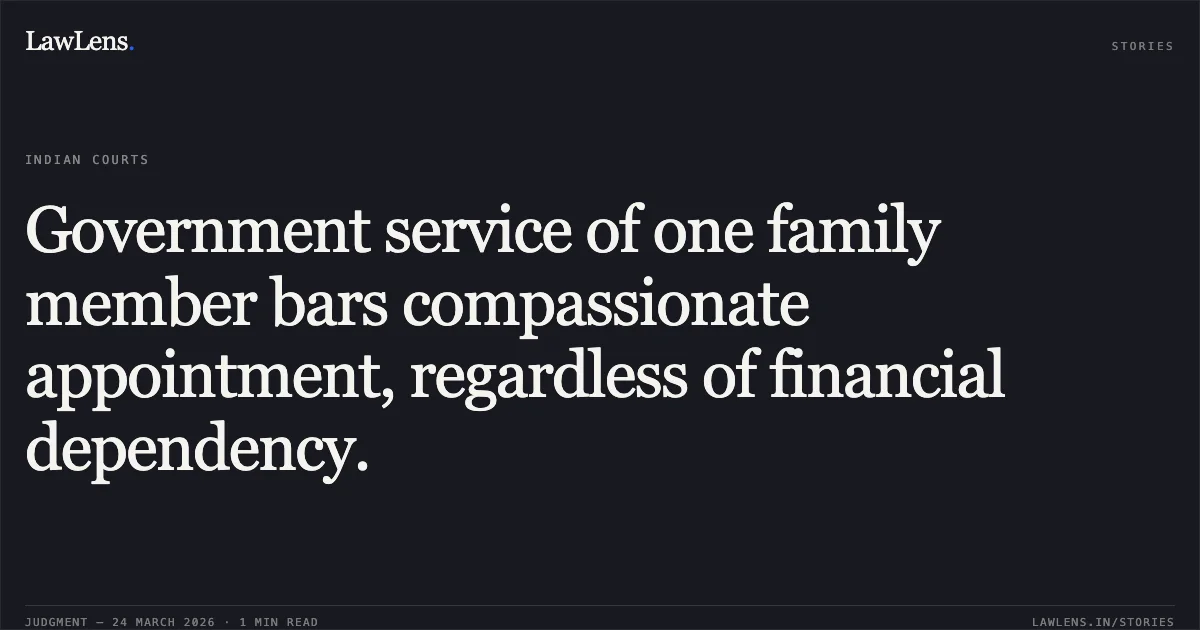
Clause 6A of the Compassionate Appointment Policy dated August 29, 2016, issued by the General Administration Department, Government of Chhattisgarh, which stipulates that if any family member of a deceased government servant is already in government service, no other member is eligible for compassionate appointment
Source reference: para. 2, 4The Court relied on the Division Bench judgment in State of Chhattisgarh v. Muniya Bai (Writ Appeal No. 33 of 2022), which held that the policy does not envisage an inquiry into the financial condition of family members
Source reference: para. 2, 4The Court applied the Full Bench decision in State of Chhattisgarh & Ors. v. Umesh Thakur (Writ Appeal No. 236 of 2022), which established that Article 226 cannot be used to mandate inquiries into financial dependency where the policy contains an express bar based on existing family employment
Source reference: para. 6Reasoning
The Court observed that Clause 6A of the governing policy explicitly prohibits compassionate appointment if a family member (as defined in the clause) is already employed by the government
Source reference: para. 4In this case, it was undisputed that the Petitioner’s brother was a government employee
Source reference: para. 7Applying the precedent in Umesh Thakur, the Court reasoned that ordering an inquiry into whether the brother actually supported the Petitioner would amount to "rephrasing or rewording" the terms of the policy, which is legally impermissible
Source reference: para. 6The Court emphasized that compassionate appointments must be granted strictly according to the prevailing policy, and judicial intervention cannot bypass express conditions or negative stipulations within such schemes
Source reference: para. 5, 8Holding
The Court answered the issues in the negative, holding that the Petitioner is ineligible for appointment due to his brother's government employment
It further held that an inquiry into financial dependency is totally barred when the policy contains an express prohibition
Source reference: para. 6Consequently, the High Court found the writ petition devoid of merit and dismissed it
Source reference: para. 9Original Court PDF
GANPATI KHUNTESHWAR,vsSTATE OF CHHATTISGARH,
Click to open original judgment
Original judgment, available to read, download and summarize on LawLens.in