Facts
The Special Police Establishment, Lokayukta, Madhya Pradesh, sought leave to appeal against the judgment dated 13 October 2022 by which the respondent was acquitted of offences under Sections 7 and 13(1)(d) read with Section 13(2) of the Prevention of Corruption Act, 1988.
Source reference: para. 2The application for leave to appeal was filed with a delay of 293 days beyond the prescribed limitation period of 90 days.
Source reference: paras. 2–3The appellant attributed the delay to the time taken in obtaining the certified copy, securing opinions and approvals from the Special Prosecutor, the Superintendent of Police, the Director General of Police and the Law Department, and the subsequent misplacement of the file in the standing counsel’s office during renovation.
Source reference: para. 3The respondent opposed condonation, contending that the explanation was vague, unsatisfactory and amounted merely to bureaucratic delay.
Source reference: para. 4Issues
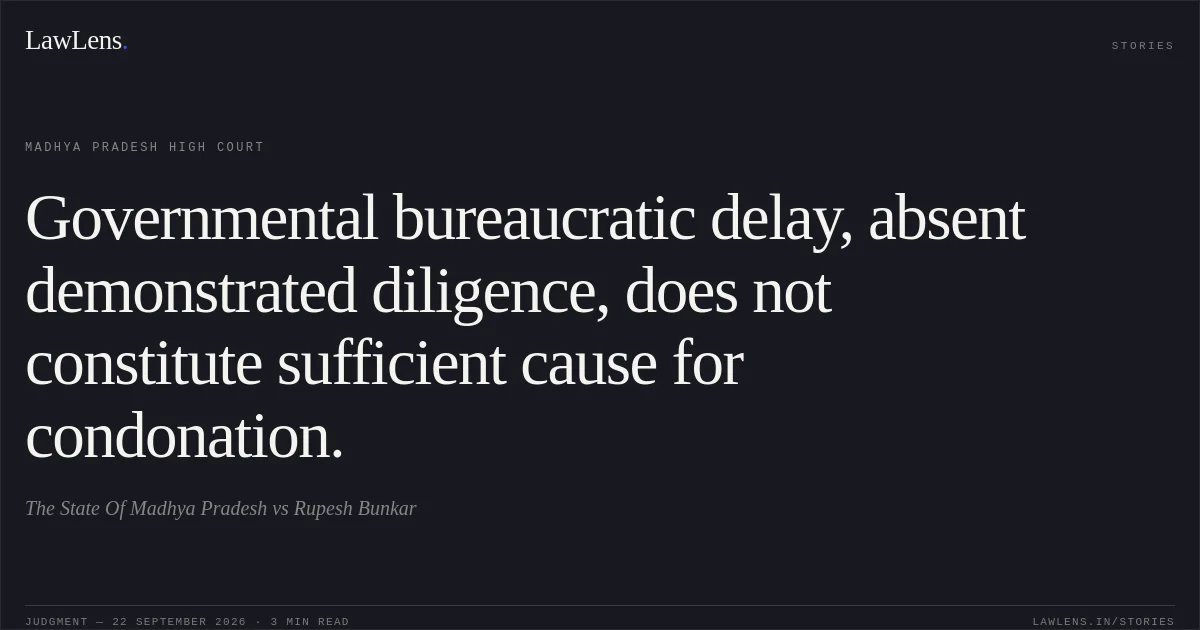
Whether the appellant established “sufficient cause” under Section 5 of the Limitation Act, 1963 for condoning the 293-day delay in filing the application for leave to appeal?
Source reference: paras. 5–11Whether bureaucratic procedures, administrative red tape and the movement or misplacement of files constituted sufficient cause in the circumstances of an appeal against acquittal?
Source reference: paras. 12–15Law Applied
Section 5 of the Limitation Act permits condonation of delay only where the applicant establishes sufficient cause; condonation is discretionary and cannot be claimed as of right.
Source reference: paras. 8–11The court relied on State of Nagaland v. Lipok AO, which adopted a pragmatic approach towards delays attributable to governmental functioning, but also on Sheo Raj Singh v. Union of India, DDA v. Tejpal, and Shivamma v. Karnataka Housing Board, which clarified that the State receives no automatic or preferential treatment and must demonstrate a bona fide, cogent and sufficiently acceptable explanation.
Source reference: paras. 7–10The court emphasised that an explanation must be distinguished from a mere excuse, and that bureaucratic red tape, procedural movement of files, inaction or casual indifference ordinarily cannot constitute sufficient cause unless the State demonstrates reasonable diligence and that the delay occurred despite genuine efforts to act within limitation.
Source reference: paras. 8–11In an appeal against acquittal, the strengthened presumption of innocence and the acquitted person’s accrued liberty require a substantial and satisfactory explanation for delay.
Source reference: para. 12Reasoning
The court found that the appellant’s explanation merely recounted the movement of the file through various governmental offices and the eventual misplacement of the file with standing counsel.
Source reference: paras. 3, 6 and 11Applying the principles in DDA v. Tejpal and Shivamma, the court held that the explanation disclosed bureaucratic lethargy, avoidable procedural delay, inaction and lack of diligence rather than circumstances beyond the appellant’s control.
Source reference: paras. 10–14The fact that the case involved serious corruption offences could not substitute for proof of sufficient cause; if the matter was considered important to public justice, the appellant’s officials were expected to act with greater vigilance and promptitude.
Source reference: para. 13Since the challenge was directed against an acquittal, the court held that the delay had a direct bearing on the respondent’s accrued liberty and therefore required a particularly satisfactory explanation.
Source reference: para. 12The appellant failed to show bona fide efforts or reasonable diligence during the relevant period.
Source reference: para. 14Holding
The High Court held that the appellant failed to establish sufficient cause for condoning the 293-day delay under Section 5 of the Limitation Act.
The application for condonation of delay, I.A. No. 17349/2024, was accordingly dismissed.
Source reference: paras. 15–16As a consequence, the criminal appeal seeking leave to challenge the respondent’s acquittal was also dismissed.
Source reference: para. 17Acts & Sections Cited
4 provisions across 2 statutes referred to in this judgment. Each provision opens on LawLens.
Prevention of Corruption Act, 19882
Original Court PDF
The State Of Madhya PradeshvsRupesh Bunkar
Click to open original judgment
Original judgment, available to read, download and summarize on LawLens.in