Facts
The State of Chhattisgarh filed an application for grant of leave to appeal along with an acquittal appeal against the judgment dated 31.10.2022 passed by the 2nd Additional Sessions Judge, Balrampur
Source reference: para. 2The respondents had been acquitted of various charges including murder (Section 302/34 IPC) and offenses under the Arms Act
Source reference: para. 2The State’s petition was filed with a delay of 124 days beyond the prescribed limitation period
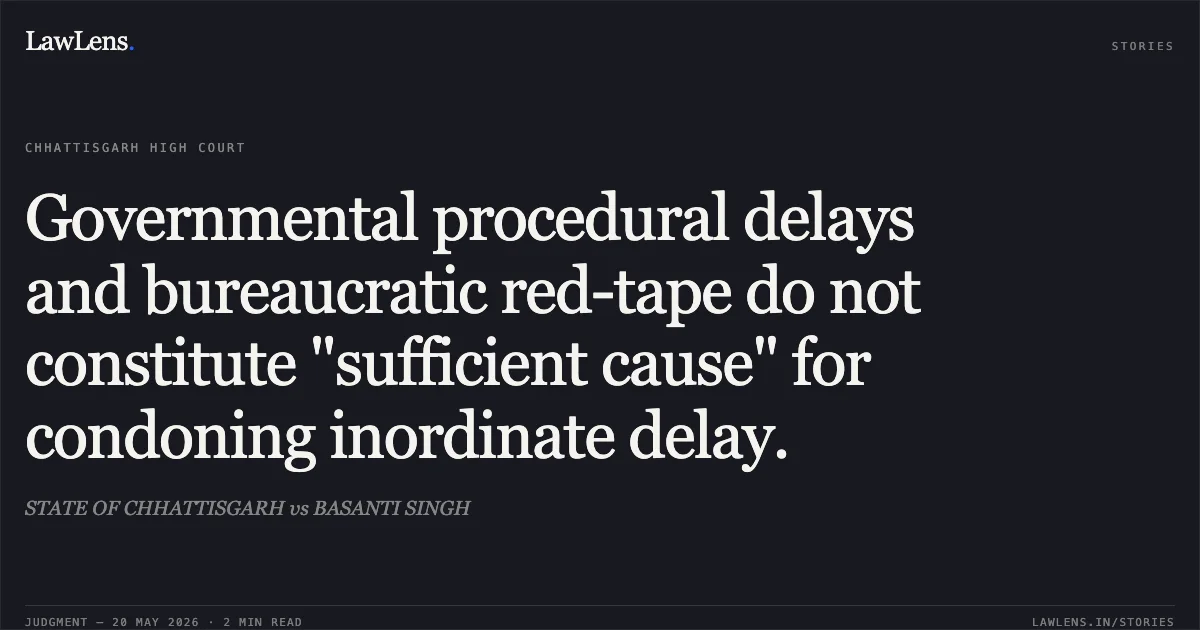
Source reference: para. 1The State attributed this delay to "departmental formalities" and the slow functioning of the "government machinery" as a multi-functional body
Source reference: para. 4Issues
Whether the provisions of Section 5 of the Limitation Act apply to an application for leave to appeal from an order of acquittal
Source reference: para. 5Whether the "departmental formalities" and "government machinery" constraints constitute "sufficient cause" to condone a delay of 124 days
Source reference: paras. 9-10Law Applied
Section 5 of the Limitation Act, 1908 (old Act), which requires the applicant to show "sufficient cause" for delay
Source reference: para. 5Postmaster General v. Living Media India Ltd. (2012), which established that government departments cannot claim a separate period of limitation or the "procedural red-tape" excuse in the age of modern technology
Source reference: para. 6State of Madhya Pradesh v. Ramkumar Choudhary (2024) and Ajit Singh Thakur Singh v. State of Gujarat (1981), which held that "sufficient cause" must be traced to circumstances arising within the limitation period, and that delay should not be excused as a matter of generosity
Source reference: para. 7Reasoning
The Court reasoned that while appellate courts have wide powers to reappreciate evidence in acquittal cases, such power is contingent upon the appeal being filed within the statutory timeframe
Source reference: para. 3The Court observed that the State failed to provide a specific or "bona fide" explanation for the delay, merely citing the movement of files between the Law Legislative Affairs Department and the Advocate General's office
Source reference: para. 9Following the precedent in Postmaster General, the Court held that the government is under a special obligation to perform duties with diligence and that condonation is an exception, not an "anticipated benefit" for the State
Source reference: paras. 6, 8The Court found that the State failed the vital test of proving reasonable diligence, as no "sufficient cause" was demonstrated to justify why the petition could not be instituted between the 1st and 90th day of the limitation period
Source reference: paras. 7, 10Holding
The Court answered that the State failed to establish sufficient cause for the delay.
The Application for condonation of delay (I.A. No. 01) and the petition for leave to appeal were rejected on the grounds of delay and laches
Source reference: para. 11Petition rejected
Source reference: para. 11Acts & Sections Cited
5 provisions across 2 statutes referred to in this judgment. Each provision opens on LawLens.
Indian Penal Code, 18603
Arms Act, 19592
Original Court PDF
STATE OF CHHATTISGARHvsBASANTI SINGH
Click to open original judgment
Original judgment, available to read, download and summarize on LawLens.in


