Facts
The petitioner served as an Assistant Teacher at a grant-in-aid primary school from 1981 until her retirement on May 31, 2018
Source reference: p. 2Following retirement, she underwent cancer treatment at a private hospital (CIMS, Ahmedabad) between 2018 and 2019, incurring expenses of ₹12,05,230/-
Source reference: p. 2Her claim for medical reimbursement was rejected by the State authorities via communications dated October 22, 2020, and November 2, 2020. The rejection was based on the grounds that as a retired teacher of a grant-in-aid school, she was not considered a "Government employee/pensioner" under Rule 1.2.2 of the Gujarat State Service (Medical Treatment) Rules, 2015, and because the treatment was at a private facility
Source reference: p. 2, 4Issues
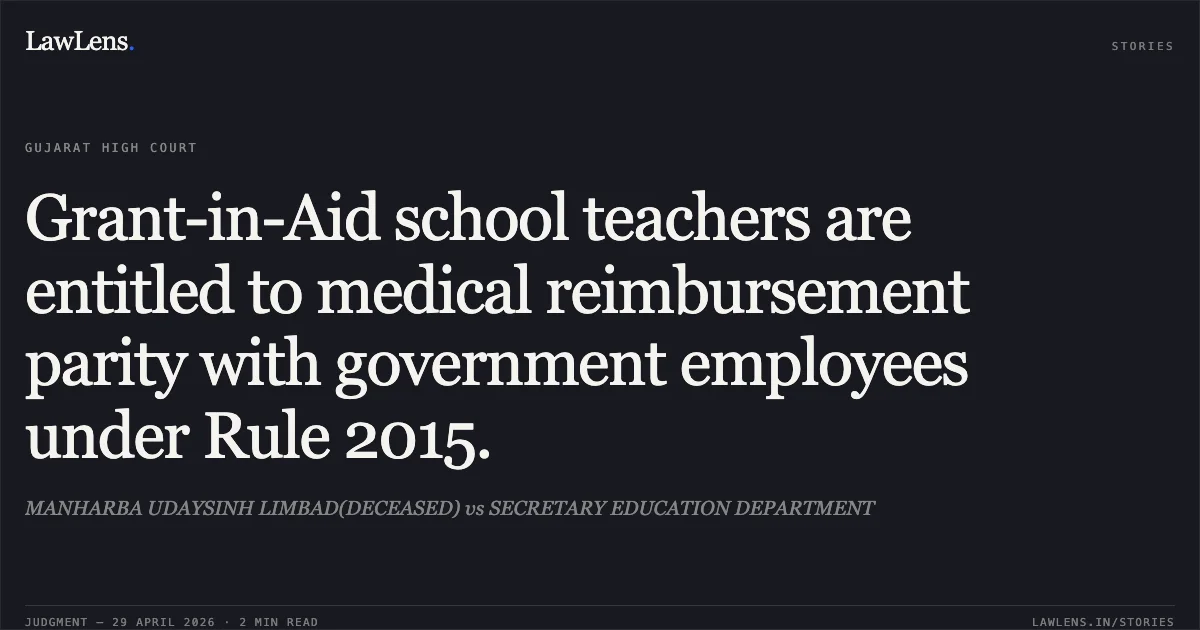
1. Whether a teacher retired from a grant-in-aid school is entitled to medical reimbursement under the Gujarat State Service (Medical Treatment) Rules, 2015
Source reference: p. 3 / para. 6.12. Whether denying medical reimbursement to primary teachers of grant-in-aid schools while providing it to secondary/college teachers constitutes hostile discrimination under Article 14
Source reference: p. 5-6 / para. 5.1Law Applied
Gujarat State Service (Medical Treatment) Rules, 2015, specifically examining the scope of Rule 1.2.2
Source reference: p. 3Article 21 (Right to Life) and Article 47 (Duty of the State to improve public health), establishing that medical aid is a fundamental right
Source reference: p. 7The court followed the precedent in Ushaben Dayashankar Shukla v. State of Gujarat (SCA No. 17320 of 2021, confirmed in LPA No. 543 of 2023), which held that teachers in grant-in-aid institutions form a homogenous class and cannot be discriminated against
Source reference: p. 5, 8State of Punjab v. Ram Lubhaya Bagga (1998) 4 SCC 117, confirming the State's obligation to provide meaningful medical facilities to citizens
Source reference: p. 7Reasoning
The court reasoned that the State’s distinction between government employees and grant-in-aid school teachers for medical benefits creates a "class within a class," which is impermissible under Article 14 of the Constitution
Source reference: p. 5-6The court noted that the need for medical aid is universal and does not vary based on the level of the educational institution (primary vs. secondary) or its grant-in-aid status
Source reference: p. 8It observed that the petitioner had previously received reimbursement for a 2007 procedure at a private hospital, making the current denial arbitrary
Source reference: p. 7, 8The court emphasized that the Rules of 2015 must be interpreted in light of the "Right to Life," and any policy excluding a specific set of teachers from this welfare benefit is unsustainable and legally flawed
Source reference: p. 8-9Holding
The High Court allowed the petition, holding that the petitioner is entitled to medical reimbursement
The court set aside the rejection and directed the petitioner to resubmit medical bills within 15 days. The respondents were ordered to process and pay the claim by June 30, 2026. Failure to comply within the stipulated time will attract interest at the rate of 6% per annum from July 1, 2026, until realization
Source reference: p. 9, 10Original Court PDF
MANHARBA UDAYSINH LIMBAD(DECEASED)vsSECRETARY EDUCATION DEPARTMENT
Click to open original judgment
Original judgment, available to read, download and summarize on LawLens.in