Facts
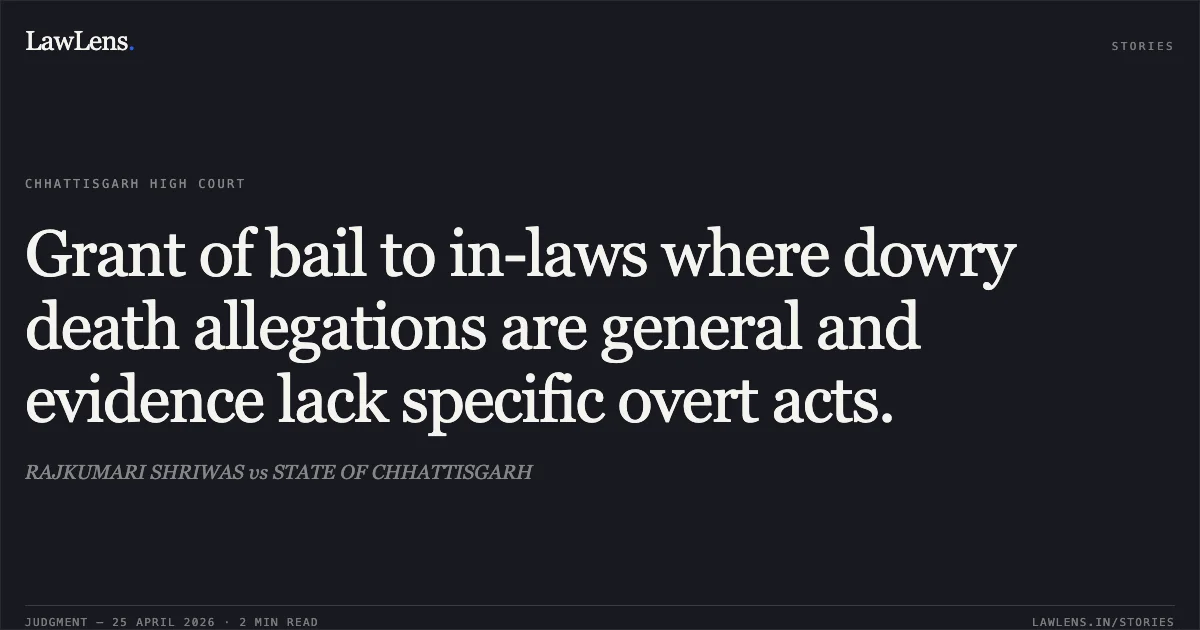
The applicants, the mother-in-law and father-in-law of the deceased (Smt. Jagriti Shriwas), sought regular bail following their arrest on February 10, 2026.
Source reference: para. 1-2The prosecution alleged that the deceased, who married the applicants’ son on July 11, 2024, committed suicide by consuming pesticide on December 8, 2025, due to physical and mental harassment related to dowry demands.
Source reference: para. 2A case was registered under Sections 80 and 3(5) of the Bharatiya Nyaya Sanhita (BNS).
Source reference: para. 2The applicants argued that only general allegations were made, the charge sheet had been filed, and the husband was already in custody.
Source reference: para. 3Issues
1. Whether the applicants are entitled to the grant of regular bail under Section 483 of the Bharatiya Nagarik Suraksha Sanhita (BNSS), 2023, considering their roles as in-laws and the nature of the evidence.
Source reference: para. 1, 6Law Applied
The court's decision was governed by Section 483 of the Bharatiya Nagarik Suraksha Sanhita (BNSS), 2023, regarding the power of the High Court to grant bail.
Source reference: para. 1The substantive charges were framed under Section 80 (dowry death/presumption) and Section 3(5) (common intention) of the Bharatiya Nyaya Sanhita (BNS).
Source reference: para. 1-2The court considered standard appellate principles for bail, including the gravity of the offence, the specificity of allegations, the status of the investigation (filing of the charge sheet), and the duration of detention.
Source reference: para. 6Reasoning
The Court observed that the marriage occurred in 2024 and that the applicants, being the mother-in-law and father-in-law, faced only "general allegations" regarding dowry demands rather than specific overt acts.
Source reference: para. 3, 6Critically, the Court noted the absence of any eye-witness accounts or a dying declaration from the deceased that implicated the applicants specifically.
Source reference: para. 3-4The prosecution acknowledged that the FSL report was still pending and that the main accused (the husband) remained in jail.
Source reference: para. 3-4Given that the charge sheet had already been filed, the applicants had been detained since February 10, 2026, and their role was distinguishable from the co-accused husband, the Court reasoned that further incarceration was unnecessary as the trial would likely consume significant time.
Source reference: para. 6Holding
The High Court allowed the bail application, holding that the applicants were entitled to release.
The Court directed their release upon furnishing a personal bond with two sureties, subject to several conditions: (i) they must not seek unnecessary adjournments; (ii) they must remain present at all trial dates or face proceedings under Section 269 of the BNS; and (iii) they must appear in person for the framing of charges and recording of statements under Section 351 of the BNSS.
Source reference: para. 7Acts & Sections Cited
7 provisions across 2 statutes referred to in this judgment. Each provision opens on LawLens.
Bharatiya Nagarik Suraksha Sanhita, 20233
Bharatiya Nyaya Sanhita, 20234
Original Court PDF
RAJKUMARI SHRIWASvsSTATE OF CHHATTISGARH
Click to open original judgment
Original judgment, available to read, download and summarize on LawLens.in