Facts
The Appellants filed multiple statutory appeals under the Designs Act, 2000, challenging the rejection of their design applications for Graphical User Interfaces (GUIs) applied to various articles like display screens, vehicle dashboards, and electrosurgical generators
Source reference: para. 4The Controller of Patents and Designs had rejected these applications on the grounds that a GUI does not constitute an "article" under Section 2(a), is not "applied" by an "industrial process" under Section 2(d), lacks "permanence" because it is only visible when the device is ON, and is protected as "artistic work" under the Copyright Act, thereby precluding dual protection
Source reference: para. 3, 5The Appellants contended that the 2021 Amendment to the Design Rules, which adopted the Locarno Classification including GUIs, signifies legislative intent to protect digital designs
Source reference: para. 3, 17Issues
1. Whether Graphical User Interface (GUI) satisfies the criteria of a "design" making it eligible for registration under the Designs Act, 2000
Source reference: para. 12. Whether the term "industrial process" under Section 2(d) includes digital or software-driven processes
Source reference: para. 103. Whether the requirement of "permanence" is a necessary prerequisite for the registration of a design
Source reference: para. 144. Whether the potential for copyright protection of a GUI as an "artistic work" bars its registration as a "design"
Source reference: para. 19Law Applied
The Court applied Section 2(a) defining "article" as any article of manufacture or substance
Source reference: para. 7Section 2(d) defining "design" as features of shape, configuration, pattern, ornament, or composition applied to an article by any industrial process which appeal to the eye
Source reference: para. 7The Court utilized the principle of "Updating Construction" to interpret statutes in light of technological advancements
Source reference: para. 11relying on *State of Punjab v. Amritsar Beverages Ltd.* [(2006) 7 SCC 607]. It further relied on the "functional utility" test and the harmonization of Copyright and Design laws as established in *Cryogas Equipment Private Limited v. Inox India Ltd.* [2025 SCC Online SC 780] and Section 15 of the Copyright Act, 1957
Source reference: para. 19-21Reference was also made to Rule 10(1) of the Design Rules, 2003 (as amended in 2021), which incorporates the Locarno Classification for "Screen Displays and Icons"
Source reference: para. 17Reasoning
The Court reasoned that "article of manufacture" is a broad term encompassing digital devices and their display units
Source reference: para. 9It rejected the Controller’s narrow interpretation of "industrial process," holding that the word "any" in Section 2(d) includes modern technical processes like rendering GUI via software and hardware
Source reference: para. 10, 13Applying "updating construction," the Court found that physical cogs are being replaced by digital signals, which nonetheless constitute industrial activity
Source reference: para. 12Regarding permanence, the Court held that Section 2(d) does not require a design to be "permanently visible"; it is sufficient if the design is visible during the article's "normal use" (i.e., when turned ON)
Source reference: para. 14-15On the issue of dual protection, the Court clarified that while a GUI's code is protected by copyright, its visual "look and feel" industrially applied to an article constitutes a "design."
Source reference: para. 20-22Once industrially applied, it transitions from a pure "artistic work" to a "design" under the Act
Source reference: para. 20-22The Court also noted that the Controller had previously registered several GUIs, creating an inconsistency in the Design Office's practice
Source reference: para. 26Holding
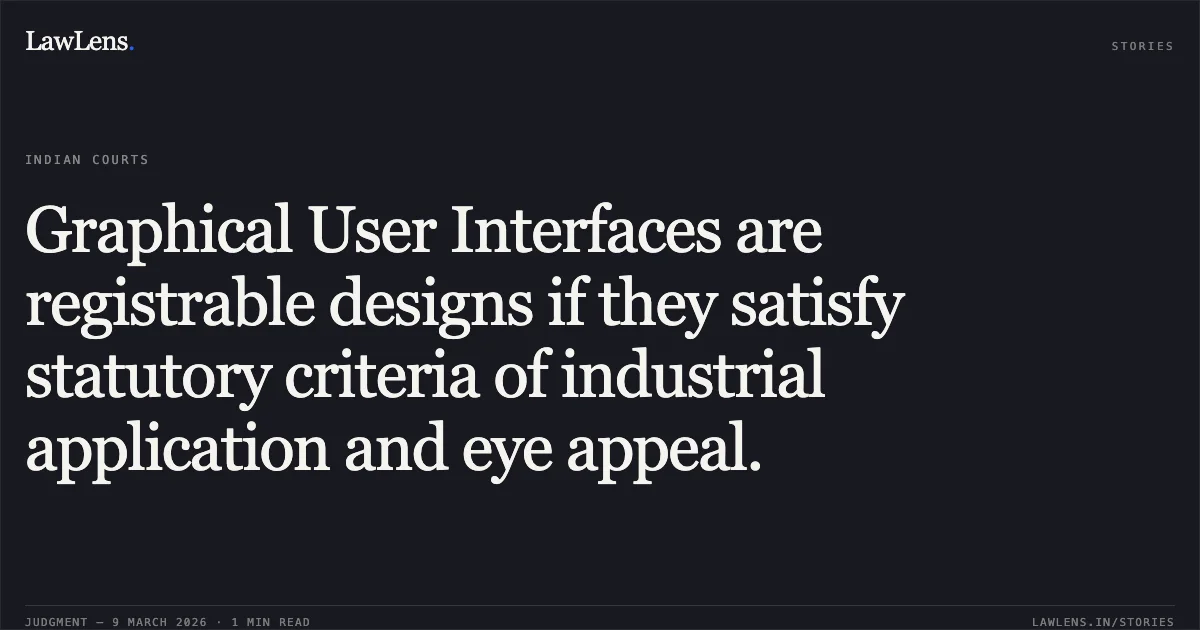
The Court answered the primary issue in the affirmative, holding that GUIs are not *per se* excluded from registration under the Designs Act provided they meet the requirements of Sections 2(a) and 2(d)
The Court set aside the impugned orders and remanded the applications to the Controller for fresh consideration
Source reference: para. 27It held that (i) GUIs can be "applied to an article"; (ii) digital rendering is an "industrial process"; (iii) "permanence" is not a statutory requirement; and (iv) the existence of copyright in the underlying code does not bar design registration of the visual interface
Source reference: para. 13-15, 22The appeals were allowed
Source reference: para. 27Acts & Sections Cited
5 provisions across 3 statutes referred to in this judgment. Each provision opens on LawLens.
Designs Act, 20001
Copyright Act, 19573
Indian Penal Code, 18601
Original Court PDF
NEC Corporation; ERBE Elektromedizin GMBH; Abiomed Inc; and TVS Motor Company LimitedVs.The Controller of Patents and Designs and Anr. (2026:CHC-OS:71)
Click to open original judgment
Original judgment, available to read, download and summarize on LawLens.in