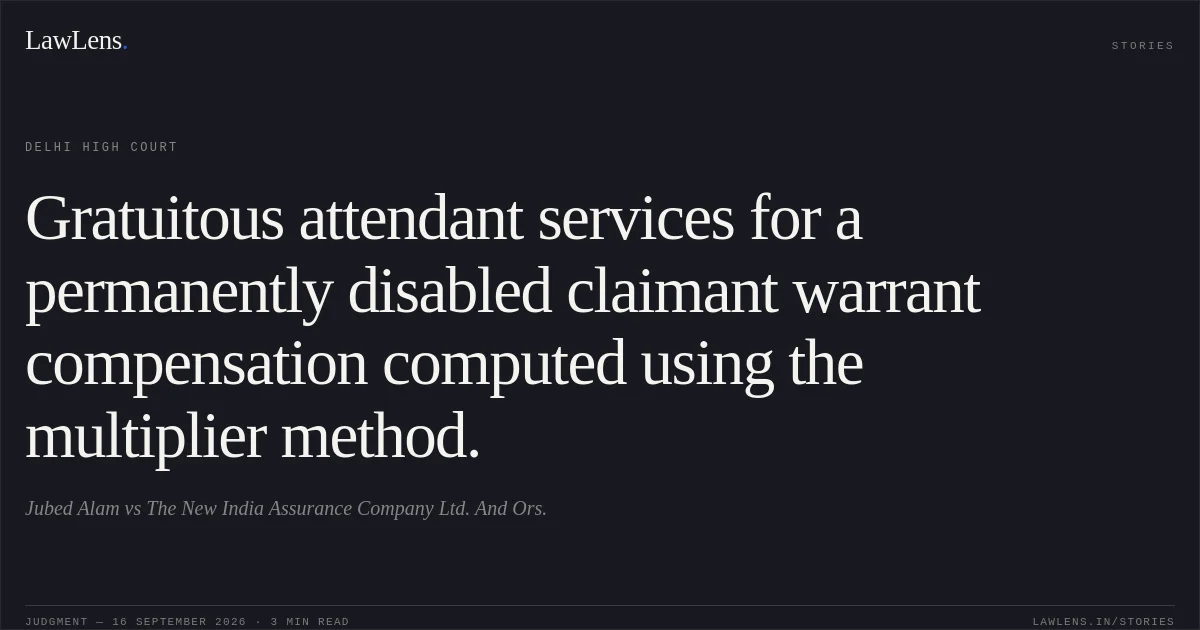
Facts
The appellant, aged 29 years, suffered serious injuries in a motor accident on 27 October 2022, resulting in 100% permanent functional disability, paraplegia, loss of bowel and bladder sensation, and inability to walk or attend to his basic needs independently.
Source reference: p.4, paras. 9–12He claimed to be working as a pipe fitter/insulator and earning approximately Rs.27,000 per month, although during cross-examination he stated that his income was Rs.24,000 per month and produced no salary or income proof.
Source reference: pp.2–3, paras. 5–7The Motor Accident Claims Tribunal assessed his income on the basis of minimum wages for a skilled worker at Rs.20,357 per month and awarded total compensation of Rs.83,10,835, including only Rs.35,000 towards attendant charges.
Source reference: p.1, para. 1; p.8, para. 16The claimant appealed seeking enhancement on the grounds of incorrect assessment of income and inadequate attendant charges.
Source reference: p.1, paras. 2–4Issues
Whether the claimant’s monthly income ought to have been assessed at more than the minimum wage adopted by the Tribunal, in light of the evidence regarding his employment and earnings?
Source reference: pp.1–3, paras. 2, 5–8Whether, despite the claimant not engaging a paid nurse or attendant, he was entitled to substantial compensation for attendant services rendered gratuitously by family members, and whether such compensation should be calculated by applying the multiplier method?
Source reference: pp.4–7, paras. 9–15Law Applied
The Court applied the principle that assessment of income in motor accident claims involves intelligent guesswork and need not be confined to minimum wages where documentary proof is unavailable; the court may consider the overall evidence, nature and location of employment, vocation, and applicable minimum-wage notifications, as stated in Savita & Ors. v. National Insurance Co. Ltd., 2026:DHC:3626.
Source reference: p.3, para. 8It relied on Chandramani Nanda v. Sarat Chandra Swain & Ors., 2024 INSC 777, and Kajal v. Jagdish Chand, (2020) 4 SCC 413, for the principle that gratuitous attendant services provided by family members have compensable value and that the tortfeasor cannot benefit from such unpaid assistance.
Source reference: pp.4–5, paras. 11–13Under Kajal, attendant charges may be determined through the multiplier method, which promotes consistency and reflects the claimant’s long-term requirements.
Source reference: pp.5–7, para. 14The Court also applied the multiplier of 17 for a claimant aged 29 years, consistently with National Insurance Co. Ltd. v. Pranay Sethi, (2017) 16 SCC 680.
Source reference: pp.7–8, para. 15Reasoning
On income, the Court rejected both the claimant’s uncorroborated assertion of Rs.27,000 per month and the Tribunal’s mechanical reliance on minimum wages. Although the claimant had previous employment-related documents and had worked in skilled occupations, there was no salary proof or testimony from his contractor, and his own statements regarding income were inconsistent. Applying the flexible benchmark-income approach in Savita, the Court assessed his monthly income at Rs.22,000.
Source reference: p.3, paras. 5–8On attendant charges, the Court held that the claimant’s admission that he had not hired nursing assistance did not defeat the claim. Medical evidence established that he was paraplegic, had permanent lower-limb disability, loss of bowel and bladder sensation, no realistic chance of recovery, and would remain unable to walk or manage basic activities independently.
Source reference: p.4, paras. 9–10Consequently, family members were presumed to be providing continuing gratuitous assistance, which was compensable under Chandramani Nanda and Kajal. The Court adopted the minimum wage applicable to a semi-skilled worker in Delhi, Rs.17,693 per month, as the cost of one attendant and applied multiplier 17, resulting in attendant charges of Rs.36,09,272.
Source reference: pp.7–8, paras. 14–16Holding
The appeal was allowed in part. The claimant’s income was reassessed at Rs.22,000 per month, and attendant charges were enhanced from Rs.35,000 to Rs.36,09,272. The total compensation was consequently enhanced from Rs.83,10,835 to Rs.1,23,64,206, resulting in an enhanced amount of Rs.40,53,371.
The enhanced compensation was directed to carry interest at 8% per annum from the date of filing of the claim petition and was to be deposited before the Tribunal within four weeks. Rs.2,00,000 was directed to be released to the claimant, while the balance was to be placed in staggered fixed deposits, with interest credited to his savings account.
Source reference: p.9, para. 18Original Court PDF
Jubed AlamvsThe New India Assurance Company Ltd. And Ors.
Click to open original judgment
Original judgment, available to read, download and summarize on LawLens.in
![Non-submission of online self-appraisal cannot automatically disqualify an employee from EPP financial upgradation.. Ashok Kumar Sahu vs Bharat Sanchar Nigam Limited. CAT - ['Jabalpur']. LawLens](/stories/thumbnails/non-submission-of-online-self-appraisal-cannot-automatically-disqualify-an-employee-from-e-211b98f9eb684a569412a8a970828971.webp)