Facts
The petitioners were private B.Ed. colleges situated within the territorial jurisdiction of respondent No. 3-University and recognized by the National Council for Teacher Education (NCTE).
Source reference: para. 2For the academic session 2026–27, the University invited applications for continuation of affiliation, which the petitioners submitted.
Source reference: para. 2The Academic Council approved their cases on 9 July 2026; however, the Executive Council, on 15 July 2026, declined to approve them and directed a fresh inquiry without assigning reasons.
Source reference: para. 3A five-member committee subsequently recommended approval on 30 July 2026, but the matter remained pending before the Executive Council as the counselling deadline of 31 August 2026 approached.
Source reference: para. 3Following directions issued during the proceedings, the Executive Council took a decision on 7 September 2026, after the counselling deadline had expired.
Source reference: para. 4Upon instructions from the State Government, the counselling portal was reopened for four days, from 10 to 14 September 2026, enabling students to opt for the petitioner colleges.
Source reference: para. 4Issues
Whether the petition had become infructuous after the State Government reopened the counselling portal and permitted students to opt for the petitioner colleges.
Source reference: paras. 4–9Whether the members of the University’s Executive Council acted improperly by delaying the decision on continuation of affiliation and ordering a fresh inspection without assigning reasons.
Source reference: paras. 9–13Whether costs and corrective directions should be imposed for the Executive Council’s failure to discharge its statutory functions in a timely and reasoned manner.
Source reference: para. 13Law Applied
The Court exercised jurisdiction under Article 226 of the Constitution to consider the petitioners’ grievance concerning affiliation and participation in the counselling process.
Source reference: para. 1It applied the principle that statutory and regulatory authorities responsible for affiliation and recognition must act promptly, transparently, for proper reasons, and within the applicable academic and counselling timelines.
Source reference: paras. 9–12The Court further emphasized that doubts regarding infrastructure, faculty, or other regulatory requirements must be examined through a timely and specifically mandated inspection, and institutions lacking requisite facilities may be stopped or penalized in accordance with law, whereas compliant institutions should not be obstructed arbitrarily.
Source reference: para. 12The petitioners had also relied upon the timeline principles referred to in Maa Vaishno Devi Mahila Mahavidyalaya v. State of U.P., W.P. (C) No. 276 of 2012, although the judgment did not independently elaborate or apply that precedent.
Source reference: para. 1Reasoning
The Court found that the State Government’s reopening of the counselling portal from 10 to 14 September 2026 cured the immediate prejudice to the petitioners by allowing students to consider all colleges, including the petitioner institutions.
Source reference: paras. 4, 6, 9Consequently, the petitioners’ primary relief had been achieved and the petition could be withdrawn.
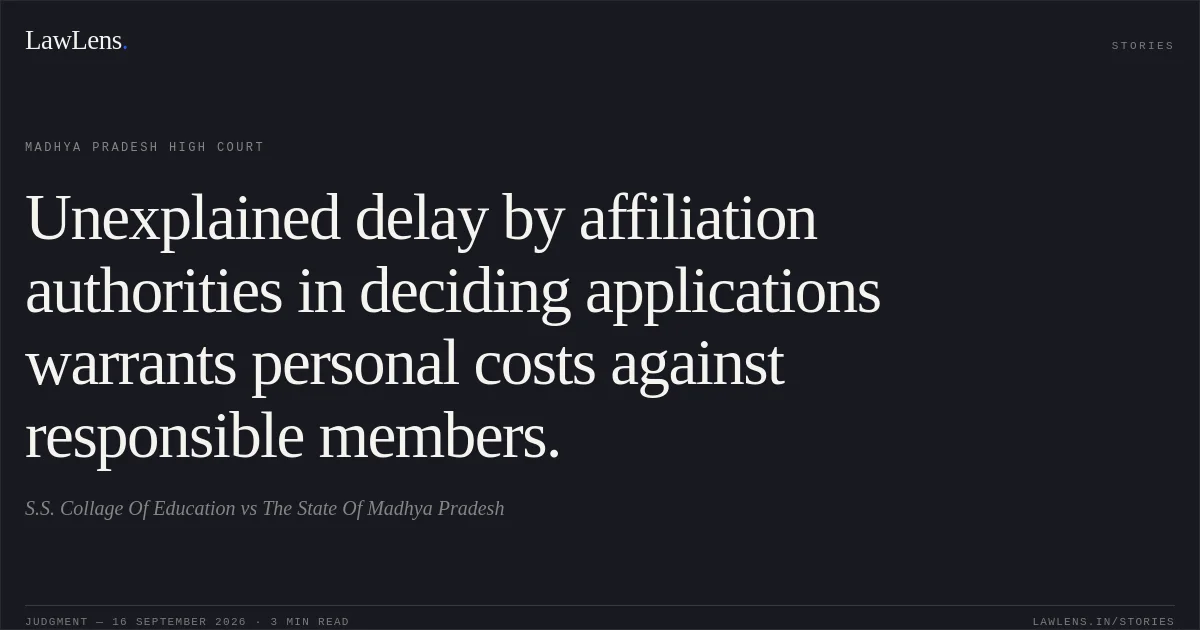
Source reference: paras. 5–9Nevertheless, the Court criticized the Executive Council for failing to decide the affiliation issue before the counselling deadline and for directing a fresh inquiry without giving reasons.
Source reference: paras. 9–12If the Council doubted the Academic Council’s findings, it was required to promptly constitute a committee with a clear mandate and complete the inspection sufficiently in advance of counselling.
Source reference: paras. 9–12The delay unnecessarily exposed the colleges to loss of admissions and compelled them to approach the Court.
Source reference: para. 12The Court therefore treated the conduct as a failure to discharge statutory duties properly and imposed a modest personal cost on the relevant members of the previous Executive Council.
Source reference: para. 13Holding
The Court held that the immediate purpose of the petition had been fulfilled because the counselling portal was reopened and students were permitted to opt for the petitioner colleges; accordingly, the writ petition was disposed of as infructuous on withdrawal.
The Court directed every member of the previous Executive Council responsible for the decision to impose a fresh inspection to deposit ₹1,000 each within one month in the Juvenile Justice Fund and cautioned them to act more carefully in future.
Source reference: para. 13The University was expected to complete affiliation-related inquiries and decisions well before counselling deadlines so that eligible colleges would not suffer prejudice.
Source reference: paras. 7, 10–12Original Court PDF
S.S. Collage Of EducationvsThe State Of Madhya Pradesh
Click to open original judgment
Original judgment, available to read, download and summarize on LawLens.in