Facts
The petitioner, a Driver employed by the respondent since 10 October 1999, was served with a charge-sheet alleging three instances of misconduct: misbehaviour with a senior officer and rash driving on 9 February 2007; unauthorised absence from duty and argumentative conduct at Gupta Nursing Home on 24 December 2007; and failure to comply with directions and discourteous behaviour on 14 January 2008.
Source reference: paras. 2–3A departmental enquiry found him guilty, pursuant to which he was removed from service on 16 October 2009. His departmental appeal and review were dismissed.
Source reference: para. 4On a reference under the Industrial Disputes Act, the Central Government Industrial Tribunal initially held that the domestic enquiry violated principles of natural justice and permitted the respondent to prove the charges independently by leading evidence before it.
Source reference: paras. 5–8The Tribunal thereafter found the charges proved and upheld the punishment of removal, while directing payment of provident fund and other permissible dues.
Source reference: para. 9Issues
1. Whether the Industrial Tribunal could sustain the findings of misconduct after the domestic enquiry had been held vitiated for violation of natural justice, particularly where reference was made to the enquiry material?
Source reference: paras. 27–282. Whether the Tribunal’s findings that the three charges against the petitioner were proved were perverse, unsupported by evidence, or otherwise amenable to interference under Articles 226 and 227 of the Constitution?
Source reference: paras. 29–463. Whether reliance on evidence relating to an incident dated 13 October 2010, occurring after the petitioner’s removal, was legally permissible?
Source reference: para. 434. Whether the punishment of removal from service was disproportionate to the misconduct proved against the petitioner?
Source reference: paras. 47–495. If removal was disproportionate, whether reinstatement or some alternative monetary relief should be granted after the passage of nearly seventeen years?
Source reference: para. 50Law Applied
The Court applied the limited scope of judicial review under Articles 226 and 227, holding that a High Court does not sit as an appellate court over factual findings of a Labour Court and may interfere only where findings are perverse, based on no evidence or irrelevant evidence, suffer from patent illegality, or disclose jurisdictional error; this principle was drawn from International Airport Authority of India v. International Air Cargo Workers Union, (2009) 13 SCC 374.
Source reference: para. 26Where a domestic enquiry is vitiated, the employer must independently establish the alleged misconduct before the Labour Court or Tribunal.
Source reference: para. 27Departmental misconduct is assessed on the touchstone of preponderance of probabilities, and strict rules of evidence do not apply.
Source reference: para. 45On punishment, the Court relied on Deputy Commissioner, Kendriya Vidyalaya Sangthan v. J. Hussain, (2013) 10 SCC 106, applying the principle that judicial interference is justified where the penalty is so disproportionate that it shocks the conscience of the Court and is arbitrary or wholly unreasonable.
Source reference: para. 48Reasoning
The Court held that although the domestic enquiry had been declared invalid, the respondent was expressly permitted to lead independent evidence and examined twelve witnesses along with producing documentary evidence.
Source reference: para. 28Accordingly, any reference to the earlier enquiry material did not invalidate the Tribunal’s conclusions because the findings were independently supported by evidence adduced before the Tribunal.
Source reference: para. 28The findings on Articles 1 and 2 were sustained on the basis of the testimony of the concerned senior officers, the written complaint, the attendance material, and the petitioner’s failure to furnish a satisfactory explanation; the Court declined to reappreciate conflicting evidence in writ jurisdiction.
Source reference: paras. 29–37Regarding Article 3, the Court accepted that the evidence of MW7 to MW9 concerning the post-removal incident of 13 October 2010 could not be considered, particularly because the Tribunal had previously excluded such subsequent incidents from the proceedings.
Source reference: para. 43Nevertheless, the remaining testimony of MW6 and MW10 independently supported the finding of discourteous behaviour, failure to follow directions and related misconduct.
Source reference: para. 44Thus, the findings of guilt were neither perverse nor unsupported by evidence.
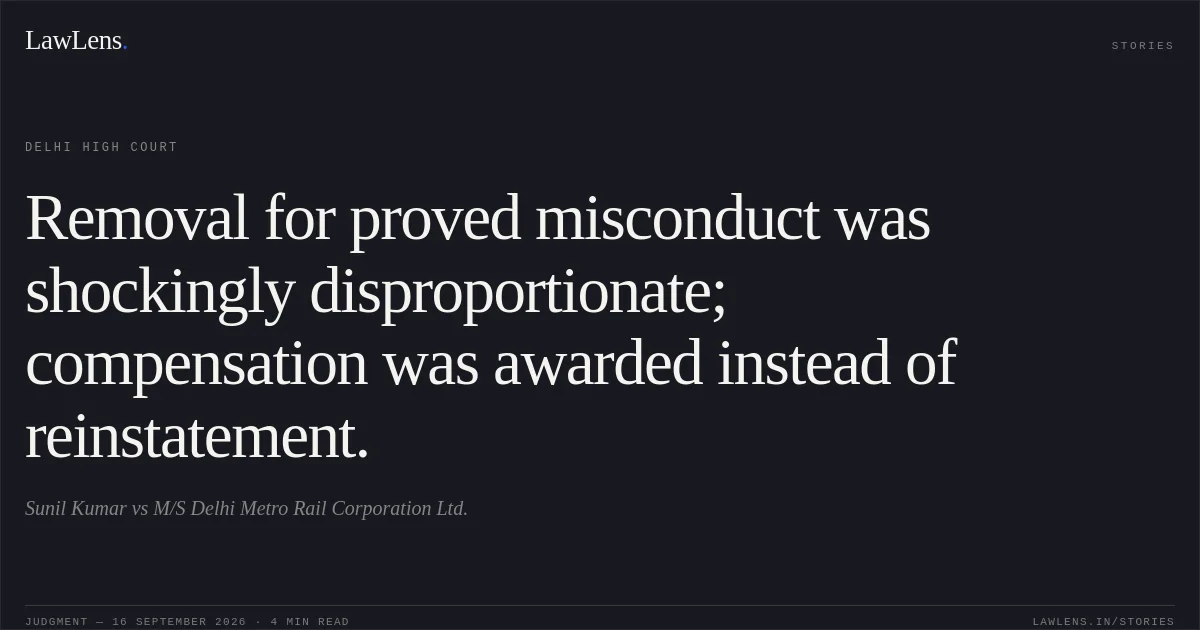
Source reference: para. 46However, considering that the charges involved three specific instances of misbehaviour, unauthorised absence and failure to comply with an instruction, and that the petitioner had served for approximately eight to nine years, the Court found removal from service shockingly disproportionate, notwithstanding the repeated nature of the misconduct.
Source reference: paras. 47–49Since nearly seventeen years had elapsed from the date of removal, reinstatement was considered impracticable, and monetary compensation was deemed appropriate.
Source reference: para. 50Holding
The petition was partly allowed.
The High Court upheld the Tribunal’s findings that the petitioner was guilty of the misconduct charged and excluded from consideration the evidence relating to the post-removal incident of 13 October 2010.
Source reference: paras. 43–46It held, however, that removal from service was shockingly disproportionate to the proved misconduct.
Source reference: paras. 47–49Reinstatement was denied due to the lapse of nearly seventeen years.
Source reference: para. 50The impugned award dated 11 February 2016 was modified, and the respondent was directed to pay the petitioner ₹3,00,000 as lump-sum compensation within eight weeks from the date of the order.
Source reference: paras. 50–52Original Court PDF
Sunil KumarvsM/S Delhi Metro Rail Corporation Ltd.
Click to open original judgment
Original judgment, available to read, download and summarize on LawLens.in