Facts
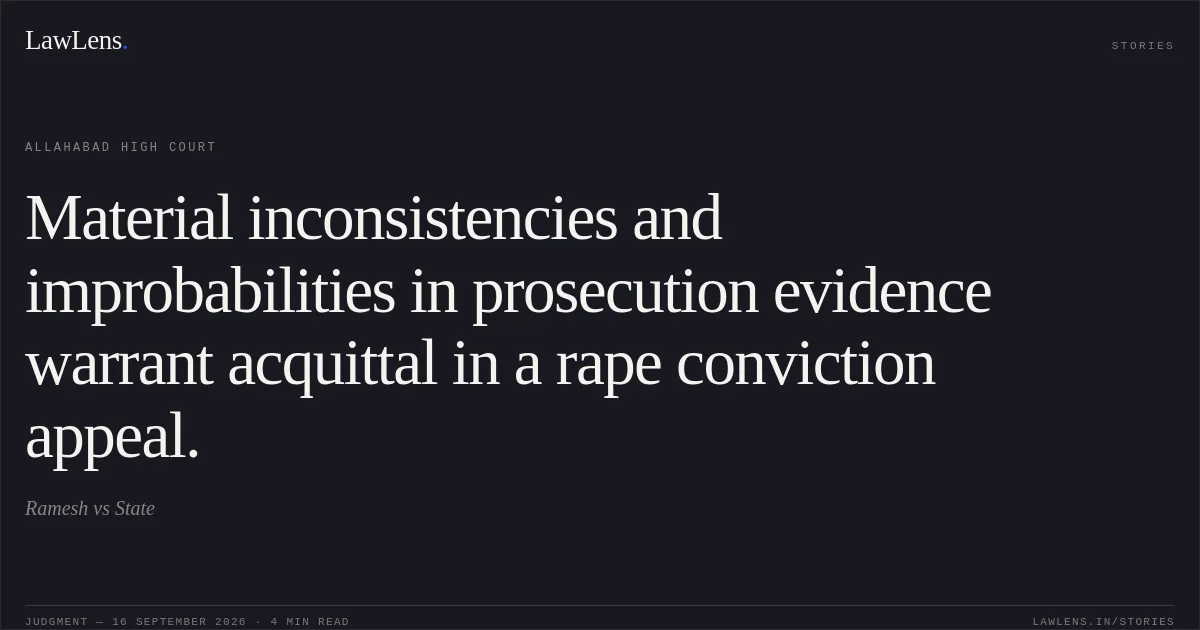
The appellants, Ramesh and Kalu, were convicted under Section 376 of the Indian Penal Code by the Second Additional Sessions Judge, Ghaziabad, and sentenced to ten years’ rigorous imprisonment for allegedly raping Smt. Munni on 2 August 1985 in a maize field.
Source reference: pp. 1–2; paras. 2–6The prosecution alleged that both accused dragged the prosecutrix into the field, gagged her, and raped her one after another; Ramesh was allegedly apprehended at the spot while Kalu escaped.
Source reference: pp. 1–2; paras. 2–6The prosecution relied principally on the testimony of the prosecutrix, her husband, Smt. Roshani Devi, Ram Kumar, medical evidence, the first information report, and the recovery of the prosecutrix’s petticoat containing semen stains.
Source reference: pp. 2–4; paras. 7–16The defence alleged false implication arising from village enmity and contended that Ramesh had been assaulted and thereafter falsely implicated.
Source reference: pp. 4–9; paras. 17–38It challenged the delay and circumstances of the FIR, inconsistencies regarding the sequence of the alleged rape, the absence of injuries on the prosecutrix, injuries found on Ramesh, and the non-production of Tej Singh, who was allegedly present at the apprehension.
Source reference: pp. 4–9; paras. 17–38During the appeal, Ramesh died on 9 October 2025; the appeal insofar as it concerned him was consequently treated as abated.
Source reference: p. 12; para. 44Issues
Whether the prosecution proved beyond reasonable doubt that Ramesh and Kalu committed rape upon the prosecutrix under Section 376 IPC?
Source reference: p. 4; para. 17Whether the testimony of the prosecutrix and the alleged eyewitnesses was sufficiently consistent and reliable to sustain the conviction despite the absence of injuries on the prosecutrix and other evidentiary discrepancies?
Source reference: pp. 4–10; paras. 20–39Whether the delay and disputed circumstances surrounding the lodging of the FIR created reasonable doubt regarding the prosecution case?
Source reference: pp. 4–5; paras. 23–27What relief followed in view of the death of appellant Ramesh and the evidentiary deficiencies concerning appellant Kalu?
Source reference: p. 12; para. 44Law Applied
The Court applied Section 376 IPC and the fundamental criminal-law requirement that the prosecution must establish guilt beyond reasonable doubt.
Source reference: pp. 1, 4, 12; paras. 2, 17, 43–44It recognised that a conviction for rape may ordinarily rest on the sole testimony of the prosecutrix if that testimony inspires confidence, but such testimony need not be accepted where it is materially inconsistent, inherently improbable, or contradicted by the surrounding circumstances.
Source reference: pp. 9–10; para. 39In this regard, the Court relied on Rajoo v. State of M.P., cautioning against mechanically accepting a prosecutrix’s testimony; Sadashiv Ramrao Hadbe v. State of Maharashtra, concerning the need for confidence-inspiring testimony where medical evidence is absent or circumstances are improbable; Tameezuddin v. State (NCT of Delhi), holding that an improbable narrative cannot be accepted merely because it concerns sexual assault; and Santosh Prasad v. State of Bihar, explaining the standard of a “sterling witness” whose testimony must remain consistent on the core aspects of the occurrence.
Source reference: pp. 9–10; para. 39The Court further applied the rule that material contradictions, unexplained investigative deficiencies, and circumstances creating reasonable doubt must enure to the benefit of the accused.
Source reference: pp. 10–12; paras. 42–44Reasoning
The Court found that the prosecution evidence was materially inconsistent regarding who first committed the alleged rape and who restrained the prosecutrix.
Source reference: pp. 5–7; paras. 29–31The prosecutrix’s account differed from the version in the FIR, while the testimonies of the prosecutrix, Ram Kumar, and Roshani Devi did not satisfactorily establish the manner, timing, or vantage point from which the alleged eyewitnesses observed the occurrence.
Source reference: pp. 5–7; paras. 29–31The Court also considered the absence of external or internal injuries on the prosecutrix, the presence of seven injuries on Ramesh, and the failure to explain how those injuries were caused.
Source reference: pp. 7–8; paras. 33–35It held that the medical and surrounding circumstances did not adequately corroborate the prosecution narrative.
Source reference: pp. 7–8; paras. 33–35The semen stains on the prosecutrix’s petticoat were not treated as conclusive proof that the alleged rape had been committed by the appellants, particularly because she was a married woman and the samples were not linked to either accused through definitive scientific testing.
Source reference: p. 8; para. 35The disputed timing of the FIR, the ambiguity concerning the police visit and the prosecutrix’s removal to the police station, and the non-examination of Tej Singh further weakened the prosecution case.
Source reference: pp. 4–7, 8–9; paras. 23–27, 32–38Applying the reasonable-doubt standard, the Court concluded that the evidence did not meet the threshold for sustaining the conviction.
Source reference: pp. 11–12; paras. 42–44Holding
The Court held that the prosecution failed to prove the charge under Section 376 IPC against the appellants beyond reasonable doubt.
The appeal was allowed, the judgment and order dated 9 March 1988 convicting the appellants were set aside, and appellant Kalu was directed to be released forthwith unless wanted in another case, subject to compliance with Section 437-A Cr.P.C.; his personal bonds were cancelled and sureties discharged.
Source reference: p. 12; para. 44The appeal concerning appellant Ramesh stood abated owing to his death on 9 October 2025.
Source reference: p. 12; para. 44Acts & Sections Cited
3 provisions across 2 statutes referred to in this judgment. Each provision opens on LawLens.
Indian Penal Code, 18601
Code of Criminal Procedure, 19732
Original Court PDF
RameshvsState
Click to open original judgment
Original judgment, available to read, download and summarize on LawLens.in