Facts
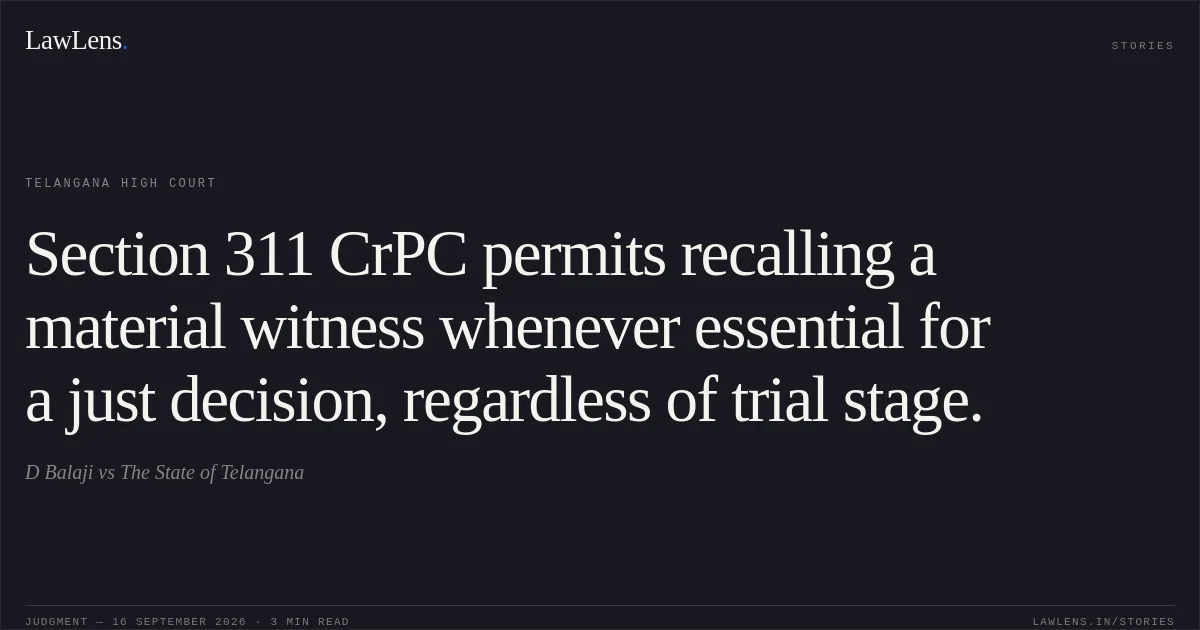
The petitioner, an Accused Officer facing prosecution under Sections 7 and 13(2) read with Section 13(1)(d) of the Prevention of Corruption Act, 1988, challenged the order permitting the prosecution to reopen the evidence and recall PW.1 under Section 311 of the Code of Criminal Procedure, 1973 (“Cr.P.C.”).
Source reference: paras. 1–2; pp. 3–4PW.1, the complainant and a material witness, was examined-in-chief, cross-examined, and re-examined on 28 June 2017, after which his evidence was closed.
Source reference: para. 6; pp. 7–8The prosecution subsequently filed Crl.M.P. No.208 of 2024 seeking recall of PW.1; that application was dismissed as “not pressed” on 25 November 2024.
Source reference: paras. 2, 6; pp. 3–4, 7–8It later filed Crl.M.P. No.459 of 2025, stating that PW.1 had not supported the prosecution case and that, due to oversight, he had not been declared hostile or cross-examined by the prosecution.
Source reference: para. 7; p. 8The trial Court allowed the latter application on 9 June 2026, leading to the present criminal petition.
Source reference: paras. 1–2, 8; pp. 3–4, 8–9Issues
Whether the trial Court was justified in exercising its power under Section 311 Cr.P.C. to reopen the evidence and recall PW.1 for further examination/cross-examination when he was a material witness and had not been declared hostile or cross-examined by the prosecution?
Source reference: paras. 7–14; pp. 8–12Whether the subsequent application under Section 311 Cr.P.C. was barred by Section 362 Cr.P.C. on the ground that an earlier application seeking recall of the same witness had been dismissed as “not pressed”?
Source reference: paras. 4.2, 9; pp. 5–6, 9Whether the prosecution’s delay and lack of diligence warranted interference with the trial Court’s order or the imposition of costs?
Source reference: paras. 15–17; pp. 12–14Law Applied
The Court applied Section 311 Cr.P.C., which empowers a criminal Court at any stage to summon, examine, recall, or re-examine a witness and makes such exercise mandatory where the evidence is essential for a just decision of the case.
Source reference: paras. 11–14; pp. 10–12The decisive considerations are the materiality, relevance, and necessity of the evidence—not merely the stage of the proceedings.
Source reference: paras. 11–14; pp. 10–12Relying on The State represented by the Deputy Superintendent of Police v. N. Seenivasagan, (2021) 14 SCC 1; Rajaram Prasad Yadav v. State of Bihar, (2013) 4 SCC 461; K.P. Tamilmaran v. State by Deputy Superintendent of Police, 2025 SCC OnLine SC 958; and Satbir Singh v. State of Haryana, 2023 SCC OnLine SC 1086, the Court held that recall should be permitted where necessary to discover the truth and secure a fair adjudication, provided that it does not cause irremediable prejudice to the opposite party.
Source reference: paras. 8, 11–14; pp. 8–12Section 362 Cr.P.C., which restricts alteration or review of a judgment or final order, was held inapplicable because the earlier application had been dismissed as “not pressed” and had not been adjudicated on merits.
Source reference: para. 9; p. 9Reasoning
The Court found that PW.1 was the complainant whose initial complaint set the criminal law in motion and that he was therefore a material witness to the prosecution case.
Source reference: paras. 6, 10; pp. 7–10Since PW.1 had allegedly not supported the prosecution, had not been declared hostile, and had not been cross-examined by the prosecution due to an oversight, his further examination was considered necessary for a proper determination of the allegations of demand and acceptance of illegal gratification.
Source reference: paras. 7, 10–14; pp. 8–12The subsequent application was not treated as a review of the earlier order because the earlier application had been dismissed solely as “not pressed,” without a decision on merits, and the later application set out the specific circumstance that PW.1 had not been declared hostile or cross-examined.
Source reference: para. 9; p. 9The Court further held that the petitioner would retain the opportunity to cross-examine PW.1 and therefore would suffer no substantial prejudice.
Source reference: paras. 8, 10, 13–14; pp. 8–12However, noting the prosecution’s prolonged delay and lack of diligence, including the lapse between the closure of evidence in 2017 and the later recall applications, the Court directed the imposition of costs.
Source reference: para. 15; pp. 12–13Holding
The High Court dismissed the criminal petition and confirmed the trial Court’s order dated 9 June 2026 permitting the prosecution to reopen the evidence and recall PW.1 under Section 311 Cr.P.C.
It held that Section 362 Cr.P.C. did not bar the subsequent application because the earlier application had been dismissed as “not pressed” and not on merits.
Source reference: para. 9; p. 9The prosecution was directed to re-examine PW.1 without seeking an adjournment, and the trial Court was directed to conclude the trial preferably within four weeks.
Source reference: para. 16; p. 13As a condition for the relief, the respondent/complainant was directed to pay ₹5,000 to the District Legal Services Authority (Special Division), Nampally, within one week.
Source reference: para. 17; p. 14Acts & Sections Cited
4 provisions across 2 statutes referred to in this judgment. Each provision opens on LawLens.
Prevention of Corruption Act, 19882
Code of Criminal Procedure, 19732
Original Court PDF
D BalajivsThe State of Telangana
Click to open original judgment
Original judgment, available to read, download and summarize on LawLens.in