Facts
Respondent No. 1 instituted O.S. No. 109/2016 against the deceased Babu for recovery of money; the suit was decreed on 06.04.2018.
Source reference: para. 6In execution thereof (Ex. Case No. 70/2019), Respondent No. 1–decree holder sought, inter alia, attachment and sale of movables, arrest of the judgment debtors, and attachment of the death fund and other benefits of the deceased Babu, whose widow (petitioner) and sons (Respondents 2 and 3) were arrayed as judgment debtors/legal representatives.
Source reference: para. 6; p.1–2The petitioner filed objections opposing execution, which the Executing Court (Principal Civil Judge JMFC, Bhadravathi) overruled, ordering attachment of the gratuity amount of the deceased Babu and release of Rs. 3,00,000/- to the decree holder by order dated 03.06.2021.
Source reference: para. 2, 6The petitioner challenged this order under Article 227 of the Constitution.
Source reference: p.2; para. 1The petitioner relied on Sri G. Narayana Rao v. V.R. Nagmani; the decree holder relied on the Delhi High Court's decision in Bureau of Outreach and Communications v. Canara Bank and the Madras High Court's decision in Murugaiah Velar v. Velammal.
Source reference: para. 2, 3Issues
1. Whether the gratuity amount of the deceased employee can be attached in the execution proceedings?
Source reference: para. 52. Whether gratuity payable to the legal representatives of a deceased employee loses its statutory immunity and becomes an attachable "estate of the family" in their hands?
Source reference: para. 16Law Applied
Section 4(1) of the Payment of Gratuity Act, 1972 makes gratuity payable on superannuation, retirement/resignation, or death/disablement, with the second proviso directing payment to the nominee or heirs upon death.
Source reference: para. 7, 8, 12Section 13 of the Payment of Gratuity Act, 1972 confers "total immunity" by barring attachment of gratuity in execution of any decree or order of any civil, revenue, or criminal court.
Source reference: para. 7, 8, 12Section 14 of the Payment of Gratuity Act, 1972 gives the Act overriding effect over inconsistent enactments.
Source reference: para. 7, 8, 12Section 60(1), proviso (g), CPC, exempts "stipends and gratuities allowed to pensioners of the Government or of a local authority or of any other employer" from attachment, read with Explanation I (exemption operates whether before or after the money is actually payable).
Source reference: para. 14–16Calcutta Dock Labour Board v. Sandhya Mitra, AIR 1985 SC 996: Section 13 gives total immunity; Section 14 has overriding effect.
Source reference: para. 12D. Vimala v. Canara Bank, 1997 (6) ALT 62: gratuity payable to legal representatives retains its character and is not liable to attachment.
Source reference: para. 9G. Narayana Rao v. V.R. Nagmani, ILR 1996 KAR 3246: gratuity exempt under Section 13; Section 14 overrides other laws.
Source reference: para. 10Reasoning
The Court held the mandate of Section 13 to be categorical: gratuity payable to an employee—whether on superannuation, retirement, resignation, or death/disablement—shall not be liable to attachment, a position affirmed by the Supreme Court in Sandhya Mitra with reference to the legislative intent underlying the Act.
Source reference: para. 12, 13Addressing the decree holder's reliance on Murugaiah Velar, the Court distinguished it on facts: there the gratuity was already "lying in the hands of the legal representatives," whereas here the decree holder sought to attach the gratuity of the deceased Babu while the amount remained with the employer.
Source reference: para. 16The Court reasoned that merely because legal representatives are entitled to receive the gratuity does not convert it into the estate of the family; the statutory bar under Section 13 of the Act and proviso (g) to Section 60(1) CPC attaches so long as the amount remains "payable" and unpaid.
Source reference: para. 16The Court clarified that only upon actual withdrawal by the legal representatives would the amount become the estate of the deceased, "but not otherwise," since Section 13 provides total immunity from attachment.
Source reference: para. 16Applying these principles, the Court found the Executing Court had committed a grave error in ordering attachment and release of Rs. 3,00,000/- from the gratuity.
Source reference: para. 17Holding
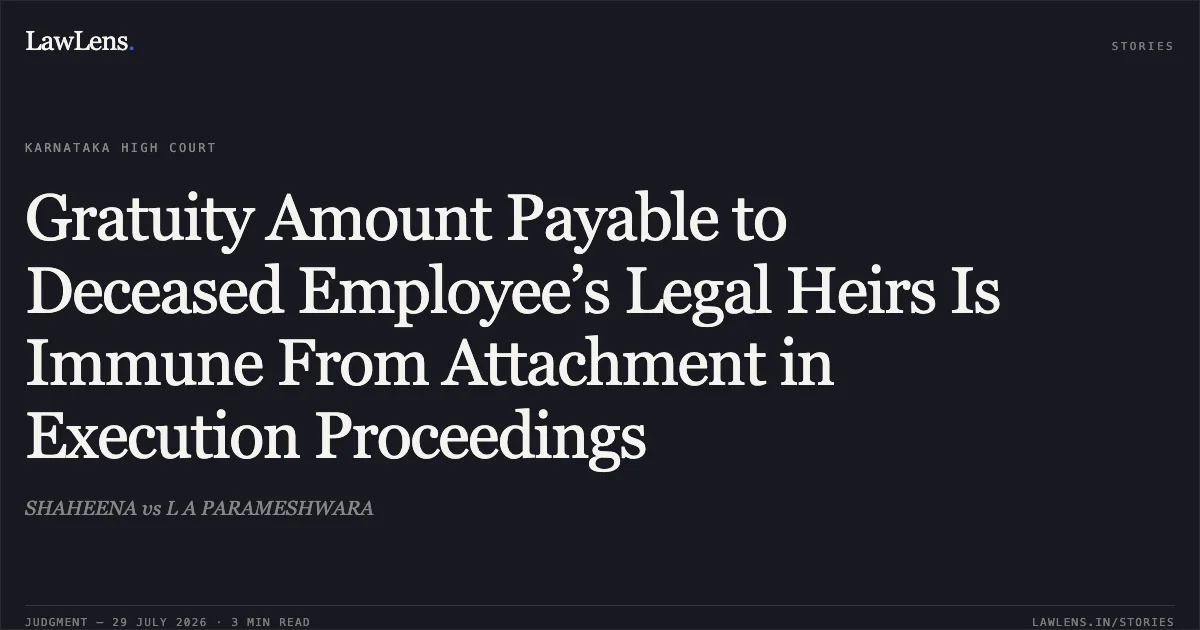
The Court answered the point in favour of the petitioner, holding that the gratuity amount of the deceased employee, lying with the employer and payable under the Payment of Gratuity Act, 1972, is immune from attachment in execution proceedings, notwithstanding that the legal representatives are entitled to receive it.
The writ petition is allowed; and the impugned order dated 03.06.2021 passed in Ex. Case No. 70/2019 by the Principal Civil Judge JMFC, Bhadravathi, is set aside; with no order as to costs.
Source reference: para. 17Acts & Sections Cited
1 provisions across 1 statute referred to in this judgment. Each provision opens on LawLens.
Code of Civil Procedure, 19081
Original Court PDF
SHAHEENAvsL A PARAMESHWARA
Click to open original judgment
Original judgment, available to read, download and summarize on LawLens.in