Facts
The case arises from a "coal levy scam" in Chhattisgarh, where a syndicate of state officials and private individuals allegedly extorted ₹25 per ton of coal by manually issuing transport permits instead of using an online system
Source reference: p.2-3This syndicate allegedly collected approximately ₹540 crores between July 2020 and June 2022
Source reference: p.3The applicant, Devendra Dadsena, served as an accountant for the Chhattisgarh Pradesh Congress Committee and personal assistant to the Treasurer, Ramgopal Agrawal
Source reference: p.4The prosecution alleges that the applicant received extorted money from associates of co-accused Suryakant Tiwari and managed the distribution of approximately ₹52.62 crore for political and election expenses
Source reference: p.4-5Evidence includes handwritten diaries seized by the Income Tax Department containing entries labeled "Bhawan" or "Congress Bhawan" corresponding to these funds
Source reference: p.5-6The applicant was arrested on 18.07.2025 and sought regular bail under Section 483 of the Bharatiya Nagrik Suraksha Sanhita, 2023
Source reference: p.1Issues
1. Whether the applicant is entitled to regular bail under Section 483 of the BNSS, 2023, given the gravity of the alleged economic offences and his role in the conspiracy
Source reference: p.1, 112. Whether the applicant can claim parity with co-accused persons who were granted bail by the Supreme Court
Source reference: p.10, 143. Whether the delay in trial and the reliance on statements of co-accused are sufficient grounds for granting bail
Source reference: p.8, 11-12Law Applied
The court applied Sections 384, 420, 120-B, 467, 468, and 471 of the IPC and Sections 7, 7-A, and 12 of the Prevention of Corruption Act, 1988
Source reference: p.1Procedurally, it applied Section 483 of the BNSS, 2023
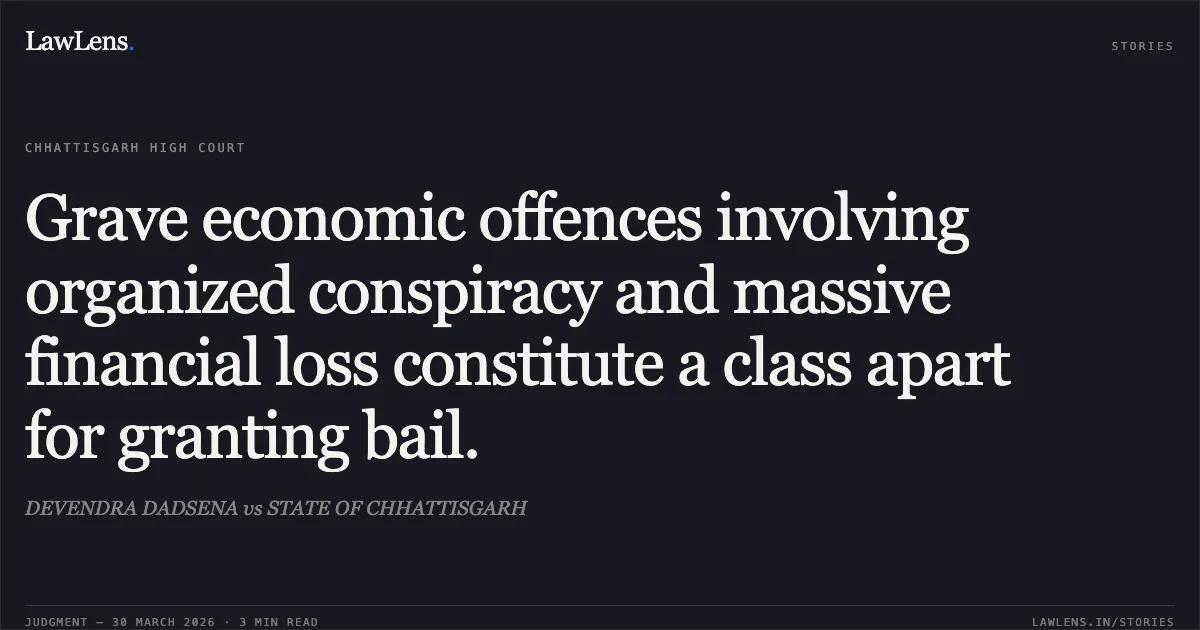
Source reference: p.1The court relied on the precedent set in P. Chidambaram v. Directorate of Enforcement and Ramesh Bhavan Rathod v. Vishanbhai Hirabhai Makwana, which establishes that economic offences constitute a "class apart" and must be viewed as grave offences affecting the national economy
Source reference: p.13-14The court also noted the principles regarding the admissibility of co-accused statements from Kashmira Singh v. State of Madhya Pradesh but emphasized that bail at this stage depends on the prima facie material collected
Source reference: p.8, 12Reasoning
The court reasoned that economic offences are committed with "cool calculation" and deliberate design for personal profit, causing significant damage to the state economy and public interest
Source reference: p.13It found that the material collected, including the "Bhawan" diary entries and witness statements, established a strong prima facie link between the applicant and the receipt and distribution of illegal funds
Source reference: p.12The court dismissed the plea for parity with co-accused (such as Saumya Chaurasiya and Ranu Sahu), noting that those individuals had spent approximately two years in custody before the Supreme Court granted them bail, whereas the applicant had only been in custody since July 2025
Source reference: p.14Regarding the delay in trial, the court observed that the applicant failed to prove the delay was solely attributable to the prosecution
Source reference: p.11-12Furthermore, the court held that the legality of the arrest and the absolute admissibility of evidence are matters for trial and cannot be the sole basis for bail when a deep-rooted conspiracy is evident
Source reference: p.12Holding
The High Court rejected the bail application
It held that the applicant played a key role as an operator and facilitator in an organized crime network and that releasing him could thwart the investigation into the remaining money trail
Source reference: p.5, 11The court clarified that these observations are limited to the bail proceedings and shall not influence the final trial
Source reference: p.14-15Acts & Sections Cited
9 provisions across 4 statutes referred to in this judgment. Each provision opens on LawLens.
Bharatiya Nagarik Suraksha Sanhita, 20231
Indian Penal Code, 18605
Prevention of Corruption Act, 19882
Prevention of Money-Laundering Act, 20021
Original Court PDF
DEVENDRA DADSENAvsSTATE OF CHHATTISGARH
Click to open original judgment
Original judgment, available to read, download and summarize on LawLens.in