Facts
The appellant, a juvenile, was accused of offenses under Section 64(1) of the BNS, Sections 4/6 of the POCSO Act, and various sections of the SC/ST Act
Source reference: p. 1The prosecution alleged the appellant was found in the victim's room at night, refused to marry her after a village panchayati, and' the victim (aged approximately 15 years) supported the allegations in her statement under Section 183 BNSS
Source reference: p. 1-2The Children Court, Madhubani, rejected the appellant’s regular bail application on 19.11.2025, primarily citing the gravity of the offense and the victim's statement
Source reference: p. 1The appellant challenged this, asserting the case was a false implication to pressure him into marriage and noting the victim's refusal of medical examination
Source reference: p. 2-3Issues
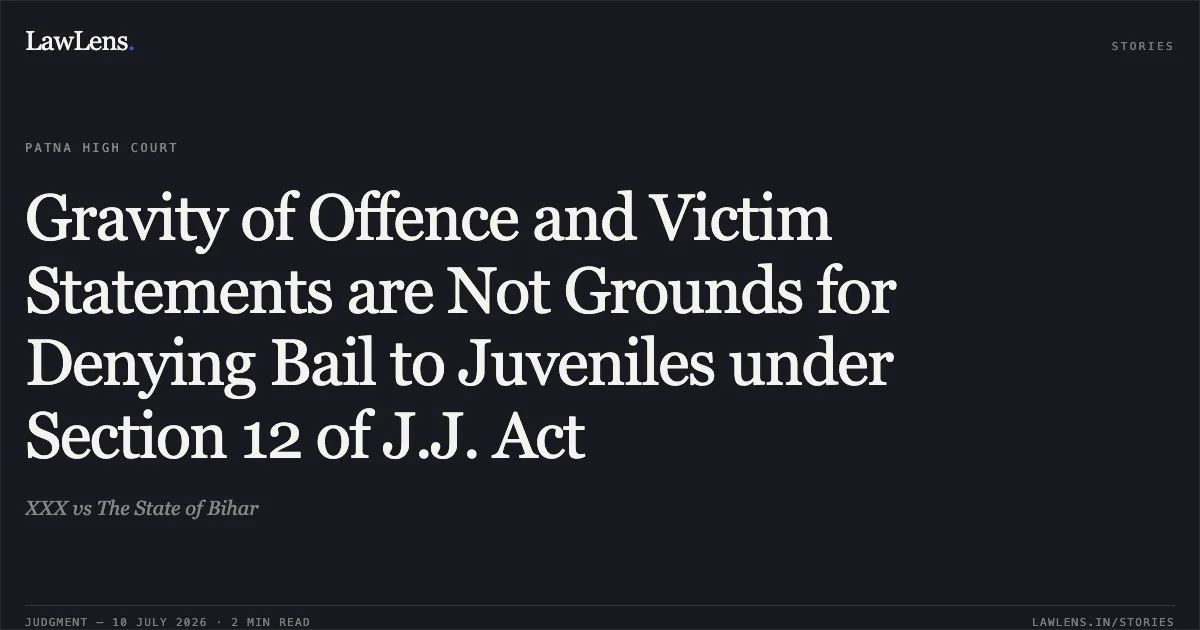
1. Whether the seriousness of the offense or the age of the juvenile are valid grounds for denying bail under Section 12 of the Juvenile Justice (Care and Protection of Children) Act, 2015
Source reference: para. 132. Whether the statutory exceptions under the proviso to Section 12(1) of the J.J. Act were made out to justify the denial of bail
Source reference: para. 9, 28Law Applied
Section 12 of the Juvenile Justice (Care and Protection of Children) Act, 2015, which mandates that a juvenile "shall" be released on bail notwithstanding the Code of Criminal Procedure, unless release brings them into association with known criminals, exposes them to danger, or defeats the ends of justice
Source reference: para. 8-9Juvenile in Conflict with Law v. State of Rajasthan (2024) and Lalu Kumar @ Lal Babu v. State of Bihar (2019) to establish that bail is the rule and the gravity of the offense is irrelevant
Source reference: para. 10, 13Section 3 of the J.J. Act, emphasizing the "Principle of best interest" and "Institutionalisation as a measure of last resort"
Source reference: para. 19, 23Reasoning
The Court observed that the lower court erroneously rejected bail based on the nature of the offense and the victim's statement, factors which are not permissible grounds under Section 12 of the J.J. Act
Source reference: para. 13, 27Analyzing the Social Investigation Report (SIR), the Court found the appellant had no criminal antecedents, a satisfactory conduct record among co-villagers, and that the incident likely stemmed from a love affair complicated by caste differences
Source reference: para. 29-30The Court reasoned that "ends of justice" in juvenile law refers to the welfare and rehabilitation of the child, not punishment
Source reference: para. 18, 22Since there was no evidence suggesting the appellant would fall into criminal association or face moral danger, the statutory exceptions were not applicable
Source reference: para. 28, 31Holding
The Court allowed the appeal and set aside the impugned order
It held that the appellant was entitled to bail as no grounds for refusal under Section 12 existed
Source reference: para. 31The appellant was ordered to be released on a bail bond of Rs. 10,000/- with an undertaking from his father to ensure supervision
Source reference: para. 33Additionally, the Court directed the District Magistrate and the Secretary, DLSA, Madhubani, to provide welfare support and rehabilitation schemes to the appellant's family due to their poverty
Source reference: para. 34-35Acts & Sections Cited
10 provisions across 5 statutes referred to in this judgment. Each provision opens on LawLens.
Bharatiya Nyaya Sanhita, 20231
Scheduled Castes and the Scheduled Tribes (Prevention of Atrocities) Act, 19891
Juvenile Justice (Care and Protection of Children) Act, 2015.5
Bharatiya Nagarik Suraksha Sanhita, 20231
Original Court PDF
XXXvsThe State of Bihar
Click to open original judgment
Original judgment, available to read, download and summarize on LawLens.in