Facts
On 29 October 2007, the appellant allegedly fixed bamboo near the rear wall of the informant’s house.
Source reference: para. 4; p. 2When the informant objected, an altercation followed, during which the appellant and other accused allegedly assaulted the informant’s brother and threw bricks at the informant, her father, and her brother, causing injuries, including a grievous head injury.
Source reference: para. 4; p. 2On the informant’s fardbeyan, Jugsalai P.S. Case No. 171 of 2007 was registered under Sections 341, 323, 325, 307 and 34 of the IPC.
Source reference: paras. 5–7; p. 2Following investigation and trial, the Additional Sessions Judge convicted the appellant under Sections 307 and 323 IPC and sentenced him to seven years’ rigorous imprisonment with fine under Section 307 and six months’ rigorous imprisonment under Section 323, with concurrent sentences.
Source reference: paras. 5–7; p. 2In appeal, the appellant challenged the finding under Section 307 IPC and alternatively sought reduction of sentence on the ground that he had already undergone one year, five months and three days in custody.
Source reference: para. 8; p. 3Issues
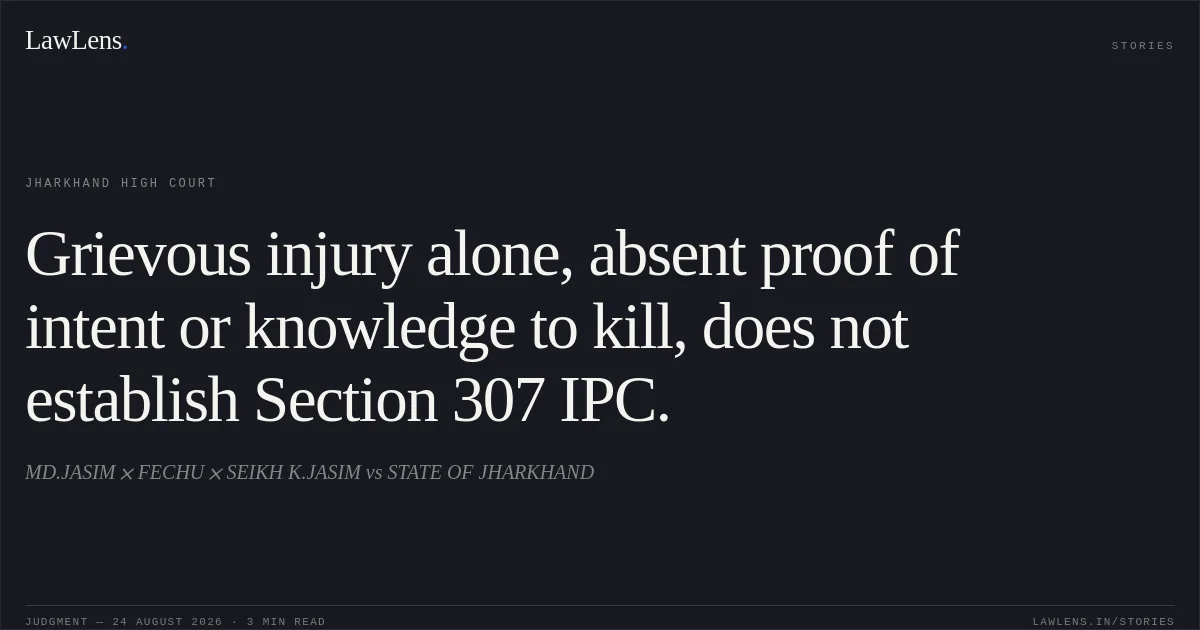
Whether the evidence established the requisite intention or knowledge to sustain the appellant’s conviction under Section 307 IPC for attempt to murder.
Source reference: para. 11; p. 4Whether, on the proved facts and injuries, the appellant’s conviction was instead sustainable under Sections 323 and 325 IPC, and whether the sentence should be reduced to the period already undergone.
Source reference: para. 16; p. 6Law Applied
The court applied Sections 307, 323 and 325 of the IPC.
Source reference: para. 14; p. 5For Section 307, the prosecution must establish both the accused’s intention to commit murder and an overt act towards its commission; the actual infliction of a fatal injury is unnecessary, but intention or knowledge must be inferred from circumstances including the weapon used, words uttered, motive, body part targeted, nature of injury and severity of the assault, as held in Jage Ram v. State of Haryana, (2015) 11 SCC 366.
Source reference: para. 14; p. 5Relying also on Hari Singh v. Sukhbir Singh, (1988) 4 SCC 551, the court reiterated that intention or knowledge to constitute murder must precede the act and cannot be inferred merely from the resulting injury; all surrounding circumstances must be considered.
Source reference: para. 15; pp. 5–6Grievous hurt may attract Section 325 IPC, while voluntarily causing simple hurt attracts Section 323 IPC.
Source reference: para. 16; p. 6Reasoning
The court found that the informant attributed brick-throwing to the appellant, while her father did not specifically name the appellant as the person who threw the brick, although he stated that the appellant threw a brick which struck the informant’s brother.
Source reference: para. 13; p. 4The evidence of other witnesses generally showed that the accused persons were assaulting the injured persons, but did not establish that the appellant alone caused the grievous injury with an intention to kill.
Source reference: para. 13; p. 4Although the doctor found a grievous injury, the court held that the existence of such injury, particularly when the injured person survived, was insufficient by itself to establish the specific mens rea required under Section 307 IPC.
Source reference: paras. 13, 16; pp. 4, 6However, the specific allegation that the appellant caused injury to the informant was corroborated by the injury report, warranting conviction under Sections 323 and 325 IPC.
Source reference: para. 16; p. 6Considering the appellant’s custody of approximately one year, five months and three days, the court treated the period already undergone as sufficient punishment.
Source reference: paras. 16–17; p. 6Holding
The appeal was dismissed on merits but the conviction and sentence were modified.
The appellant was acquitted of the charge under Section 307 IPC and was instead held guilty under Sections 323 and 325 IPC.
Source reference: paras. 16–18; pp. 6–7He was sentenced to imprisonment for the period already undergone.
Source reference: paras. 16–17; p. 6As he was on bail, he was discharged from the liabilities of his bail bonds and the sureties were released.
Source reference: para. 19; p. 7Acts & Sections Cited
6 provisions across 1 statute referred to in this judgment. Linked provisions open on LawLens.
Indian Penal Code, 18606
Original Court PDF
MD.JASIM FECHU SEIKH K.JASIMvsSTATE OF JHARKHAND
Click to open original judgment
Original judgment, available to read, download and summarize on LawLens.in