Facts
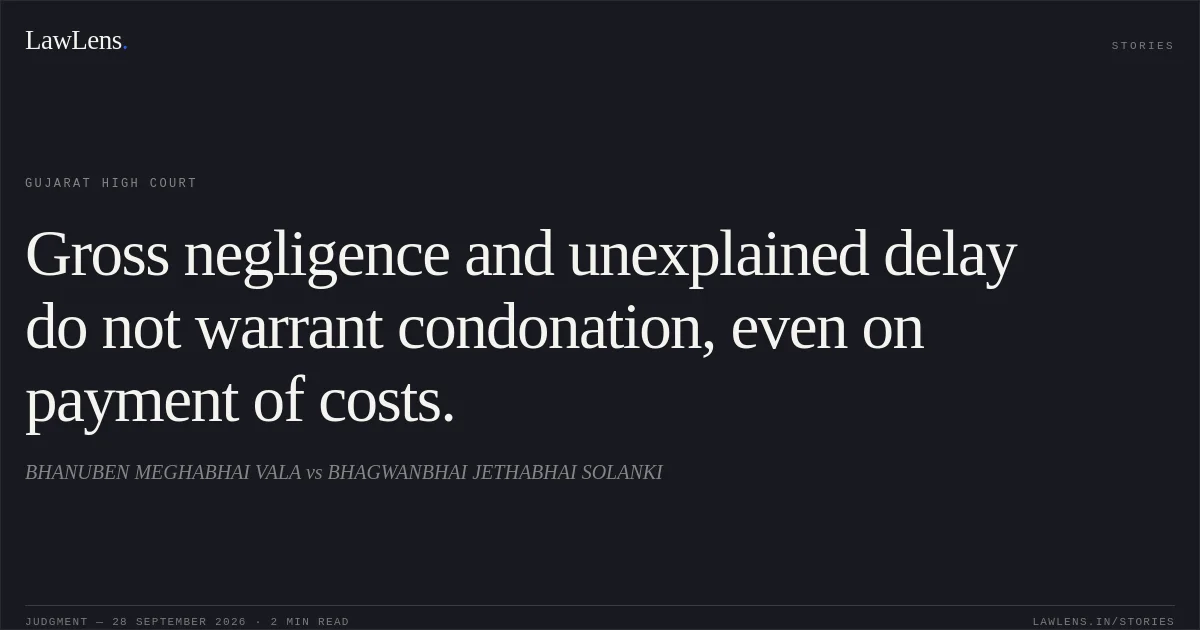
The petitioners, original plaintiffs in Regular Civil Suit No. 87 of 2019, challenged the rejection of their application to condone delay in seeking restoration of the suit.
Source reference: para. 3The suit had been dismissed for non-prosecution on 9 March 2020 after the plaintiffs and their advocate failed to appear despite opportunities.
Source reference: para. 3, 6They attributed their failure to act to the COVID-19 pandemic, but obtained a certified copy of the dismissal order on 28 November 2022 and filed the delay application only on 21 September 2023.
Source reference: para. 3, 8The petitioners sought relief under Article 227 of the Constitution, including setting aside the trial court’s order and directing it to decide the restoration application on its merits.
Source reference: para. 2Issues
1. Whether the petitioners established sufficient cause to condone the delay in seeking restoration of the suit.
Source reference: para. 8–92. Whether the trial court’s refusal to condone the delay warranted interference under Article 227 of the Constitution.
Source reference: para. 12–13Law Applied
Section 5 of the Limitation Act, 1963 permits condonation of delay where sufficient cause is established, and should be applied through a liberal, justice-oriented approach; however, that discretion is not warranted where the applicant’s explanation is inadequate or the delay reflects negligence, inaction, or lack of bona fides.
Source reference: para. 10.2–10.5The Court relied on Esha Bhattacharjee v. Managing Committee of Raghunathpur Nafar Academy, Basawaraj v. Special Land Acquisition Officer, K.B. Lal v. Gyanendra Pratap, Pathapati Subba Reddy v. Special Deputy Collector (LA), and Shivamma (Dead) by LRs v. Karnataka Housing Board for these principles.
Source reference: para. 10.2–10.5It also cited Rajneesh Kumar v. Ved Prakash on the purpose of limitation periods: to require timely assertion of rights and discourage stale claims.
Source reference: para. 10.1Under Article 227, interference was appropriate only if the impugned order was perverse, grossly erroneous, or contrary to settled law.
Source reference: para. 12Reasoning
Although the Court recognised that courts should not take a pedantic approach to delay, it found the petitioners had not explained their prolonged inaction.
Source reference: para. 7–9The pandemic did not account for their failure to check the suit’s status for over two years after normal court functioning resumed; further, they waited about eleven months after obtaining the certified copy before filing the delay application.
Source reference: para. 7–9In light of this unexplained delay and the resulting negligence, the Court held that sufficient cause was absent and that imposing costs would not justify condonation.
Source reference: para. 9, 11It found no perversity or other infirmity in the trial court’s order warranting Article 227 intervention.
Source reference: para. 12–13Holding
The Court held that the petitioners had not shown sufficient cause for condonation of delay and that the trial court’s order disclosed no ground for supervisory interference.
The petition was dismissed in limine, with no order as to costs.
Source reference: para. 13–14Acts & Sections Cited
2 provisions across 1 statute referred to in this judgment. Each provision opens on LawLens.
Original Court PDF
BHANUBEN MEGHABHAI VALAvsBHAGWANBHAI JETHABHAI SOLANKI
Click to open original judgment
Original judgment, available to read, download and summarize on LawLens.in