Facts
The Directorate General of GST Intelligence was investigating M/s Alphaneon Techsolutions Pvt. Ltd. and its group entities for allegedly wrongful availment and passing of input tax credit, circular invoicing, and non-payment of GST on import of services.
Source reference: para. 4(a)–(b)The respondent was present during inspection of the registered premises and was issued three summonses under Section 70 of the Central Goods and Services Tax Act, 2017 (“CGST Act”). He sought adjournments instead of appearing and thereafter applied for anticipatory bail before the Sessions Court, which rejected the application. Pursuant to interim directions of the Bombay High Court, he appeared before the Department and his statement was recorded.
Source reference: para. 4(a)–(b)Before the High Court, the Department stated that no authorisation order under Section 69 of the CGST Act had been passed because the investigation was at a nascent stage.
Source reference: para. 4(c)–(d)The High Court rejected the application for anticipatory bail on the ground that, in the absence of a Section 69 order, there could be no apprehension of arrest; however, it directed that the respondent should not be arrested for one week from intimation of any order subsequently passed under Section 69.
Source reference: para. 4(c)–(d)The respondent did not challenge the rejection of anticipatory bail before the Supreme Court.
Source reference: para. 3Issues
1. Whether a High Court or Sessions Court, while dismissing an application for pre-arrest or anticipatory bail as not maintainable, can nevertheless grant protection from arrest for a specified period.
Source reference: paras. 7–112. Whether an order authorising arrest under Section 69(1) of the CGST Act is a prerequisite for maintaining an application for anticipatory bail.
Source reference: paras. 5–7, 16–183. Whether the Commissioner’s order under Section 69 of the CGST Act must be communicated to the person sought to be arrested before arrest can be effected.
Source reference: paras. 13–22Law Applied
Section 70 of the CGST Act authorises the issuance of summons for evidence or production of documents during an inquiry, but a person summoned is not, merely by reason of the summons, an accused.
Source reference: para. 5Section 69(1) requires the Commissioner to form “reasons to believe,” based on relevant material and application of mind, before authorising arrest for specified offences under Section 132.
Source reference: para. 15Applying State of Orissa v. Madan Gopal Rungta, the Court held that interim relief can only be ancillary to, and in aid of, a substantive relief that is maintainable; once the principal proceeding is dismissed, protective interim relief cannot survive.
Source reference: para. 8Relying on Hema Mishra v. State of U.P., the Court extended this principle to applications for pre-arrest bail.
Source reference: paras. 9–11Radhika Agarwal v. Union of India established that mere issuance of summons under Section 70 does not make the summoned person an accused.
Source reference: para. 5The Court further relied on Gurbaksh Singh Sibbia v. State of Punjab and Sushila Aggarwal v. State (NCT of Delhi) to protect the constitutional value of personal liberty and the right to seek anticipatory bail.
Source reference: no citationConsequently, an order under Section 69 must be communicated to the person concerned before arrest, including through electronic and other legally permissible modes, with reference to Rule 8 of the CGST Rules.
Source reference: paras. 18–21Reasoning
The respondent had only been summoned under Section 70 and no Section 69 arrest authorisation existed when he sought anticipatory bail.
Source reference: paras. 5–6In view of Radhika Agarwal, the summons did not make him an accused or create a legally cognisable apprehension of arrest; therefore, the High Court correctly rejected the anticipatory-bail application, and that part of the order remained undisturbed.
Source reference: paras. 5–6However, having dismissed the application, the High Court could not grant an independent one-week restraint on arrest.
Source reference: paras. 8–11Under Madan Gopal Rungta and Hema Mishra, such protection was not ancillary to any surviving substantive relief and effectively operated as interim relief after dismissal of the application.
Source reference: paras. 8–11The Court further reasoned that because a Section 69 order is the basis on which the person becomes liable to arrest and may seek anticipatory bail, non-communication of that order would unfairly prevent the person from knowing or challenging the basis of the proposed arrest.
Source reference: paras. 16–20Communication would not impede the investigation and was necessary to preserve the person’s right to seek judicial protection.
Source reference: paras. 16–20Accordingly, the Commissioner was required to communicate the Section 69 order before arrest could take place.
Source reference: paras. 21–22Holding
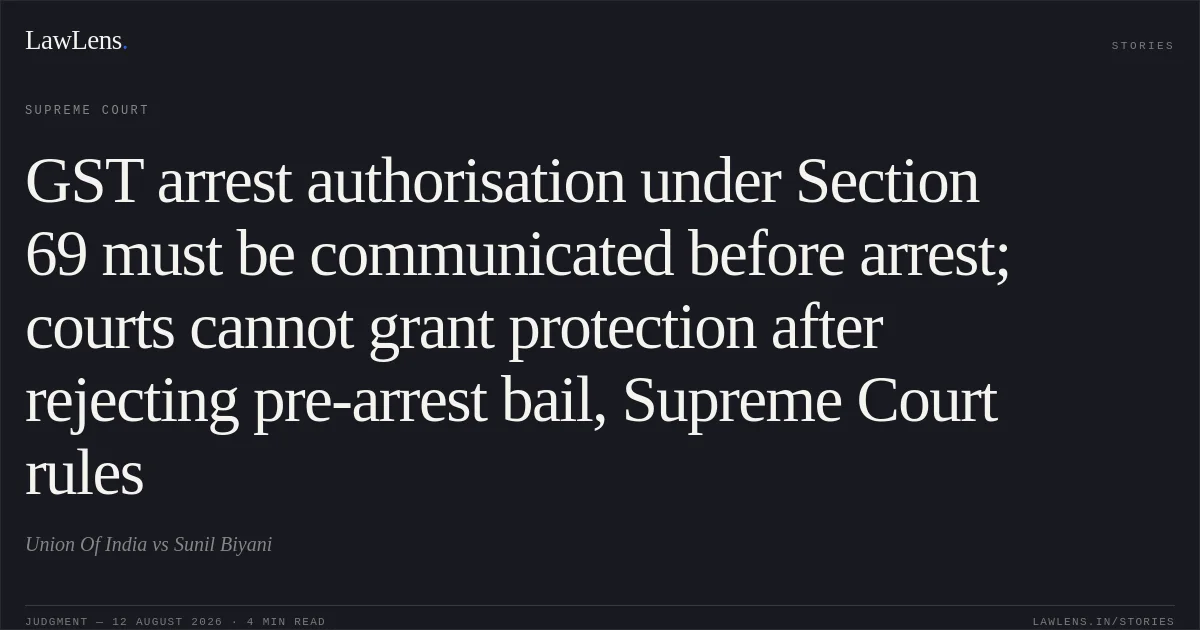
The Supreme Court held that a court dismissing an application for pre-arrest bail, including on the ground of non-maintainability, cannot nevertheless grant or continue protection from arrest in the nature of interim relief.
The protection granted by the Bombay High Court was therefore set aside.
Source reference: para. 12The Court further directed that any order passed under Section 69 of the CGST Act must be communicated to the respondent through electronic means and other permissible modes, and reiterated that, without such communication, the question of arrest would not arise.
Source reference: paras. 21–22The investigation was permitted to continue uninfluenced by the Court’s observations.
Source reference: para. 24Acts & Sections Cited
6 provisions across 4 statutes referred to in this judgment. Each provision opens on LawLens.
Code of Civil Procedure, 19081
Code of Criminal Procedure, 19731
Bharatiya Nagarik Suraksha Sanhita, 20231
Central Goods and Services Tax Act, 20173
Original Court PDF
Union Of IndiavsSunil Biyani
Click to open original judgment
Original judgment, available to read, download and summarize on LawLens.in