Facts
An assessment order dated 17 March 2023 was passed against the petitioner for the assessment period 2017–2020.
Source reference: p.1The petitioner challenged that order in W.P. No. 41890 of 2025, principally contending that multiple assessment periods had been clubbed.
Source reference: p.1On 25 February 2026, the Court granted an interim order directing that recovery proceedings remain in abeyance.
Source reference: p.1Prior to that order, on 4 February 2025, the petitioner’s electronic credit ledger had been blocked by reference No. BL3302250000152.
Source reference: p.1The petitioner filed the present writ petition seeking removal of the blockage and permission to utilise the input tax credit (“ITC”) available in the ledger.
Source reference: p.1Issues
Whether the interim order dated 25 February 2026, directing that recovery proceedings remain in abeyance, required the respondent to lift the earlier blockage of the petitioner’s electronic credit ledger
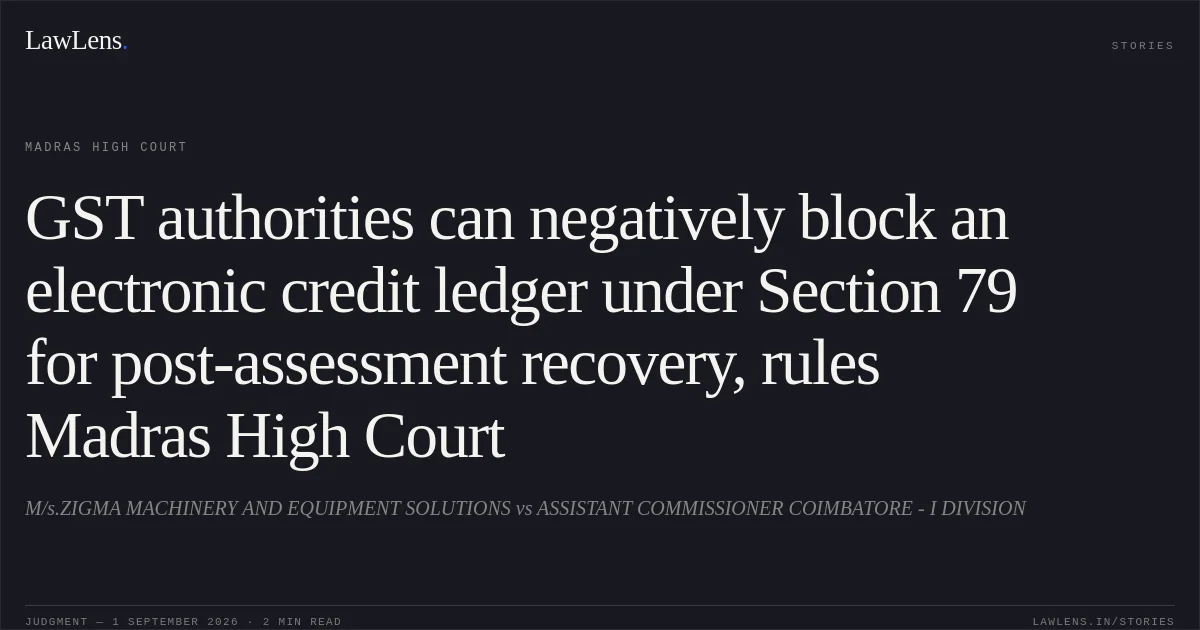
Source reference: pp.2–3Whether blocking, including negative blocking, of an electronic credit ledger is permissible as a mode of recovery under Section 79 of the applicable GST enactments
Source reference: pp.2, 6–7Law Applied
The Court applied Section 79(1) of the applicable GST enactments, which empowers the proper officer to recover amounts payable to the Government through one or more specified modes, including deduction from money under the officer’s control, recovery from goods, garnishee proceedings, distraint and sale of property, and recovery through the Collector or Magistrate.
Source reference: pp.3–6The Court held that the width of Section 79 encompasses blocking of the electronic credit ledger, including negative blocking.
Source reference: p.6The Court distinguished Rule 86A, which authorises provisional blocking of ITC generally at the pre-determination stage, from Section 79, which operates post-determination when amounts are due and payable and provides wider recovery powers.
Source reference: p.7Reasoning
The Court rejected the petitioner’s argument that the interim order in the connected assessment challenge nullified the earlier blocking order.
Source reference: pp.2–3The interim order only directed that recovery proceedings be kept in abeyance; consequently, its limited effect was to prevent debit of amounts lying in the electronic credit ledger for recovery of the adjudicated dues. It did not expressly require lifting the pre-existing blockage.
Source reference: pp.2–3On the statutory issue, the Court construed Section 79 broadly.
Source reference: p.6Since the provision permits recovery from money under the control of the proper officer and authorises multiple forms of post-determination recovery, blocking the petitioner’s credit ledger—including blocking it negatively—was held to fall within the statutory recovery framework.
Source reference: p.6The Court further held that the petitioner’s reliance on Rule 86A was misplaced because Rule 86A concerns provisional restrictions before determination of liability, whereas the present action followed an assessment order and was undertaken for recovery of amounts determined as payable.
Source reference: p.7Holding
The Court held that the interim order dated 25 February 2026 did not require removal of the electronic credit ledger blockage and that negative blocking of the ledger was legally permissible under Section 79.
The writ petition was accordingly disposed of without any order as to costs, with no direction to lift the blockage or permit unrestricted utilisation of the ITC.
Source reference: p.7Acts & Sections Cited
1 provisions across 1 statute referred to in this judgment. Each provision opens on LawLens.
Central Goods and Services Tax Act, 20171
Original Court PDF
M/s.ZIGMA MACHINERY AND EQUIPMENT SOLUTIONSvsASSISTANT COMMISSIONER COIMBATORE - I DIVISION
Click to open original judgment
Original judgment, available to read, download and summarize on LawLens.in