Facts
A batch of 22 writ appeals—16 filed by State GST authorities and six by Central GST authorities—challenged a common order of the writ court dated 11 March 2024.
Source reference: p.17The writ court had quashed the impugned proceedings, including summons and assessments, on the ground that cross-empowerment under Section 6 of the Central Goods and Services Tax Act, 2017 (“CGST Act”) required a notification that had not been issued.
Source reference: p.17The Supreme Court subsequently decided the related cross-empowerment issues in Armour Security (India) Ltd. v. Commissioner, CGST, Delhi East Commissionerate, 2025 INSC 982.
Source reference: pp.18–20In W.A. No. 687 of 2026, the assessee’s requested relief had meanwhile been granted by an adjudication order dated 20 January 2025, which was under a pending statutory appeal under Section 107 of the CGST Act.
Source reference: p.27Issues
Whether a notification under Section 6(1) of the CGST Act is a prerequisite for State or Central tax authorities to exercise cross-empowered functions.
Source reference: pp.21–24Whether the writ court’s orders quashing the proceedings should stand, or whether the matters should be reconsidered in light of the Supreme Court’s conclusions and guidelines in Armour Security.
Source reference: pp.18–21, 26–27Law Applied
Section 6(1) of the CGST Act and the corresponding State GST provisions provide for cross-empowerment; as explained in the CBIC clarification dated 22 June 2020, a notification is required to impose conditions on that power, and its absence does not suspend the statutory power.
Source reference: pp.22–24Under Section 6(2)(b), as interpreted in Armour Security (India) Ltd. v. Commissioner, CGST, Delhi East Commissionerate, 2025 INSC 982, parallel proceedings are barred where they concern the same subject matter; intelligence-based enforcement may be initiated by either tax administration, but duplicate proceedings concerning an identical liability or contravention must not continue.
Source reference: pp.18–20A summons or investigative step does not itself amount to formal initiation of proceedings; that occurs with the issuance of a show-cause notice.
Source reference: pp.18–20The Court also relied by analogy on M/s Gannon Dunkerley & Co. v. State of Rajasthan, (1993) 1 SCC 364, for the principle that the absence of a later law imposing conditions does not, by itself, prevent the exercise of an existing statutory power.
Source reference: pp.24–26Reasoning
The writ court had treated the absence of a Section 6 notification as fatal to the authorities’ cross-empowerment.
Source reference: p.17The Division Bench held that this reasoning could not stand in light of Armour Security and the clarification considered there: the notification contemplated by Section 6(1) serves to impose conditions, and its non-issuance does not render the provision inoperative.
Source reference: pp.21–24However, the Supreme Court’s framework requires examination of whether the matters involve overlapping proceedings on the same subject matter.
Source reference: pp.18–20The Court therefore directed that the appeals, other than W.A. No. 687 of 2026, be remitted for disposal under Armour Security and its guidelines.
Source reference: pp.26–27Holding
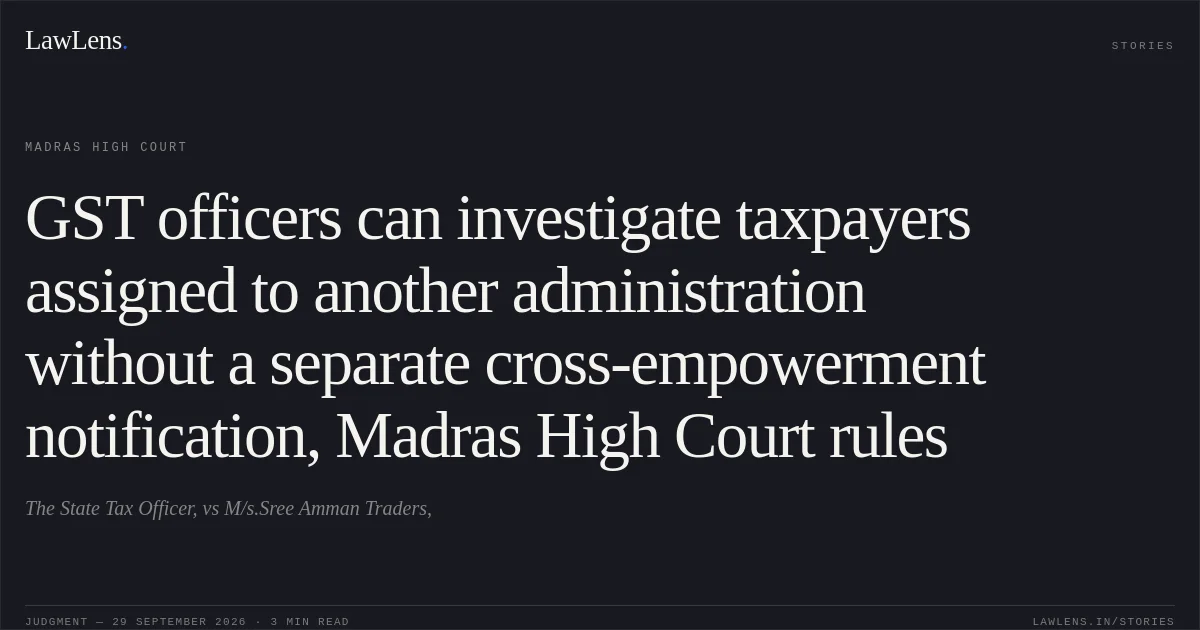
The Court rejected the assessees’ argument that cross-empowerment was unavailable without a Section 6(1) notification and set aside the writ court’s orders.
All appeals other than W.A. No. 687 of 2026 were allowed by way of remand, with the appellants granted four weeks to file counters in matters where none had been filed.
Source reference: p.27W.A. No. 687 of 2026 was closed because the assessee had obtained the relief sought and a statutory appeal against the adjudication order was pending.
Source reference: p.27No costs were ordered, and the connected miscellaneous petitions were closed.
Source reference: p.27Acts & Sections Cited
7 provisions across 3 statutes referred to in this judgment. Each provision opens on LawLens.
Central Goods and Services Tax Act, 20175
Goods and Services Tax (Compensation to States) Act, 20171
Union Territory Goods and Services Tax Act, 20171
Original Court PDF
The State Tax Officer,vsM/s.Sree Amman Traders,
Click to open original judgment
Original judgment, available to read, download and summarize on LawLens.in