Facts
The petitioner challenged an assessment order dated 26 September 2024 and consequential demand order dated 27 September 2024 for FY 2017–18.
Source reference: p.2The notices had been uploaded to the GST portal, but the petitioner said it was unaware of them and did not file a reply.
Source reference: p.2The petitioner contended that no personal hearing had been provided and stated that it had paid the disputed tax.
Source reference: p.2The respondent acknowledged that no personal hearing was given and requested that the matter be remitted.
Source reference: p.3The Court noted that the show-cause notice was uploaded on the GST portal and that the assessment order confirmed the notice’s proposals without a personal hearing.
Source reference: p.3Issues
Whether the assessment and demand orders should be set aside where the petitioner did not respond to notices uploaded on the GST portal and was not afforded a personal hearing.
Source reference: pp.3–4Whether the matter should be remanded for fresh consideration, given the petitioner’s assertion that it had paid the disputed tax.
Source reference: p.5Law Applied
Section 169(1) of the GST Act recognises prescribed modes of service, including service through the GST portal and other modes.
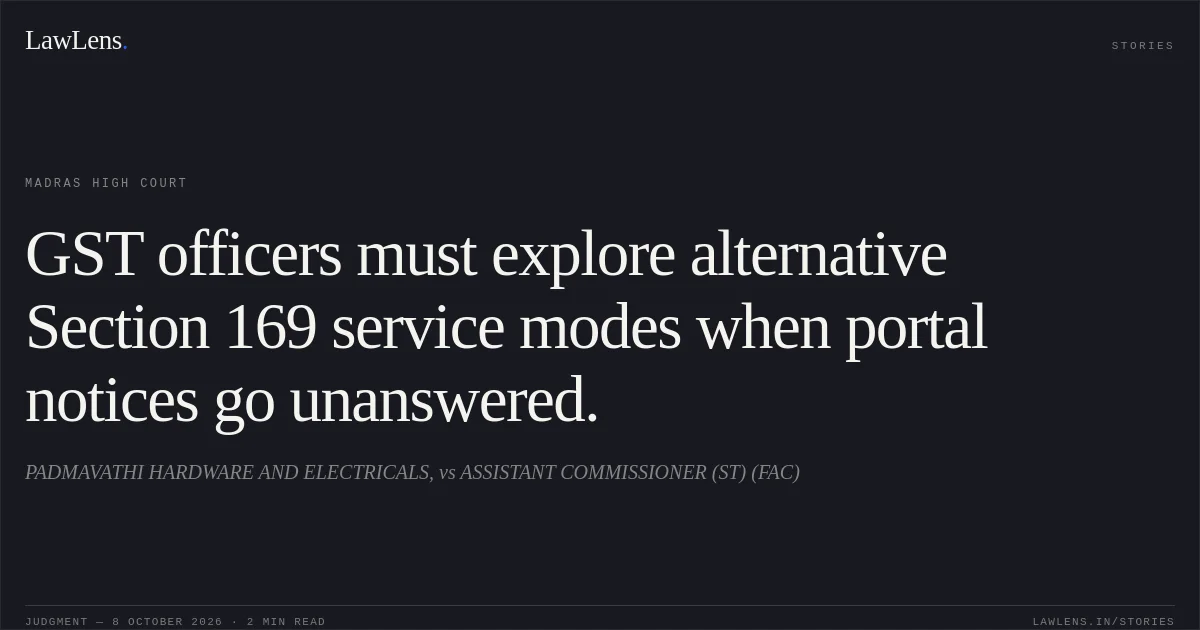
Source reference: pp.4–5The Court accepted that portal service is sufficient, but held that where a taxpayer does not respond to notices sent through one mode, the officer should explore other available modes—preferably registered post with acknowledgment due (RPAD)—to achieve effective service rather than merely fulfil formalities.
Source reference: pp.4–5The Court also proceeded on the basis that the petitioner should receive a personal hearing before fresh orders were made.
Source reference: pp.3, 5No precedent was cited.
Source reference: no citationReasoning
Although uploading the notice to the GST portal constituted a valid mode of service, the absence of any response should have prompted the respondent to consider other modes available under Section 169(1), rather than proceed ex parte.
Source reference: pp.3–5The respondent also admitted that no personal hearing had been afforded.
Source reference: pp.3–5In light of these circumstances and the petitioner’s submission that it had paid the disputed tax, the Court found it appropriate to set aside the orders and remit the matter for fresh consideration.
Source reference: pp.3–5Holding
The Court set aside the assessment order dated 26 September 2024 and consequential demand order dated 27 September 2024, and remanded the matter to the respondent.
The petitioner was directed to file its reply or objections, with supporting documents, within three weeks of receiving a copy of the order.
Source reference: p.5Upon receipt, the respondent must issue 14 days’ clear notice fixing a personal hearing and then pass fresh orders on the merits and in accordance with law.
Source reference: p.5The writ petition was disposed of without costs, and the connected miscellaneous petition was closed.
Source reference: p.5Acts & Sections Cited
1 provisions across 1 statute referred to in this judgment. Each provision opens on LawLens.
Central Goods and Services Tax Act, 20171
Original Court PDF
PADMAVATHI HARDWARE AND ELECTRICALS,vsASSISTANT COMMISSIONER (ST) (FAC)
Click to open original judgment
Original judgment, available to read, download and summarize on LawLens.in