Facts
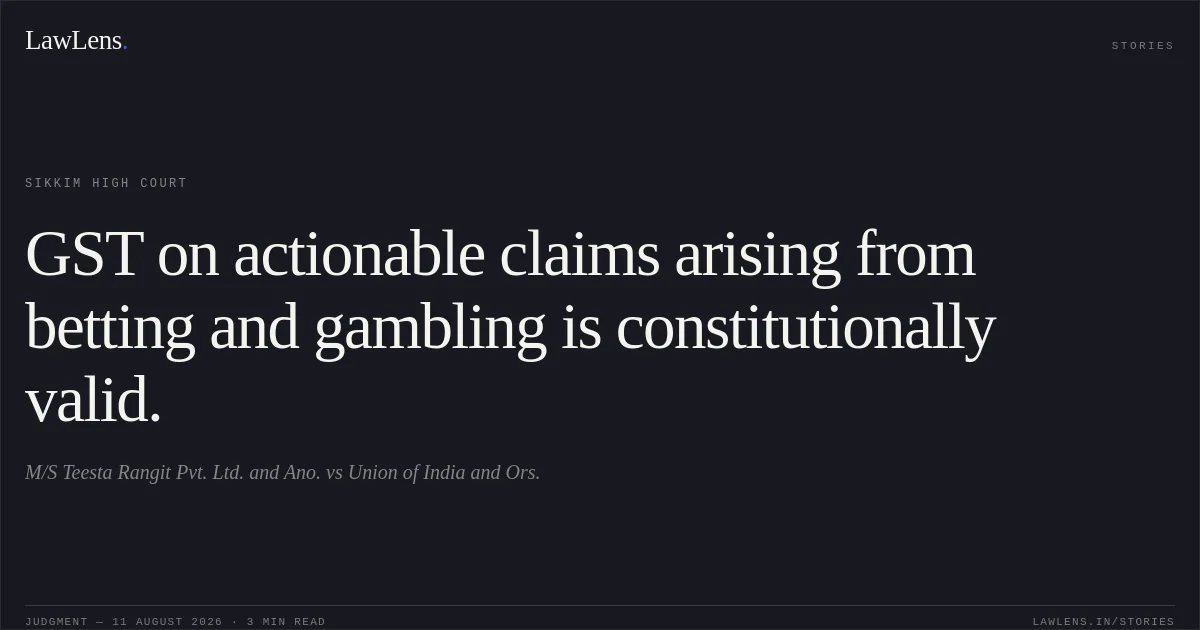
The petitioners filed a writ petition raising five substantive challenges concerning the levy and valuation of GST on betting, gambling and online gaming transactions.
Source reference: p.1, para.1On 20 September 2024, the petitioners’ counsel informed the High Court that similar issues were pending before the Supreme Court.
Source reference: p.1, para.1The Supreme Court subsequently decided the connected issues in its judgment dated 27 May 2026, reported as 2026 INSC 595, upholding the constitutional and statutory validity of the GST levy on actionable claims arising from betting and gambling, including organised online gaming and fantasy sports.
Source reference: p.1–p.6, paras.2–3In view of that pronouncement, the High Court considered whether any issue in the present writ petition survived for independent consideration.
Source reference: p.8, para.4Issues
Whether the levy of GST on actionable claims arising from betting, gambling, online gaming and fantasy sports is constitutionally and statutorily valid under the CGST Act and corresponding State GST enactments
Source reference: p.1–p.6, paras.2–3Whether Sections 2(31), 2(52), 7, 9 and 15 of the CGST Act, the relevant provisions of the State GST enactments, and Rules 31A, 31B and 31C of the CGST Rules are constitutionally valid
Source reference: p.2–p.6, para.2Whether pooled stakes, prize pools, winnings and payouts could be excluded while determining the taxable value of online gaming and fantasy sports transactions
Source reference: p.3–p.5, para.2Whether the 2023 amendments, including the amendment to Entry 6 of Schedule III and insertion of Rules 31B and 31C, operated retrospectively and governed pending proceedings
Source reference: p.4–p.7, paras.2–3What consequential directions should govern the petitioners’ pending show-cause proceedings, including the time for filing replies and adjudication
Source reference: p.7–p.9, paras.3 and 6Law Applied
Under Sections 2(31), 2(52), 7, 9 and 15 of the CGST Act, actionable claims arising from betting and gambling constitute taxable supplies, and “consideration” includes the amount staked or appropriated for participation in gameplay.
Source reference: p.2–p.4, para.2Betting and gambling are characterised by staking money or money’s worth on uncertain outcomes, irrespective of whether the underlying game involves skill or chance.
Source reference: p.1–p.2, para.2Rules 31A, 31B and 31C were upheld as valid machinery and valuation provisions; the 2023 amendments were held clarificatory and retrospective in the manner specified by the Supreme Court.
Source reference: p.3–p.5, para.2Pending show-cause notices and adjudication proceedings were required to be dealt with under the applicable valuation framework, including Rules 31B and 31C.
Source reference: p.6–p.7, paras.2–3The High Court consequently treated the Supreme Court’s determination as controlling the issues raised in the writ petition.
Source reference: p.8, para.4Reasoning
The High Court noted that all five substantive prayers in the writ petition concerned issues that had been directly considered and decided by the Supreme Court.
Source reference: p.8, para.4The Supreme Court had rejected the constitutional challenges, held that organised online gaming platforms supplied taxable actionable claims, upheld valuation on the basis of the statutory framework without excluding prize pools or payouts, and directed that pending proceedings be decided in accordance with Rules 31B and 31C, as applicable.
Source reference: p.2–p.7, paras.2–3Since no independent issue remained for determination beyond the Supreme Court’s judgment, the High Court declined to re-examine the merits and disposed of the writ petition in conformity with that judgment.
Source reference: p.8, paras.4–5Holding
The writ petition was dismissed and disposed of in terms of the Supreme Court’s judgment dated 27 May 2026.
The interim order previously granted by the High Court was vacated.
Source reference: p.8, para.5The petitioners were directed to submit their replies to the show-cause notice within eight weeks from the date of the High Court’s order, and the competent authority was directed to consider the replies and pass orders in accordance with law and the Supreme Court’s findings within twelve weeks thereafter.
Source reference: p.8–p.9, para.6Acts & Sections Cited
6 provisions across 2 statutes referred to in this judgment. Each provision opens on LawLens.
Central Goods and Services Tax Act, 20175
Transfer of Property Act, 18821
Original Court PDF
M/S Teesta Rangit Pvt. Ltd. and Ano.vsUnion of India and Ors.
Click to open original judgment
Original judgment, available to read, download and summarize on LawLens.in