Facts
The petitioners, principally holding companies that had furnished corporate guarantees for loans and credit facilities obtained by their subsidiaries, challenged the levy of GST on such guarantees.
Source reference: paras. 1, 2.19–2.30, pp. 2–33The guarantees were generally furnished without separate consideration. The challenge was directed against Rule 28(2) of the CGST Rules, Section 15(4) of the CGST Act, and CBIC Circulars dated 27 October 2023 and 11 July 2024.
Source reference: paras. 1, 2.19–2.30, pp. 2–33Certain petitioners also challenged GST demands relating to pledges of shares, guarantees issued before 26 October 2023, guarantees furnished for foreign subsidiaries, and proceedings initiated under Section 74 of the CGST Act.
Source reference: paras. 2.19–2.30, pp. 2–33The Revenue maintained that a corporate guarantee between related persons constituted a supply of service under Section 7(1)(c) read with Schedule I and Schedule II, even without consideration, and that Rule 28(2) validly prescribed its valuation.
Source reference: paras. 3.1–18, pp. 34–54Issues
1. Whether the furnishing of a corporate guarantee by a holding company for the benefit of its subsidiary, without separate consideration, constitutes a taxable supply of services under Section 7(1)(c) read with Schedule I and Schedule II of the CGST Act.
Source reference: paras. 24–49, pp. 55–792. Whether a corporate guarantee constitutes an actionable claim excluded from GST under Section 7(2) read with Schedule III of the CGST Act.
Source reference: paras. 50–55, pp. 79–843. Whether the subsidiary is the “recipient” of the corporate-guarantee service under Section 2(93) of the CGST Act.
Source reference: paras. 47–49, pp. 77–794. Whether furnishing a corporate guarantee is an activity undertaken “in the course or furtherance of business” under Section 2(17) and Schedule I.
Source reference: paras. 35–40, pp. 63–745. Whether Rule 28(2), Section 15(4), and the prescribed valuation of 1% of the guaranteed amount are ultra vires the CGST Act or violative of Articles 14, 19(1)(g), and 265 of the Constitution.
Source reference: paras. 68–74, 100–110, pp. 96–105, 118–1346. Whether Rule 28(2) could validly operate in respect of corporate guarantees furnished before 26 October 2023.
Source reference: paras. 111–115, pp. 135–1397. Whether the impugned CBIC Circulars and proceedings under Section 74 of the CGST Act were legally sustainable.
Source reference: paras. 116–121, pp. 140–147Law Applied
The Court applied Section 7(1)(c) of the CGST Act and Entry 2 of Schedule I, under which supplies of goods or services between related persons made in the course or furtherance of business are taxable even without consideration.
Source reference: paras. 27–29, pp. 57–61Section 7(1A) and Entry 5(e) of Schedule II classify an existing supply involving an agreement to do an act as a supply of services.
Source reference: paras. 41–46, pp. 74–77Sections 126, 127, 140 and 145 of the Indian Contract Act, 1872 establish the legal nature of a guarantee, the sufficiency of benefit to the principal debtor as consideration, the surety’s right of subrogation, and the principal debtor’s implied promise to indemnify the surety.
Source reference: paras. 30–35, pp. 61–64Sections 15(4), 15(5), 2(87), and 164 of the CGST Act authorise prescribed valuation mechanisms, including delegated rules framed on GST Council recommendations.
Source reference: paras. 68–74, pp. 96–105The Court relied on Union of India v. Mohit Minerals Pvt. Ltd., Gameskraft Technologies (P.) Ltd., Ashok Leyland Ltd. v. State of Tamil Nadu, Wipro Ltd. v. Assistant Collector of Customs, Munjaal Manishbhai Bhatt v. Union of India, and Authorised Officer, Central Bank of India v. Shanmugavelu for the broad supply-centric GST framework, permissible deeming provisions, limits on arbitrary valuation, and the doctrine of reading down.
Source reference: paras. 28–29, 71–74, 102–110, pp. 59–61, 99–105, 119–134The Court distinguished Commissioner of CGST v. Edelweiss Financial Services Ltd., as it concerned the consideration-based pre-GST service-tax regime.
Source reference: paras. 23–24, 76, pp. 55–56, 106Reasoning
The Court held that a holding company and its subsidiary are related persons because the holding company directly or indirectly controls the subsidiary. A corporate guarantee enables the subsidiary to obtain credit and protects the holding company’s commercial and investment interests; it is therefore an incidental or ancillary business activity within Section 2(17), even when furnished without a separate fee.
Source reference: paras. 35–40, pp. 63–74The Court treated the benefit of the loan facility, together with the statutory consequences under Sections 127, 140 and 145 of the Contract Act, as sufficient consideration in the broader contractual sense, while recognising that Section 7(1)(c) independently permits taxation of specified related-party supplies without consideration.
Source reference: paras. 33–35, pp. 63–64The subsidiary was held to be the recipient because the guarantee is furnished for its benefit and is triggered by its requirement for financial assistance.
Source reference: paras. 47–49, pp. 77–79The guarantee was not an actionable claim: the guarantor’s liability is secondary and contingent upon the subsidiary’s default, whereas an actionable claim involves a direct claim to an unsecured debt or beneficial interest.
Source reference: paras. 50–55, pp. 79–84The Court further held that Rule 28(2) was within the delegated legislative framework of Sections 15(4), 15(5) and 164 and that the 1% benchmark had a rational basis in GST Council deliberations and the difficulty of determining open-market value.
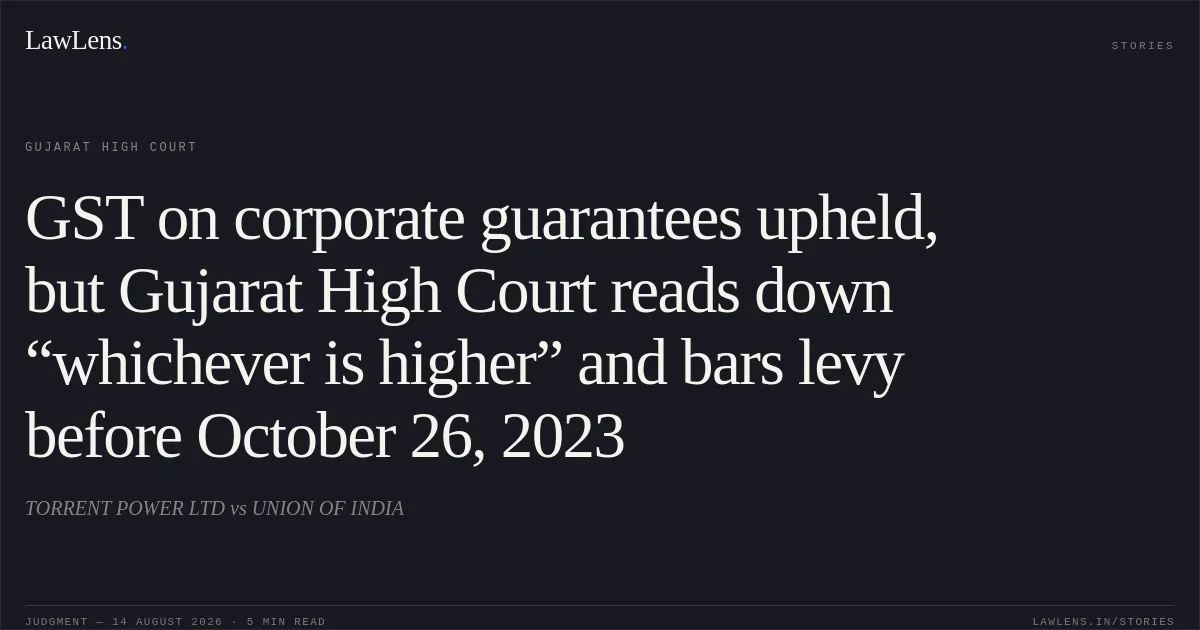
Source reference: paras. 100–110, pp. 118–134However, making 1% compulsorily applicable over actual consideration, by the words “whichever is higher,” was arbitrary; those words were therefore read down to permit valuation by reference to the actual consideration/commission or the prescribed 1% benchmark.
Source reference: paras. 100–110, pp. 118–134The Court also held that applying Rule 28(2) to guarantees furnished before its introduction on 26 October 2023 imposed an impermissibly harsh and retroactive burden, although guarantees continuing after that date could attract the levy prospectively.
Source reference: paras. 111–114, pp. 135–139Finally, because the dispute involved a bona fide and contested interpretation of the GST framework, the ingredients of fraud, wilful misstatement, or deliberate suppression necessary for Section 74 were not established.
Source reference: paras. 119–121, pp. 143–147Holding
The petitions were allowed in part. Rule 28(2) and Section 15(4) of the CGST Act were upheld as constitutionally valid, but the expression “whichever is higher” in Rule 28(2) was read down; taxpayers could determine the value by applying the actual consideration/commission or the 1% benchmark in accordance with the Court’s directions.
GST could not be levied under Rule 28(2) on corporate guarantees furnished before 26 October 2023, though the levy could apply to guarantees continuing on or after that date.
Source reference: conclusion B, para. 122, p. 147The impugned Section 74 proceedings and demands were quashed, and excess GST paid was directed to be refunded or adjusted.
Source reference: conclusions D–E, para. 122, p. 148The impugned CBIC Circulars were set aside to the extent inconsistent with the judgment, with liberty to the Revenue to issue fresh administrative instructions.
Source reference: conclusion F, para. 122, p. 148The directions were ordered to be implemented within three months, and the writ petitions were accordingly allowed in part.
Source reference: conclusions G–H, para. 122, p. 148Acts & Sections Cited
41 provisions across 10 statutes referred to in this judgment. Each provision opens on LawLens.
Central Goods and Services Tax Act, 2017
Indian Contract Act, 1872
Companies Act, 20133
Transfer of Property Act, 18822
Customs Act,19622
Central Excise Act, 19441
Central Sales Tax Act, 19567
Hindu Succession Act, 19561
Integrated Goods and Services Tax Act, 20171
Original Court PDF
TORRENT POWER LTDvsUNION OF INDIA
Click to open original judgment
Original judgment, available to read, download and summarize on LawLens.in