Facts
The petitions challenged show-cause notices and orders-in-original imposing personal penalties under Section 122(1A) of the Central Goods and Services Tax Act, 2017 (“CGST Act”).
Source reference: no citationIn the lead matters, the adjudicating authority confirmed a demand against a company for allegedly availing input tax credit (“ITC”) through invoices issued without actual supply and imposed separate penalties on three individuals who had served as the company’s directors.
Source reference: para. 5–7The batch raised common questions about the reach and temporal operation of Section 122(1A).
Source reference: para. 2–4Although an appeal under Section 107 was available, the Court entertained the petitions to determine those questions of law, while leaving the individual factual disputes to the appellate authorities.
Source reference: para. 2–4, 52–54Issues
Whether the expression “any person” in Section 122(1A) includes a person who is not a taxable person under the CGST Act.
Source reference: para. 3(i)Whether Section 122(1A), effective from 1 January 2021, applies to transactions or acts occurring before that date.
Source reference: para. 3(ii)Law Applied
Section 122(1A) applies where a person both retains the benefit of a transaction covered by Section 122(1)(i), (ii), (vii) or (ix), and causes that transaction to be conducted; these are cumulative requirements.
Source reference: para. 22–23The distinct expressions “taxable person” in Section 122(1), “any person” in Section 122(1A), and “registered person” in Section 122(2), read with the broad definition of “person” in Section 2(84), indicate that Section 122(1A) is not confined to taxable persons.
Source reference: para. 24–27, 37Section 122(1A) is penal in consequence and applies only to acts or transactions occurring on or after its commencement on 1 January 2021; the date of the show-cause notice does not determine its temporal reach.
Source reference: para. 45–49In reaching this conclusion, the Court considered Article 20(1) of the Constitution and the parallel amendments to Sections 122 and 132, and adopted the temporal reasoning in *Amit Manilal Haria v. Joint Commissioner, CGST and Central Excise* while declining to follow the contrary approach in *Bhupender Kumar v. Additional Commissioner (Adjudication), CGST*.
Source reference: para. 39–51The Court also relied on *Bharat Parihar v. State of Maharashtra* and its own decision in *Gurudas Mallik Thakur v. Commissioner of Goods and Service Tax* in construing “any person”.
Source reference: para. 31–35Reasoning
The Court treated the wording of Section 122 as deliberate: limiting “any person” in Section 122(1A) to a taxable person would disregard the statutory distinction and could leave the individuals who orchestrate and benefit from transactions through a company beyond the provision’s reach.
Source reference: para. 24–30, 32–37That wider reach does not dispense with proof: the authority must establish both personal retention of the benefit and that the transaction was conducted at the person’s instance.
Source reference: para. 22–23On timing, the Court reasoned that Section 122(1A) imposes a penal consequence for specified conduct, so its applicability must turn on when the underlying act occurred, not when the Department issued a notice.
Source reference: para. 39–49The amendments to Sections 122 and 132 formed part of the same legislative exercise, and the Court considered it inconsistent to confine the amended criminal consequences under Section 132 to post-commencement conduct while applying the corresponding penalty under Section 122(1A) retrospectively.
Source reference: para. 39–49The Court did not decide whether any particular petitioner met the statutory conditions or whether the relevant transactions occurred after the cut-off date.
Source reference: para. 54Holding
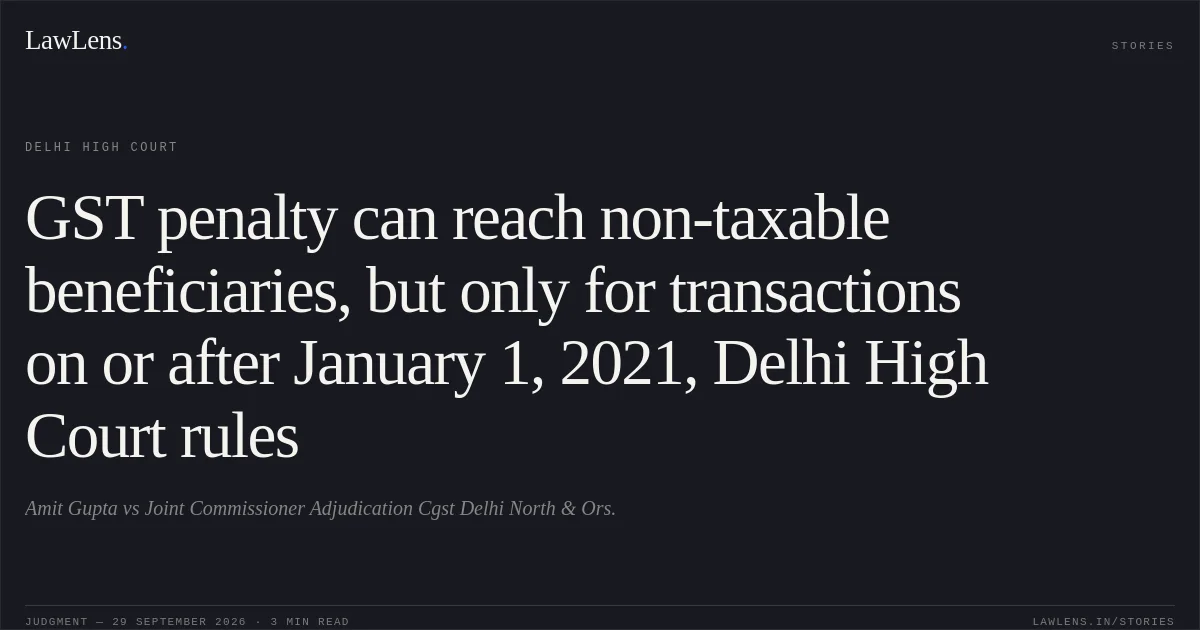
The Court held that “any person” in Section 122(1A) includes a person who is not registered or liable to be registered, provided that the person retained the benefit of a specified transaction and the transaction was conducted at that person’s instance.
It further held that Section 122(1A) applies only to acts or transactions occurring on or after 1 January 2021, irrespective of the date of the show-cause notice.
Source reference: para. 55(ii)The petitions were disposed of with liberty to appeal under Section 107; the appellate authorities must determine the individual factual questions in accordance with the judgment.
Source reference: para. 56–59Appeals filed within four weeks of the judgment are not to be dismissed as time-barred and must be considered on the merits.
Source reference: para. 56–59Acts & Sections Cited
17 provisions across 1 statute referred to in this judgment. Each provision opens on LawLens.
Original Court PDF
Amit GuptavsJoint Commissioner Adjudication Cgst Delhi North & Ors.
Click to open original judgment
Original judgment, available to read, download and summarize on LawLens.in