Facts
The petitioner, a registered proprietorship firm engaged in bullion, gems and jewellery, was issued a show-cause notice dated 21.05.2024 proposing penalties under Section 122(1) of the Central Goods and Services Tax Act, 2017 (“CGST Act”).
Source reference: p.2, para. 2An investigation report for initiating prosecution under Section 132 of the CGST Act was prepared by the Deputy Commissioner and countersigned and approved by Shri Mahipal Singh, Additional Commissioner (A.E.).
Source reference: p.3, para. 6; p.7, para. 11The same Shri Mahipal Singh subsequently adjudicated the matter and passed the Order-in-Original dated 16.01.2025 imposing penalties under Sections 122(1)(ii), (vii), (xii), (xvi) and (xvii) of the CGST Act.
Source reference: p.1, para. 1The petitioner objected that the officer’s prior involvement in approving the prosecution-related investigation report created a reasonable apprehension of bias. The objection was rejected, and the appellate authority affirmed the adjudication order by Order-in-Appeal dated 28.01.2026. The petitioner therefore challenged both orders before the Rajasthan High Court.
Source reference: p.1, para. 1; pp.3–4, para. 7Issues
Whether an officer who countersigned or approved an investigation report recommending initiation of prosecution could subsequently adjudicate the penalty proceedings arising from the same facts without violating the principles of natural justice and impartial decision-making?
Source reference: pp.6–7, paras. 11–13Whether the impugned Order-in-Original and Order-in-Appeal were liable to be quashed on the ground of reasonable apprehension of bias, even without proof of actual bias or prejudice?
Source reference: p.7, paras. 12–14Law Applied
The Court considered the penalties imposed under Section 122(1)(ii), (vii), (xii), (xvi) and (xvii) of the CGST Act and the prosecution framework under Section 132, including Section 132(6), which requires the Commissioner’s previous sanction for prosecution.
Source reference: pp.1, 3–4, paras. 1, 7It applied the principles of natural justice and the rule against bias—*nemo judex in causa sua*—under which justice must not only be done but must also appear to be done.
Source reference: pp.4–6, para. 10Relying on *Ashok Kumar v. State of Haryana*, (1985) 4 SCC 417, the Court held that actual bias need not be established; a reasonable likelihood or apprehension of bias is sufficient, and the principle applies not only to courts but also to administrative and quasi-judicial authorities.
Source reference: pp.4–6, para. 10The Court also referred to its decision in *M/s Ramjilal Mohanlal v. Union of India & Ors.*, D.B. Civil Writ Petition No. 7616/2024, decided on 29.01.2026.
Source reference: p.6, para. 8Reasoning
The Court found that Shri Mahipal Singh had directly participated in the prosecution-related process by countersigning and approving the investigation report, and had thereafter acted as the quasi-judicial adjudicating authority in the penalty proceedings arising from the same factual foundation.
Source reference: p.7, paras. 11–12His reasoning in paragraph 25.3 of the Order-in-Original, which characterised the petitioner’s objection as an attempt to hinder or hamper the proceedings, further demonstrated that the objection had not been impartially addressed.
Source reference: pp.3–4, para. 7; p.7, para. 12The respondents’ argument that the officer’s role in approving an investigation report was distinct from his quasi-judicial role, and that actual prejudice had not been shown, was rejected. Applying *Ashok Kumar*, the Court held that the relevant test was whether the circumstances created a reasonable apprehension of bias, not whether actual bias could be proved.
Source reference: pp.6–7, paras. 12–13The Court therefore treated the combination of investigative/prosecution-approval and adjudicatory functions in the same matter as inconsistent with the impartiality required of a quasi-judicial authority.
Source reference: no citationHolding
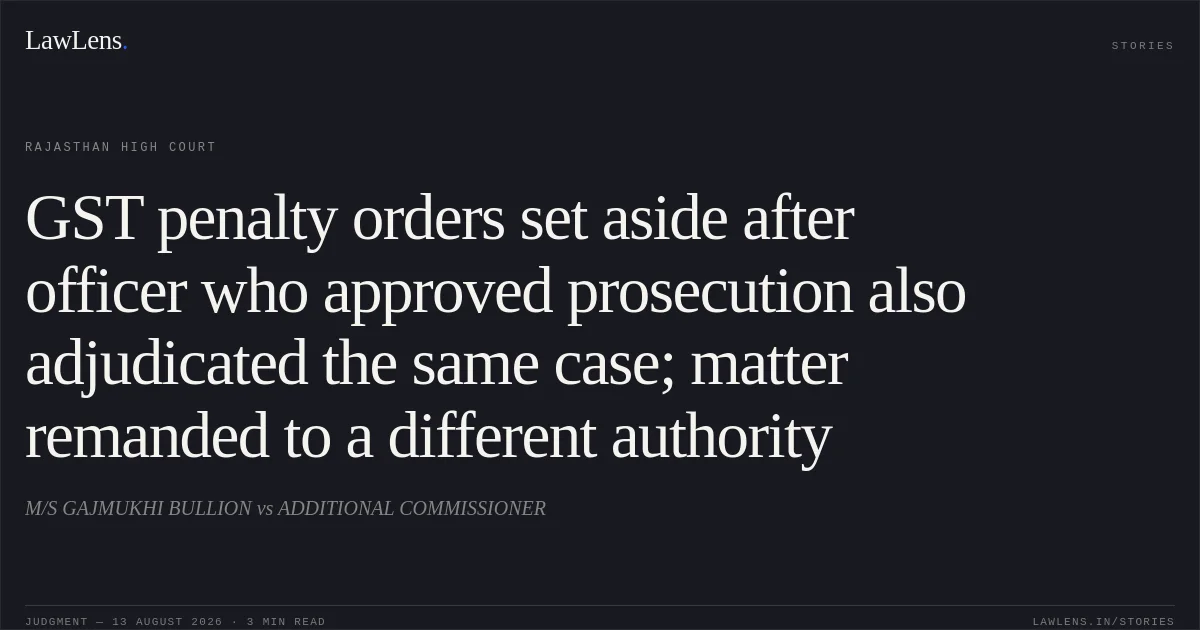
The High Court held that the petitioner’s objection was legally sustainable because the same officer had been involved in approving the investigation report leading to prosecution proceedings and had subsequently adjudicated the penalty matter.
Without recording a finding of actual bias or prejudice, the Court quashed the Order-in-Original dated 16.01.2025 and the Order-in-Appeal dated 28.01.2026 and remanded the matter for fresh adjudication by a competent authority.
Source reference: p.7, para. 13It directed that the roles of investigator, approving authority and quasi-judicial adjudicator should not be performed by the same individual. All other issues and contentions were left open for determination in accordance with law.
Source reference: p.8, para. 14Acts & Sections Cited
2 provisions across 1 statute referred to in this judgment. Each provision opens on LawLens.
Central Goods and Services Tax Act, 20172
Original Court PDF
M/S GAJMUKHI BULLIONvsADDITIONAL COMMISSIONER
Click to open original judgment
Original judgment, available to read, download and summarize on LawLens.in