Facts
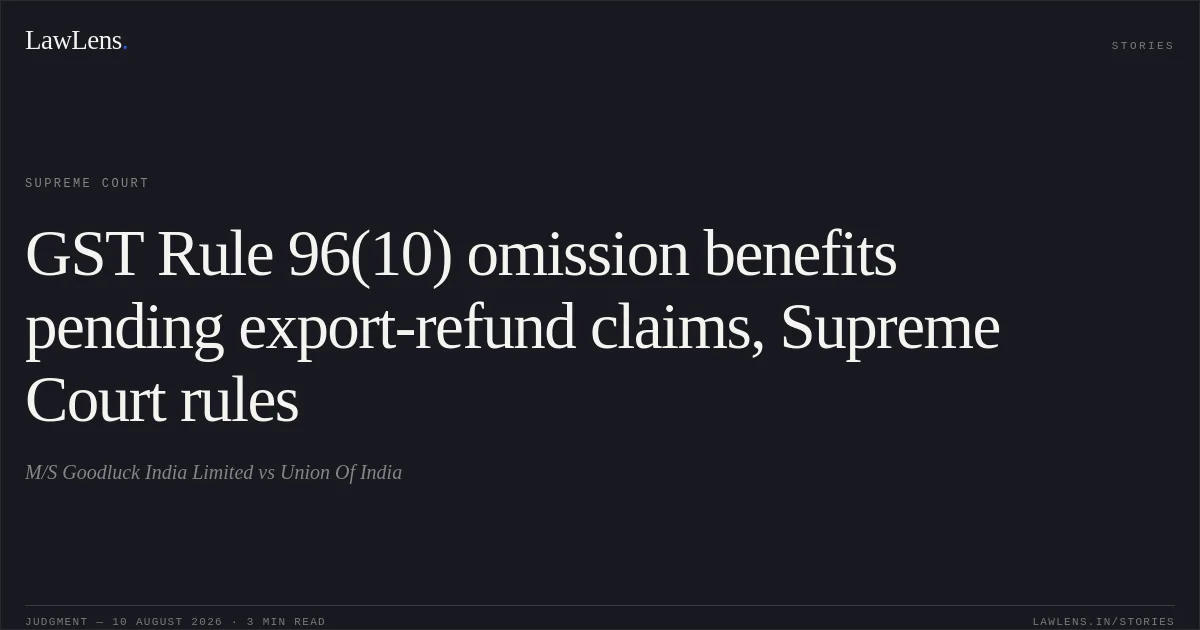
The proceedings arose from a batch of challenges concerning the omission of Rule 96(10) of the Central Goods and Services Tax Rules, 2017 (“CGST Rules”) by Notification No. 20/2024 with effect from 8 October 2024.
Source reference: p.4Rule 96(10) restricted refund of integrated tax paid on goods and services exported from India where the exporter had received supplies after availing specified exemption or concessional-duty notifications.
Source reference: p.4The High Court held that the omission of Rule 96(10), being without a saving clause, applied to proceedings pending on the date of omission, thereby permitting refund claims to be considered without applying the restriction contained in the omitted sub-rule.
Source reference: p.3The Union of India and the Department challenged that determination.
Source reference: p.3In SLP (C) Nos. 24550 of 2025 and 26411 of 2026, the assessees challenged the vires and validity of Rule 96(10); those challenges had not been examined by the High Court because of its conclusion regarding the retrospective application of the omission.
Source reference: p.3The Supreme Court dismissed the two assessee SLPs as infructuous and granted leave in the remaining matters.
Source reference: p.4Issues
Whether the omission of Rule 96(10) of the CGST Rules by Notification No. 20/2024, with effect from 8 October 2024, applies to refund proceedings pending on the date of omission, in the absence of a saving clause?
Source reference: pp.4, 7Whether pending refund proceedings could continue to be governed by the omitted Rule 96(10) on the basis of the GST Council’s recommendation that the omission operate prospectively?
Source reference: pp.4–7Whether the challenges to the vires and validity of Rule 96(10) required adjudication in the assessee’s SLPs?
Source reference: pp.3–4Law Applied
The Court applied Rule 96 of the CGST Rules, particularly Rule 96(10), which imposed restrictions on refund of integrated tax paid on exports where specified exemption or concessional-duty benefits had been availed.
Source reference: p.4It considered Notification No. 20/2024, which omitted Rule 96(10) without incorporating a saving clause or sunset clause.
Source reference: pp.4, 7Relying on Kolhapur Canesugar Works Ltd. v. Union of India, (2000) 2 SCC 536, the Court applied the principle that omission of a rule obliterates it from the statute book, and that proceedings under the omitted rule can continue only where a saving provision or an equivalent statutory legal fiction preserves them.
Source reference: pp.5–6The Court further held that Section 6 of the General Clauses Act, 1897, which ordinarily preserves pending proceedings upon repeal of a Central Act or regulation, does not apply to the mere omission of a rule.
Source reference: p.6The GST Council’s recommendation was treated as advisory and not binding on the rule-making authority.
Source reference: pp.4, 7Reasoning
The Court noted that Rule 96(10) had been omitted without any express provision preserving proceedings initiated or pending under that sub-rule.
Source reference: pp.4, 7Applying the Constitution Bench ruling in Kolhapur Canesugar Works, the Court held that, in the absence of a saving clause or statutory fiction, the omitted restriction could not continue to govern pending refund proceedings.
Source reference: pp.5–6The Court rejected the Union’s reliance on the GST Council minutes because the Council’s recommendation that the omission operate prospectively was advisory only and had not been incorporated into the notification or rules.
Source reference: pp.4, 7The stated rationale for omission was that Rule 96(10) caused “unnecessary complications without any intended benefit being served”; preserving its operation for pending proceedings would therefore defeat the purpose of the omission.
Source reference: p.7Consequently, the High Court’s conclusion that the omission benefited all pending proceedings was upheld.
Source reference: p.8Holding
The Supreme Court held that the omission of Rule 96(10) of the CGST Rules operates in respect of all proceedings pending on 8 October 2024, and that refund claims in such proceedings must be considered without applying the restriction contained in the omitted sub-rule.
SLP (C) Nos. 24550 of 2025 and 26411 of 2026, concerning the vires and validity of Rule 96(10), were dismissed as infructuous.
Source reference: p.4Leave was granted in the remaining matters, but the appeals were ultimately dismissed, and the High Court judgment was left undisturbed.
Source reference: pp.4, 8The Registry was directed to circulate the order to all High Courts so that pending cases on the issue could be listed and disposed of expeditiously.
Source reference: p.8Acts & Sections Cited
3 provisions across 2 statutes referred to in this judgment. Each provision opens on LawLens.
Central Excise Act, 19441
Original Court PDF
M/S Goodluck India LimitedvsUnion Of India
Click to open original judgment
Original judgment, available to read, download and summarize on LawLens.in