01Facts
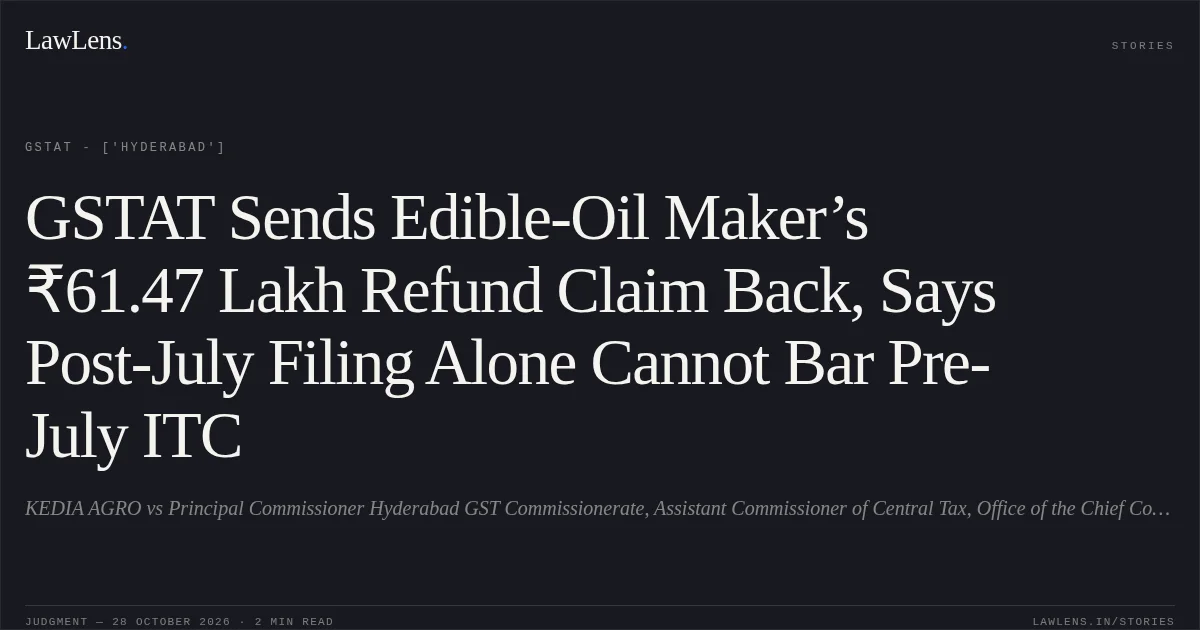
Kedia Agro claimed a refund of ₹61,47,671 for unutilised ITC accumulated due to an inverted duty structure during May 2020–March 2021.
¶ 8.1–8.3It had first filed a refund application on 18 June 2022, which it later withdrew, and filed a fresh application on 25 March 2023 for the same period.
¶ 8.1–8.3The Assistant Commissioner rejected the fresh claim because it was filed after 18 July 2022, applying Notification No. 09/2022 and CBIC Circular No. 181/13/2022-GST; the First Appellate Authority upheld that decision.
¶ 8.4–8.802Issues
i.1. Whether refund of ITC accumulated before 18 July 2022 could be denied solely because the refund application was filed on or after that date.
¶ 5.0ii.2. Whether Notification No. 09/2022, read with Circular No. 181/13/2022-GST, barred the appellant’s claim despite its asserted compliance with the limitation period under Section 54.
¶ 5.1iii.3. Whether the rejection orders were legally sustainable.
¶ 5.203Law Applied
Section 54(1) of the CGST Act permits a refund application within the prescribed limitation period, while Section 54(3) provides for refund of unutilised ITC accumulated due to an inverted duty structure, subject to statutory exceptions; Rule 89 prescribes the refund-application procedure and calculation.
Notification No. 09/2022-Central Tax (Rate), effective from 18 July 2022, added specified goods to the categories for which such refunds are restricted. Circular No. 181/13/2022-GST stated that the restriction applied to applications filed on or after that date.
The Tribunal relied on Gemini Edibles and Fats India Ltd. v. Assistant Commissioner of Central Tax (Andhra Pradesh High Court, 29 January 2025), which held that the circular’s filing-date restriction was unsustainable insofar as it prevented refund of ITC accumulated before 18 July 2022; it also considered consistent decisions of the Gujarat, Rajasthan, Allahabad and Calcutta High Courts.
¶ 10.0–10.5Provisions in the judgment · 4 · Linked ones open on LawLens
Central Goods and Services Tax Act, 2017 Section 54Section 74Section 112Section 168
04Reasoning
The Tribunal found that the disputed ITC related to May 2020–March 2021, before the notification took effect, and that the fresh application was filed within the limitation period.
¶ 11.0(i)Although that application was filed after 18 July 2022, the Tribunal held that the notification did not itself impose a filing-date bar on refunds of pre-effective-date ITC; that bar arose from the circular’s interpretation.
¶ 11.0(iii)–(iv), 12.0Following the cited High Court decisions, the Tribunal concluded that the circular could not curtail the claim merely because the earlier application had been withdrawn and the fresh application filed later. The rejection orders, resting on that ground, could not stand.
¶ 10.0–10.6, 12.005Holding
The Tribunal allowed the appeal and set aside the orders of the Original Adjudicating Authority and the First Appellate Authority.
¶ 12.0–12.4It remitted the refund claim to the Original Adjudicating Authority for fresh consideration in accordance with law and applicable judicial precedents; it directed that the claim for interest also be examined under the applicable legal provisions. The Tribunal did not itself order payment of the refund.
¶ 12.0–12.4Original Court PDF
KEDIA AGROvsPrincipal Commissioner Hyderabad GST Commissionerate, Assistant Commissioner of Central Tax, Office of the Chief Commissioner of GST and Customs Hyderabad Zone
Click to open original judgment
Original judgment, available to read, download and summarize on LawLens.in