Facts
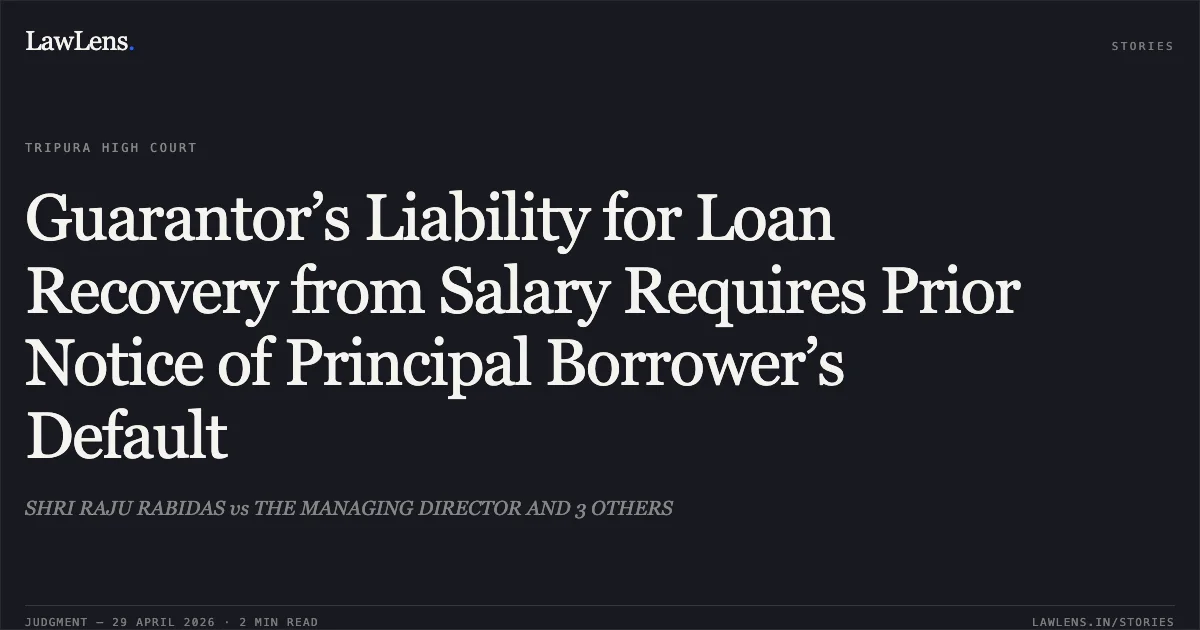
The petitioner, an L.D.C. at a government school, stood as a guarantor for a loan of ₹2,85,000 taken by Respondent No. 4 (the beneficiary) from the Tripura Scheduled Caste Co-Op. Dev. Corpn. Ltd. (Respondents No. 1 and 2).
Source reference: p. 3Upon the borrower's default, the Corporation issued a communication [Annexure-5] to the petitioner’s employer (Respondent No. 3) seeking a monthly salary deduction of ₹10,000 from the petitioner.
Source reference: p. 3The petitioner challenged this, alleging that no prior notice of default was served upon him and that the Corporation failed to exhaust the recovery procedures (specifically Clause 12 and 17) against the borrower’s properties before targeting the guarantor.
Source reference: p. 3-4Issues
1. Whether the respondent Corporation could initiate salary deductions from the guarantor without first exhausting recovery via hypothecated goods under Clauses 12 and 17 of the agreement.
Source reference: p. 4 / p. 62. Whether the lack of prior formal notice to the guarantor regarding the borrower's default invalidated the recovery communication.
Source reference: p. 3 / p. 53. Whether a cause of action under Article 226 of the Constitution had accrued to the petitioner at the current stage.
Source reference: p. 7Law Applied
Clause 7 stipulates that if a borrower fails to repay three consecutive installments, the guarantor becomes liable and the DDO may be directed to recover the amount from the guarantor's salary.
Source reference: p. 5Clauses 12 and 17 provide the Corporation the right to take possession of and sell hypothecated goods to satisfy the debt.
Source reference: p. 6The court applied the principle that the liability of a guarantor is triggered by the default of the principal debtor as per the agreed terms, but also noted the necessity of procedural fairness (notice) and the exhaustion of specific contractual stages for recovery.
Source reference: p. 7Reasoning
The Court observed that Clause 7 explicitly makes the guarantor liable upon the borrower's failure to pay three consecutive installments.
Source reference: p. 5While the petitioner argued that the Corporation must first invoke Clauses 12 and 17 (seizure of goods), the Corporation clarified that no goods were actually hypothecated at the time of the loan, rendering those clauses inapplicable.
Source reference: p. 7The Court found a significant procedural lapse: the Corporation admitted that no formal notice of default had been served on the petitioner.
Source reference: p. 4The employer (Respondent No. 3) had not yet acted upon the recovery letter or informed the petitioner of any imminent deduction. Consequently, the Court reasoned that since the recovery process had not actually been enforced or legally finalized against the petitioner’s salary, the petition was premature.
Source reference: p. 4 / p. 7Holding
The Court held that no cause of action had yet accrued to the petitioner under Article 226 because the recovery clauses had not been fully invoked or executed.
The writ petition was dismissed as devoid of merit, however, the Court mandated that the Corporation must first exhaust the requirements of Clause 7 and provide due notice before proceeding with recovery under other clauses. All pending applications were disposed of.
Source reference: p. 7-8Original Court PDF
SHRI RAJU RABIDASvsTHE MANAGING DIRECTOR AND 3 OTHERS
Click to open original judgment
Original judgment, available to read, download and summarize on LawLens.in