Facts
The petitioner was appointed as a Guest Teacher in Government Schools during the academic sessions 2018–19, 2019–20 and 2020–21, rendering 163, 153 and 22 days of service respectively, totalling 338 days.
Source reference: paras. 2–4She qualified the Primary Teacher Eligibility Test, 2020 with 83.75 marks.
Source reference: para. 4The recruitment framework for Primary Teachers provided benefits, including reservation and age relaxation, to eligible Guest Teachers who had completed 200 days of service over three academic sessions.
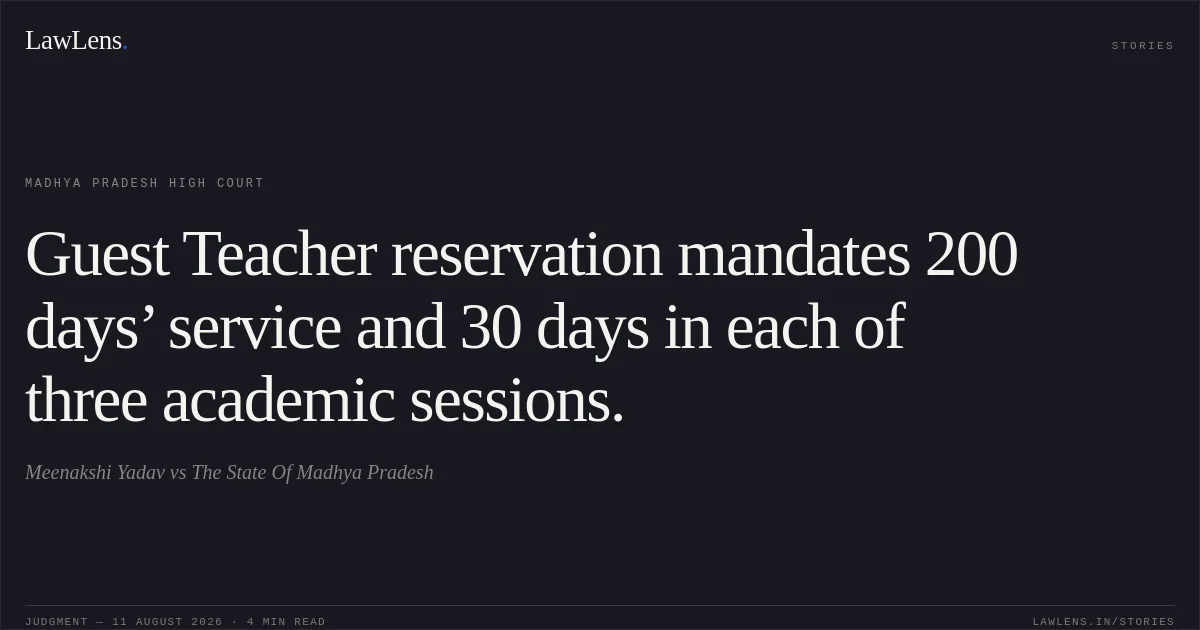
Source reference: paras. 5–6When the petitioner applied for the 2025 Primary Teacher Selection Examination, the M.P. Online Portal required at least 30 days of service in each of three academic sessions.
Source reference: para. 7Since she had rendered only 22 days during 2020–21, the portal did not recognise her as an eligible Guest Teacher.
Source reference: para. 7She challenged the requirement, sought the benefit of 50% reservation, and prayed for deletion of the relevant “Spashtikaran” or Explanation under the 2018 Recruitment Rules.
Source reference: para. 1Issues
1. Whether the petitioner, despite having completed 338 days of Guest Teacher service over three academic sessions, was eligible for Guest Teacher reservation and other benefits when she had rendered fewer than 30 days of service in one of those sessions?
Source reference: paras. 17–21, 252. Whether the requirement of a minimum of 30 days of service in each of three academic sessions constituted an impermissible alteration of the eligibility criteria or could be relaxed on account of the COVID-19 pandemic?
Source reference: paras. 22–263. Whether the High Court could direct repeal, deletion or amendment of the Explanation contained in sub-clause (4) of Rule 7 read with Rule 11 of the 2018 Recruitment Rules?
Source reference: para. 27Law Applied
The Court applied the Recruitment Rules, 2025, particularly Clause 7.2(3), which reserved 50% of the relevant posts for Guest Teachers having service in three academic sessions subject to the prescribed minimum service in each session, and Clause 12.7, which required the educational qualification and experience to exist on the date of application.
Source reference: para. 17The applicable eligibility requirement was a total of at least 200 days of teaching experience, with a minimum of 30 days in each of three academic sessions; where experience existed in more than three sessions, any three qualifying sessions could be selected, subject to those conditions.
Source reference: paras. 18–20, 29The Court further applied the principle that courts cannot relax mandatory eligibility conditions after commencement of a selection process, as doing so would amount to changing the rules of the game and prejudice candidates who complied with the notified requirements.
Source reference: para. 26It relied on the binding Division Bench decision in Adarsh Kourav v. State of Madhya Pradesh, W.A. No. 1177 of 2026, which upheld the 30-day-per-session requirement and rejected relaxation on equitable grounds.
Source reference: para. 24The Court also held that, although judicial review under Article 226 permits examination of the legality or constitutional validity of a rule, the Court cannot issue a mandamus directing the competent rule-making authority to repeal, amend or delete a statutory rule.
Source reference: para. 27Reasoning
The Court found that the 30-day requirement was contained in the Recruitment Rules, 2025, which had been notified on 27 December 2024, before the recruitment advertisement and application period; therefore, there was no alteration of the eligibility criteria after commencement of the selection process.
Source reference: para. 17Although the petitioner had completed 338 total days, her 22 days of service in 2020–21 fell eight days short of the mandatory minimum for that academic session.
Source reference: para. 25She had no additional academic session from which a different qualifying combination of three sessions could be selected.
Source reference: paras. 20–21The Court rejected COVID-19 as a basis for relaxation because neither the Recruitment Rules nor the advertisement provided such an exemption.
Source reference: para. 22Granting relaxation after the selection process would prejudice candidates who had satisfied the notified condition and would impermissibly change the rules of the game.
Source reference: para. 26Finally, the challenge to the Explanation was rejected because the rule-making power belonged to the competent authority and the validity of the relevant eligibility framework had already been upheld in Adarsh Kourav.
Source reference: para. 27Holding
The Court held that the petitioner was not entitled to Guest Teacher reservation or related concessions because she had not completed the mandatory minimum of 30 days of service in each of three academic sessions, notwithstanding her aggregate experience of 338 days.
It further held that the requirement was neither arbitrary nor retrospectively introduced, and could not be relaxed on account of the COVID-19 pandemic or equitable considerations.
Source reference: paras. 23, 26The prayer for repeal or deletion of the Explanation under the 2018 Rules was also rejected.
Source reference: para. 27Following W.A. No. 1177 of 2026, the writ petition was dismissed for lack of merit, with no order as to costs.
Source reference: para. 30Original Court PDF
Meenakshi YadavvsThe State Of Madhya Pradesh
Click to open original judgment
Original judgment, available to read, download and summarize on LawLens.in