01Facts
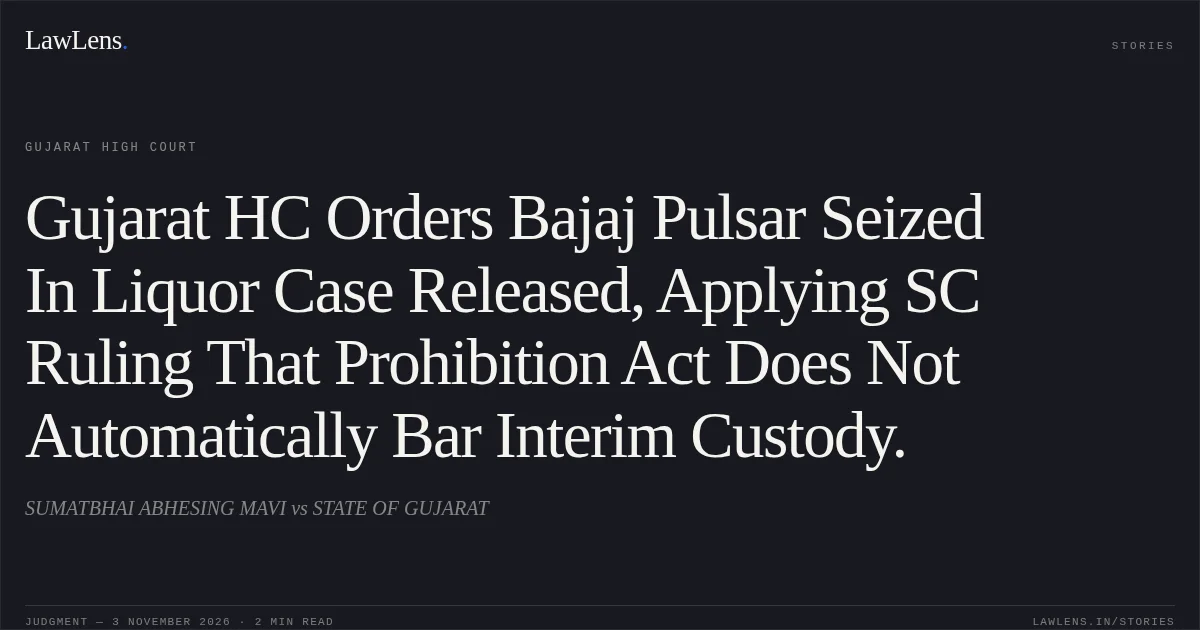
The petitioner, the registered owner of a Bajaj Pulsar 150 DTS I, sought its interim release after police seized it in connection with an alleged liquor offence under the Gujarat Prohibition Act.
¶ 2–6The petitioner invoked Articles 21 and 226 of the Constitution and Section 497 of the Bharatiya Nagarik Suraksha Sanhita, 2023.
¶ 2–6The State opposed release by reference to the Act’s confiscation provisions, while accepting that the High Court could order release in an appropriate case.
¶ 2–6The petitioner relied on Sunderbhai Ambalal Desai v. State of Gujarat and a coordinate Bench decision concerning release of seized vehicles.
¶ 5, 7–802Issues
i.Whether the High Court could direct interim release of a vehicle seized in a Gujarat Prohibition Act case, notwithstanding the Act’s confiscation provisions.
¶ 6, 9ii.Whether release should be granted subject to conditions protecting the vehicle’s availability and evidentiary value during trial.
¶ 8, 11–1303Law Applied
Articles 21 and 226 of the Constitution permit the High Court to grant appropriate relief concerning seized property.
Section 497 of the Bharatiya Nagarik Suraksha Sanhita, 2023 (corresponding to Section 451 of the Code of Criminal Procedure, 1973) empowers a court to make appropriate orders for the custody of property pending trial.
In Sunderbhai Ambalal Desai v. State of Gujarat, AIR 2003 SC 638, the Supreme Court discouraged keeping seized vehicles at police stations for prolonged periods and advised prompt release on suitable bonds, guarantees, or security.
¶ 8The Court also relied on M/s ABC Express v. State of Gujarat, 2026 LiveLaw (SC) 885, which held that Section 98(2) of the Gujarat Prohibition Act, 1949 is not an absolute bar to interim release of a seized vehicle and that a court may order its proper custody under Section 451 CrPC.
¶ 9Provisions in the judgment · 3 · Linked ones open on LawLens
Bharatiya Nagarik Suraksha Sanhita, 2023 Section 497
Code of Criminal Procedure, 1973 Section 451
Gujarat Prohibition Act, 1949. Section 98
04Reasoning
The Court considered that prolonged retention of the motorcycle at the police station could cause deterioration and that interim release could be balanced against the need to preserve the vehicle and ensure its production at trial.
¶ 8–12It relied on the Supreme Court’s guidance in Sunderbhai and its account of M/s ABC Express to conclude that the confiscation provision did not create an absolute bar to release.
¶ 8–12It therefore ordered release subject to security, an undertaking against transfer, production of the vehicle when required, and documentation of its condition through photographs and a panchnama.
¶ 8–1205Holding
The petition was allowed and the vehicle was ordered to be released to the petitioner upon furnishing a solvent surety equal to the vehicle’s value stated in the FIR, undertaking not to transfer it until the trial’s final disposal, and agreeing to produce it when directed.
¶ 10–14The order further provided for confiscation in the event of a subsequent offence; required police to photograph the vehicle and prepare a panchnama at the petitioner’s cost; and directed that the order be sent to the RTO for recording the restraint on transfer, subject to any later order of the Trial Court.
¶ 10–14Original Court PDF
SUMATBHAI ABHESING MAVIvsSTATE OF GUJARAT
Click to open original judgment
Original judgment, available to read, download and summarize on LawLens.in