01Facts
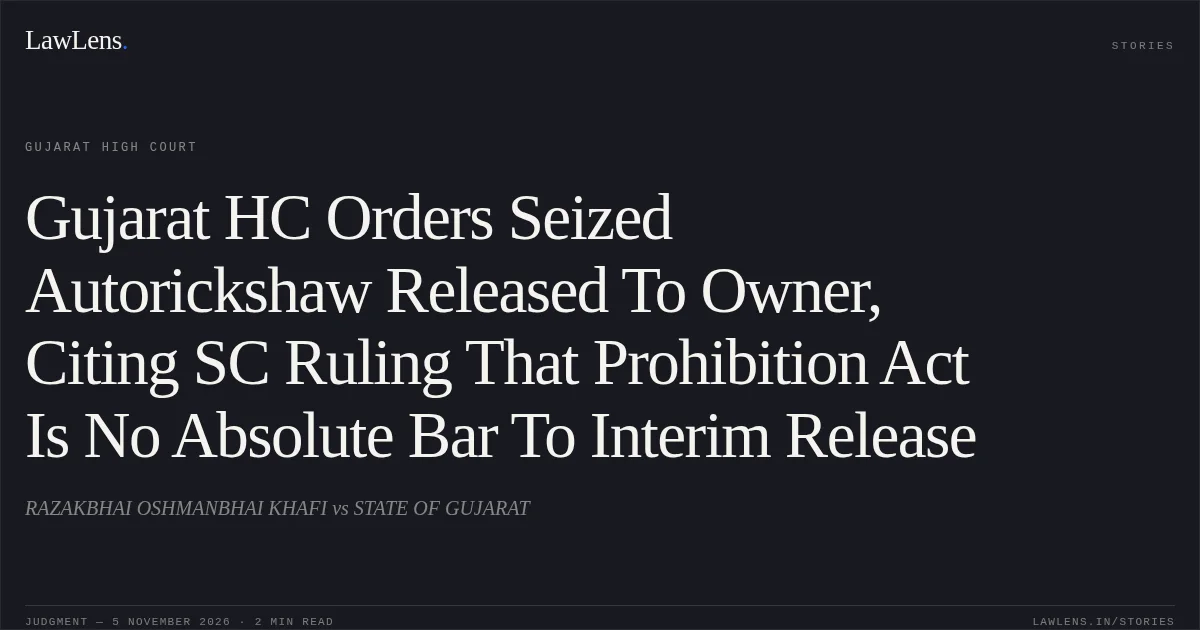
Police seized the petitioner’s Bajaj Maxima Z CNG autorickshaw, registration No. GJ-10-TZ-3997, in connection with a prohibition offence registered as C.R. No. 11202002261368 of 2026 at City C-Division Police Station, Jamnagar.
pp. 1–2 · ¶ 1–3The petitioner’s applications for release of the vehicle before the lower courts were rejected.
pp. 1–2 · ¶ 1–3He sought its release before the High Court, submitting that continued retention risked deterioration and producing a no-objection certificate from Mahindra Finance, which held a hypothecation over the vehicle.
pp. 1–2 · ¶ 1–302Issues
i.1. Whether the High Court could order interim release of a vehicle seized in connection with an offence under the Gujarat Prohibition Act, notwithstanding the Act’s confiscation provisions.
pp. 2–4 · ¶ 5, 10ii.2. Whether the vehicle should be released to its registered owner pending trial, and, if so, on what conditions.
pp. 2–5 · ¶ 3–4, 7–1303Law Applied
The Court invoked its constitutional jurisdiction under Articles 226 and 227 of the Constitution and its reference to Section 497 of the Bharatiya Nagarik Suraksha Sanhita, 2023, concerning interim custody of property.
p. 1 · ¶ 1It relied on Sunderbhai Ambalal Desai v. State of Gujarat, AIR 2003 SC 638, which discourages prolonged retention of seized vehicles at police stations and supports release on appropriate bonds, guarantees, and security.
pp. 3–4 · ¶ 9It also relied on Musa Khan Jat v. State of Gujarat, SCR.A/7190/2017, concerning release of a vehicle in comparable circumstances.
p. 3 · ¶ 8It also relied on M/s ABC Express v. State of Gujarat, 2026 LiveLaw (SC) 885, which held that Section 98(2) of the Gujarat Prohibition Act, 1949, does not impose an absolute bar on interim release and that the court may order proper custody under Section 451 of the Code of Criminal Procedure, 1973, corresponding to Section 497 of the BNSS.
p. 4 · ¶ 10Provisions in the judgment · 3 · Linked ones open on LawLens
Bharatiya Nagarik Suraksha Sanhita, 2023 Section 497
Gujarat Prohibition Act, 1949. Section 98
Code of Criminal Procedure, 1973 Section 451
04Reasoning
The petitioner was the vehicle’s registered owner, and the Court considered the risk that continued police custody would cause the vehicle to deteriorate, as well as the financier’s no-objection certificate.
p. 2, 4 · ¶ 3, 7Applying Sunderbhai and the Supreme Court’s ruling in M/s ABC Express, the Court concluded that the Prohibition Act’s confiscation provisions did not prevent interim release.
pp. 3–5 · ¶ 9–13It therefore ordered release subject to conditions intended to secure the vehicle’s value, prevent its transfer, ensure its production when required, and preserve evidence for trial.
pp. 3–5 · ¶ 9–1305Holding
The petition was allowed and the vehicle was ordered to be released to the petitioner upon furnishing a solvent surety equal to its price as stated in the FIR; filing an undertaking not to transfer it until final disposal of the trial; and undertaking to produce it when directed.
pp. 4–5 · ¶ 11–15The order further provided that the vehicle would stand confiscated in the event of a subsequent offence.
pp. 4–5 · ¶ 11–15Before release, police were directed to photograph the vehicle and prepare a panchnama at the petitioner’s cost, with both to form part of the charge-sheet papers.
pp. 4–5 · ¶ 11–15A copy of the order was also to be sent to the RTO for a corresponding entry recording the restraint on transfer, subject to any later order of the Trial Court.
pp. 4–5 · ¶ 11–15Original Court PDF
RAZAKBHAI OSHMANBHAI KHAFIvsSTATE OF GUJARAT
Click to open original judgment
Original judgment, available to read, download and summarize on LawLens.in