01Facts
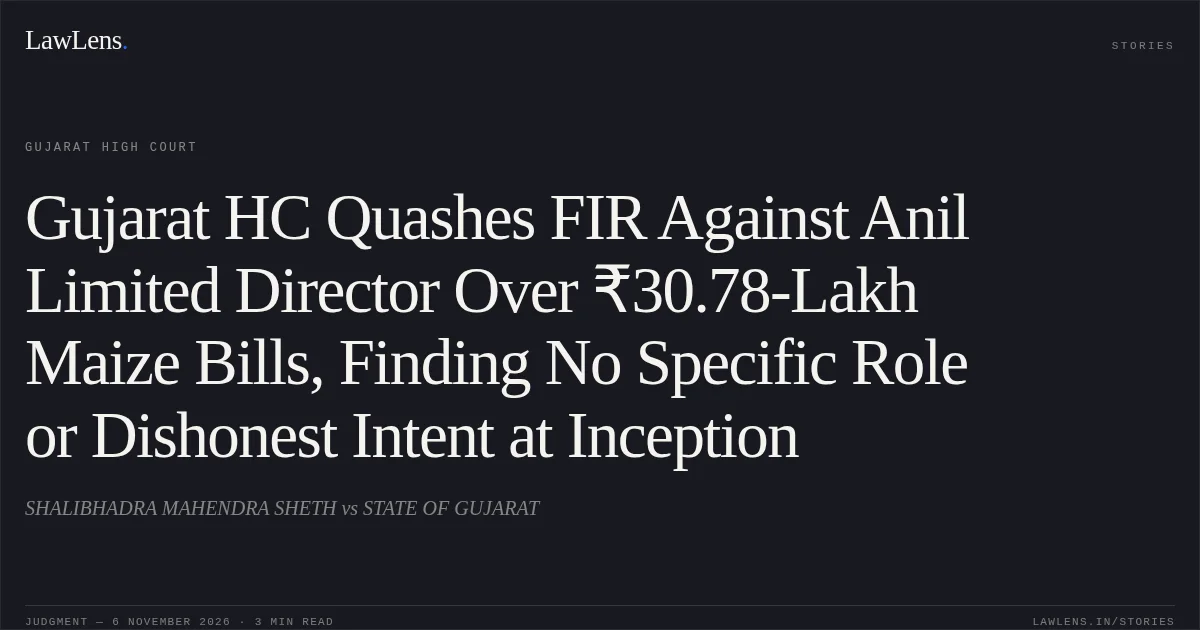
The complainant alleged that Ganesh Trading supplied maize worth ₹30,78,437 to Anil Limited between 6 July and 7 August 2016.
¶ 2Seven cheques were issued, but the complainant was allegedly asked not to present them; after they expired, they were altered without valid countersignatures.
¶ 2In April 2018, an FIR alleging offences under Sections 406, 420 and 114 IPC was registered against twelve persons, including the applicant, described as the company’s Chief Financial Officer.
¶ 2The applicant sought quashing under Section 482 CrPC, contending that the FIR attributed no specific act to him and that his association with the company had ended in August 2016.
¶ 8–11The complainant opposed the application, disputing the significance of the resignation and relying on other proceedings against the applicant.
¶ 13–2002Issues
i.1. Whether the FIR’s allegations disclosed the ingredients of criminal breach of trust or cheating against the applicant, including whether Sections 406 and 420 IPC could apply to the alleged commercial transactions.
¶ 22(I), 23–29ii.2. Whether the applicant’s employment and alleged antecedent proceedings justified continuing the prosecution despite the absence of specific allegations connecting him to the alleged offences.
¶ 22(II), 30–34iii.3. Whether the FIR was an abuse of criminal process arising from a commercial payment dispute and therefore liable to be quashed under Section 482 CrPC.
¶ 22(III), 35–4203Law Applied
Section 406 IPC requires entrustment of property and subsequent dishonest misappropriation; a sale of goods ordinarily transfers ownership and creates a debtor–creditor relationship, not an entrustment [Delhi Race Club (1940) Ltd. v. State of Uttar Pradesh, (2024) 10 SCC 690].
¶ 24, 27Section 420 IPC requires fraudulent or dishonest intention when the promise or representation is made; subsequent non-performance alone does not establish cheating [Hridaya Ranjan Prasad Verma v. State of Bihar, (2000) 4 SCC 168].
¶ 28The court also applied the principle that the IPC does not impose vicarious criminal liability for cheating or breach of trust merely because a person was employed by a company.
¶ 29, 37Under Section 482 CrPC, proceedings may be quashed where the allegations do not disclose an offence or are manifestly mala fide, applying the categories in State of Haryana v. Bhajan Lal, 1992 Supp (1) SCC 335.
¶ 39The court also relied on Indian Oil Corpn. v. NEPC India Ltd., (2006) 6 SCC 736, concerning misuse of criminal proceedings to pursue recovery of commercial debts.
¶ 38Provisions in the judgment · 7 · Linked ones open on LawLens
Code of Criminal Procedure, 1973 Section 482Section 87
Indian Penal Code, 1860 Section 406Section 420Section 114
Negotiable Instruments Act, 1881 Section 138Section 141
04Reasoning
The court treated the allegations as arising from a sale of maize on credit. It found no entrustment capable of supporting Section 406 IPC and held that the FIR did not allege facts showing dishonest intent at the inception of the transaction sufficient to support Section 420 IPC.
¶ 26–29It further found no specific act or role attributed to the applicant; his former employment or the existence of unrelated proceedings could not substitute for allegations establishing his culpability in this transaction.
¶ 32–34The court considered the unpaid invoices and requests to defer cheque presentation consistent with a commercial default, absent specific allegations of fraudulent inducement.
¶ 35–39It concluded that the case fell within the relevant Bhajan Lal categories and that continuing the prosecution would amount to misuse of criminal process.
¶ 35–3905Holding
The High Court allowed the application under Section 482 CrPC and quashed FIR C.R. No. I-57 of 2018, registered at Mansa Police Station, Gandhinagar, and all consequential proceedings, including any charge-sheet or process, qua the applicant.
¶ 42–44The Rule was made absolute in those terms.
¶ 42–44Original Court PDF
CHINTAN JITENDRA ACHARYAvsSTATE OF GUJARAT
Click to open original judgment
Original judgment, available to read, download and summarize on LawLens.in