01Facts
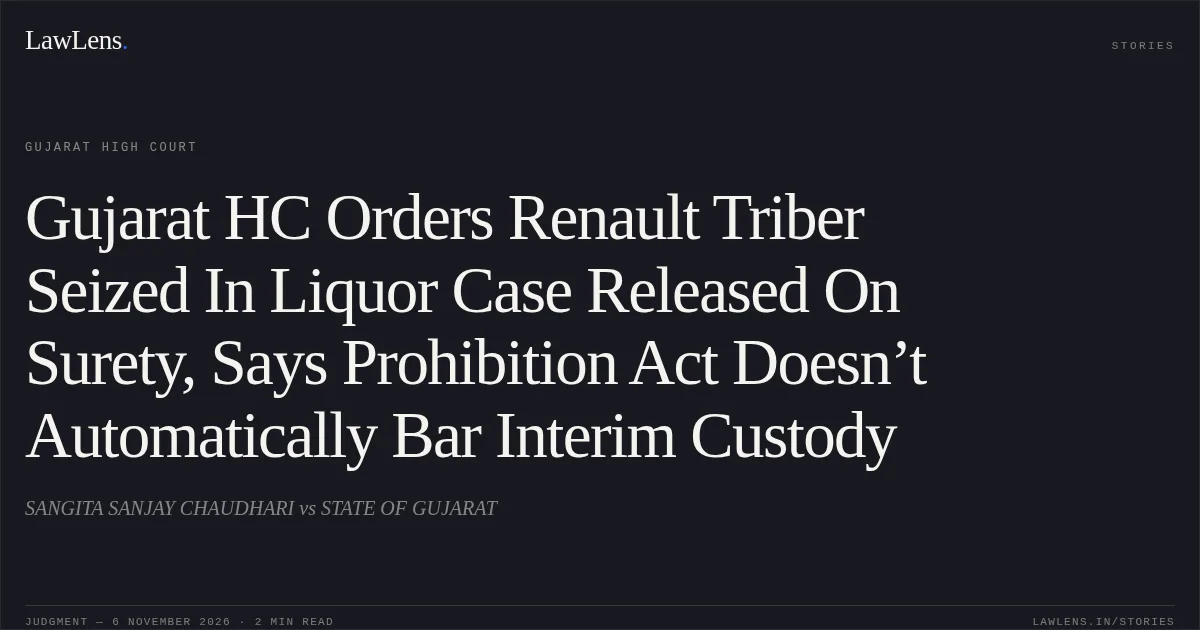
The petitioner, the registered owner of a Renault Duster bearing registration No. GJ-01-RC-7210, sought interim release of the vehicle, which had been seized in connection with a prohibition offence after its driver was allegedly found carrying liquor without a pass or permit
p. 1, 3The Magistrate rejected the release application on 2 April 2026, and the Sessions Court dismissed the petitioner’s revision on 4 June 2026
p. 2The petitioner then sought relief under Articles 21 and 226 of the Constitution and Section 497 of the Bharatiya Nagarik Suraksha Sanhita, 2023
p. 102Issues
i.1. Whether the seized vehicle could be released to its registered owner on interim custody despite the confiscation provisions of the Gujarat Prohibition Act
pp. 2–4ii.2. Whether release was appropriate where continued retention could result in deterioration of the vehicle, subject to conditions securing its production and preservation
pp. 2, 4–503Law Applied
Article 226 of the Constitution empowers the High Court to direct release of a seized vehicle where appropriate; the Court also referred to its powers under Section 497 of the BNSS, corresponding to Section 451 of the Code of Criminal Procedure, to make orders for proper custody of property pending trial
p. 1, 4In Sunderbhai Ambalal Desai v. State of Gujarat, the Supreme Court observed that seized vehicles should not be left to deteriorate at police stations and may be handed over on suitable bonds, guarantees and security
pp. 2–4 · AIR 2003 SC 638The Court also relied on M/s ABC Express v. State of Gujarat, which held that Section 98(2) of the Gujarat Prohibition Act does not absolutely bar interim release of a seized vehicle and that the court may order its proper custody pending trial
p. 4 · 2026 LiveLaw (SC) 885It further referred to the coordinate Bench decision in Musa Khan Jat v. State of Gujarat
p. 3Provisions in the judgment · 3 · Linked ones open on LawLens
Bharatiya Nagarik Suraksha Sanhita, 2023 Section 497
Code of Criminal Procedure, 1973 Section 451
Gujarat Prohibition Act, 1949. Section 98
04Reasoning
The petitioner was the vehicle’s registered owner, and the vehicle had been seized in the pending prohibition case
p. 3Applying the principles in Sunderbhai and M/s ABC Express, the Court concluded that the possibility of confiscation under the Prohibition Act did not, by itself, prevent interim release; retaining the vehicle risked its deterioration
pp. 3–4The Court therefore ordered release on conditions designed to secure the vehicle’s value, prevent its transfer, and ensure its production when required
p. 505Holding
The petition was allowed, and the vehicle was ordered to be released to the petitioner upon furnishing a solvent surety equal to the vehicle’s price stated in the FIR, undertaking not to transfer it until the trial concludes, and agreeing to produce it when directed; the order further provided for confiscation in the event of a subsequent offence
p. 5Before release, police were directed to photograph the vehicle and prepare a panchanama, with both included in the charge-sheet papers; the order was also to be sent to the RTO for recording the restraint on transfer
p. 5Rule was made absolute
p. 5Original Court PDF
RAJPUT HARSH UDESINGvsSTATE OF GUJARAT
Click to open original judgment
Original judgment, available to read, download and summarize on LawLens.in