Facts
The petitioner challenged the show-cause notice dated 30 October 2025, the GST registration-cancellation order dated 15 December 2025, the order rejecting the revocation application dated 10 March 2026 and issued on 23 March 2026, and the appellate order dated 25 May 2026 along with GST APL-04 dated 26 May 2026.
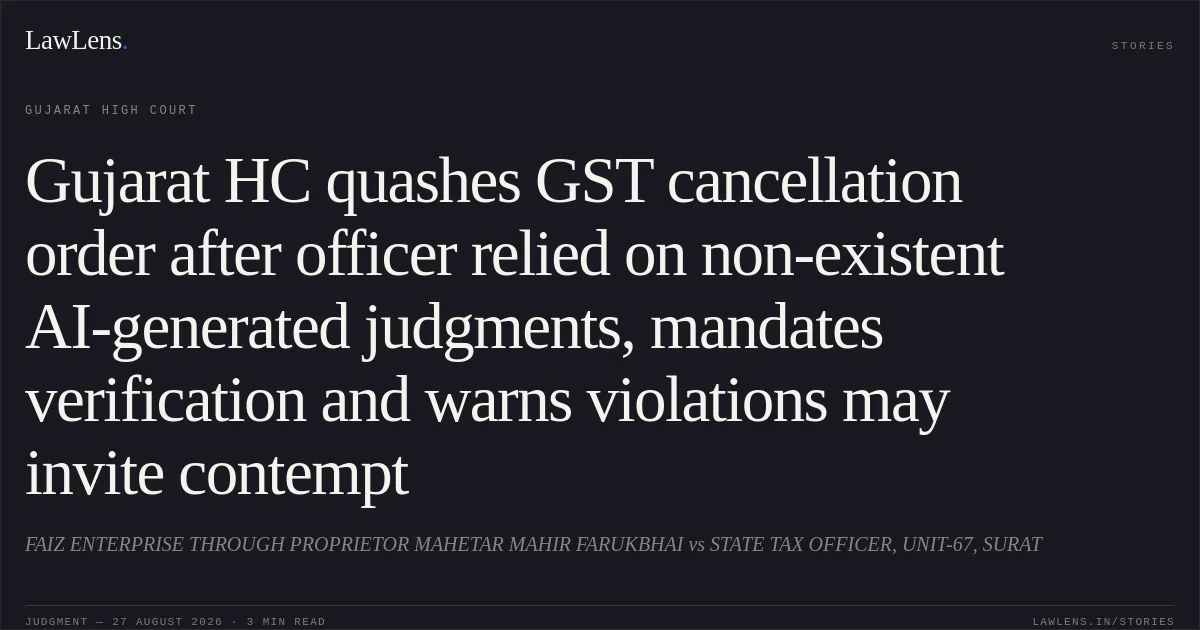
Source reference: para. 9, p. 7In an earlier order dated 13 August 2026, the Court noted that the State Tax Officer appeared to have relied exclusively on AI-generated case law, including non-existent or irrelevant judgments.
Source reference: para. 1, pp. 1–2The State Tax Officer filed an affidavit tendering an unconditional apology and attributed the error to his lack of experience as a probationary officer.
Source reference: para. 3, p. 3The State Tax Department subsequently issued administrative instructions regulating the use of AI in adjudication and quasi-judicial proceedings, including mandatory verification of AI-generated legal material and independent application of mind.
Source reference: para. 4, pp. 4–6The respondents also stated that they intended to revise the impugned orders under Section 108 of the Goods and Services Tax Act, 2017, or, if necessary, issue a fresh show-cause notice.
Source reference: para. 7, p. 6Issues
Whether an adjudication order relying on non-existent or irrelevant AI-generated judgments, without independent verification or proper application of mind, could be sustained.
Source reference: paras. 1–3, pp. 1–3Whether the impugned show-cause notice, cancellation order, revocation-rejection order, and appellate order should be quashed and the matter remitted for fresh adjudication.
Source reference: paras. 7–9, pp. 6–7Whether directions should be issued to regulate the use of AI by adjudicating and quasi-judicial authorities.
Source reference: paras. 4–6, pp. 4–6Law Applied
The Court applied the principle that an adjudicating authority must independently verify the authenticity, citation, legal status, and relevance of every judgment, statutory provision, rule, circular, or notification identified through AI before relying upon it.
Source reference: para. 4, p. 5AI may assist legal research and drafting but cannot substitute the authority’s independent legal reasoning, human oversight, or application of mind; the ultimate responsibility for the correctness of the order remains with the issuing authority.
Source reference: para. 4, p. 5The Court further relied on Section 108 of the Goods and Services Tax Act, 2017, under which the Department proposed to revise the impugned orders.
Source reference: para. 7, p. 6It also directed strict compliance with the Department’s AI-use instructions and held that their violation would amount to contempt of court.
Source reference: para. 6, p. 6Reasoning
The Court found that the impugned order had relied on AI-generated authorities that were either non-existent or did not apply to the issue under consideration.
Source reference: para. 1, pp. 1–2Such reliance demonstrated a failure of verification and independent application of mind, rendering the adjudicatory process legally unsustainable.
Source reference: no citationThe State Tax Officer’s unconditional apology and the Department’s issuance of corrective instructions addressed the institutional issue, but did not validate the defective orders.
Source reference: paras. 3–5, pp. 3–6Since the respondents themselves accepted that the orders required revision or fresh adjudication, the Court considered it appropriate to set aside the entire sequence of impugned proceedings and require the Department to commence the matter afresh.
Source reference: no citationThe Court also protected the petitioner’s procedural rights by directing that its reply and defence be duly considered and that a reasoned order be passed in accordance with law.
Source reference: paras. 7–9, pp. 6–7Holding
The Court quashed and set aside the show-cause notice dated 30 October 2025, the cancellation order dated 15 December 2025, the order rejecting revocation dated 10 March 2026/issued on 23 March 2026, the appellate order dated 25 May 2026, and GST APL-04 dated 26 May 2026.
The respondent authority was directed to issue a fresh notice and pass a reasoned order after duly considering the petitioner’s reply and defence.
Source reference: para. 9, p. 7The petitioner was directed to cooperate with the proceedings, while all parties’ rights and contentions were left open.
Source reference: para. 9, p. 7The Court further directed strict compliance with the Department’s AI-use instructions, warning that any violation would amount to contempt of court.
Source reference: para. 6, p. 6The petition was accordingly disposed of.
Source reference: para. 10, p. 7Acts & Sections Cited
1 provisions across 1 statute referred to in this judgment. Linked provisions open on LawLens.
Goods and Services Tax Act, 20171
Original Court PDF
FAIZ ENTERPRISE THROUGH PROPRIETOR MAHETAR MAHIR FARUKBHAIvsSTATE TAX OFFICER, UNIT-67, SURAT
Click to open original judgment
Original judgment, available to read, download and summarize on LawLens.in
![Courts will not interfere with transfers absent mala fides or violation of statutory rules.. M Ramya vs EMPLOYEES STATE INSURANCE CORPORATION (ESIC). CAT - ['Chennai']. LawLens](/stories/thumbnails/courts-will-not-interfere-with-transfers-absent-mala-fides-or-violation-of-statutory-rules-a6845e9ca6f548fca284c51c8351957f.webp)
![Courts cannot direct one-time recruitment age relaxation absent authority in the governing rules or advertisement.. UT OF PUDUCHERRY vs M ANDAL. CAT - ['Chennai']. LawLens](/stories/thumbnails/courts-cannot-direct-one-time-recruitment-age-relaxation-absent-authority-in-the-governing-895d78fde47143e2a8ed0207c4b6a44f.webp)
![A review cannot correct an allegedly erroneous decision absent an error apparent on the record.. Ajit Kumar Jha vs RAILWAY BOARD. CAT - ['Delhi']. LawLens](/stories/thumbnails/a-review-cannot-correct-an-allegedly-erroneous-decision-absent-an-error-apparent-on-the-re-8ac952fd4eba470c92f7da20af72a220.webp)