Facts
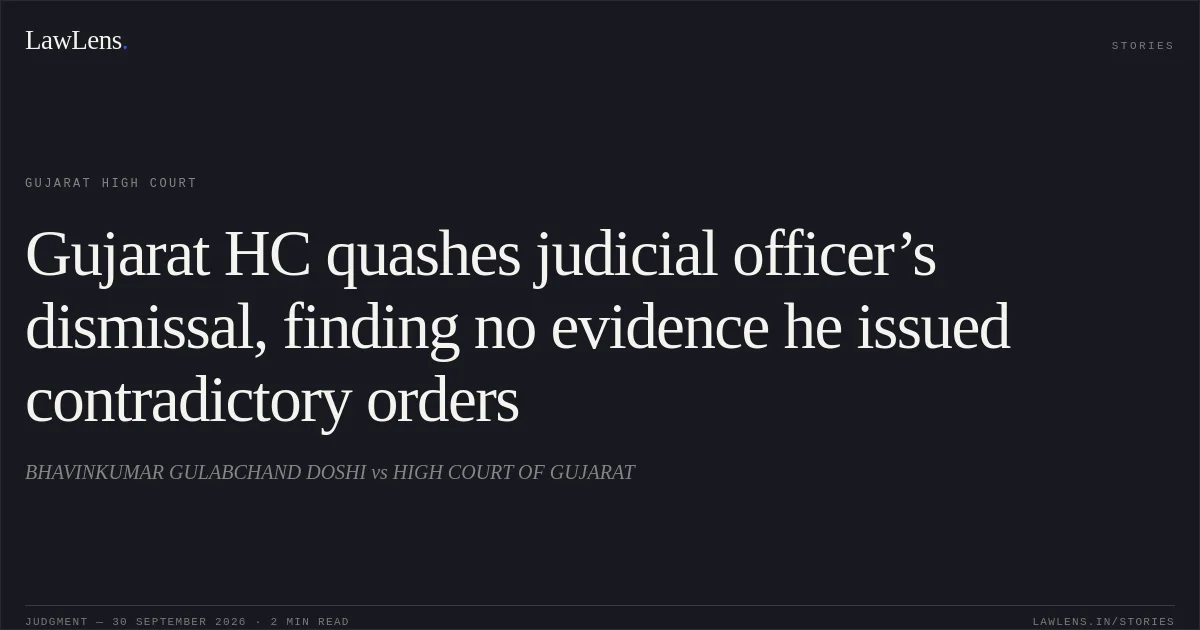
The petitioner, a judicial officer, was dismissed from service following a departmental inquiry into allegations that he pronounced an order partly allowing an appeal on 21 December 2012, then issued a contradictory order dismissing it on 7 January 2013, and improperly maintained the case record.
Source reference: para. 2, 20–21The Inquiry Officer found the charges unproved. A two-Judge Committee disagreed, and the Standing Committee and Full Court accepted its recommendation for dismissal; the State Government accordingly dismissed the petitioner.
Source reference: para. 2(xxiv)–(xxxi)The petitioner challenged the dismissal under Article 226.
Source reference: para. 17–19During the proceedings, he undertook to waive salary and allowances from dismissal until superannuation, seeking retirement benefits instead.
Source reference: para. 17–19Issues
Whether the disciplinary finding that the petitioner had pronounced two contradictory orders was supported by evidence and could be sustained despite the Inquiry Officer’s exonerating findings.
Source reference: para. 19–25Whether the dismissal order, based on the disciplinary authority’s disagreement with the Inquiry Officer, warranted interference under Article 226.
Source reference: para. 20–23, 42–43Law Applied
Under B.C. Chaturvedi v. Union of India, (1995) 6 SCC 749, and Union of India v. P. Gunasekaran, (2015) 2 SCC 610, judicial review under Articles 226 and 227 ordinarily does not permit reappreciation of evidence or reassessment of its adequacy or reliability; however, interference is warranted where a finding is arbitrary or perverse, rests on irrelevant considerations, or is unsupported by evidence.
Source reference: para. 20–22The charge also invoked Rule 3(1) of the Gujarat Civil Services (Conduct) Rules, 1971, concerning conduct unbecoming of a government servant.
Source reference: para. 2(xx)Reasoning
The Court held that the central allegation—that an order had been pronounced on 21 December 2012—lacked evidentiary support: the alleged order was not produced or found in the record, while the stenographer and senior clerk testified that no order was pronounced that day and that the matter was later listed for 7 January 2013.
Source reference: para. 25–28The copy applications filed on 21 December did not, by themselves, prove pronouncement; the Rojkam contained no “seen” endorsement, and evidence concerning the complainant’s account and the alleged stay application undermined that account.
Source reference: para. 29–36The premature uploading of the later judgment and handwritten board entries did not establish the petitioner’s misconduct, particularly given the evidence about clerical handling and the continuity of the Rojkam.
Source reference: para. 37–41In the Court’s view, the Committee’s disagreement rested on an insufficient inference from the copy applications and could not displace the Inquiry Officer’s finding that the charge was unproved.
Source reference: para. 42–43Holding
The Court allowed the petition and quashed the dismissal order.
In accordance with the petitioner’s undertaking, he was denied salary arrears from dismissal until superannuation but was granted retirement benefits, including pension and gratuity, with consequential revisions in pay and pension; pension was payable from 31 July 2025.
Source reference: para. 44–45The order was directed to be complied with within eight weeks, and the request for stay was rejected.
Source reference: p. 29Acts & Sections Cited
1 provisions across 1 statute referred to in this judgment. Each provision opens on LawLens.
Code of Civil Procedure, 19081
Original Court PDF
BHAVINKUMAR GULABCHAND DOSHIvsHIGH COURT OF GUJARAT
Click to open original judgment
Original judgment, available to read, download and summarize on LawLens.in