Facts
The petitioner’s return for A.Y. 2011–12 was scrutinised under Section 143(3) of the Income Tax Act, 1961, and an assessment order was passed on 12 March 2014 assessing total income at Rs. 24,73,826.
Source reference: p. 1; pp. 4–5On 27 March 2018, the Assessing Officer issued a notice under Section 148 alleging, first, an incorrect claim of set-off of business loss and unabsorbed depreciation of Rs. 32,01,046 and, second, a late deposit of TDS on commission, allegedly requiring disallowance under Section 40(a)(ia).
Source reference: p. 1The petitioner challenged the notice and a subsequent order dated 15 June 2018, contending that the relevant matters had been disclosed and examined during the original scrutiny assessment.
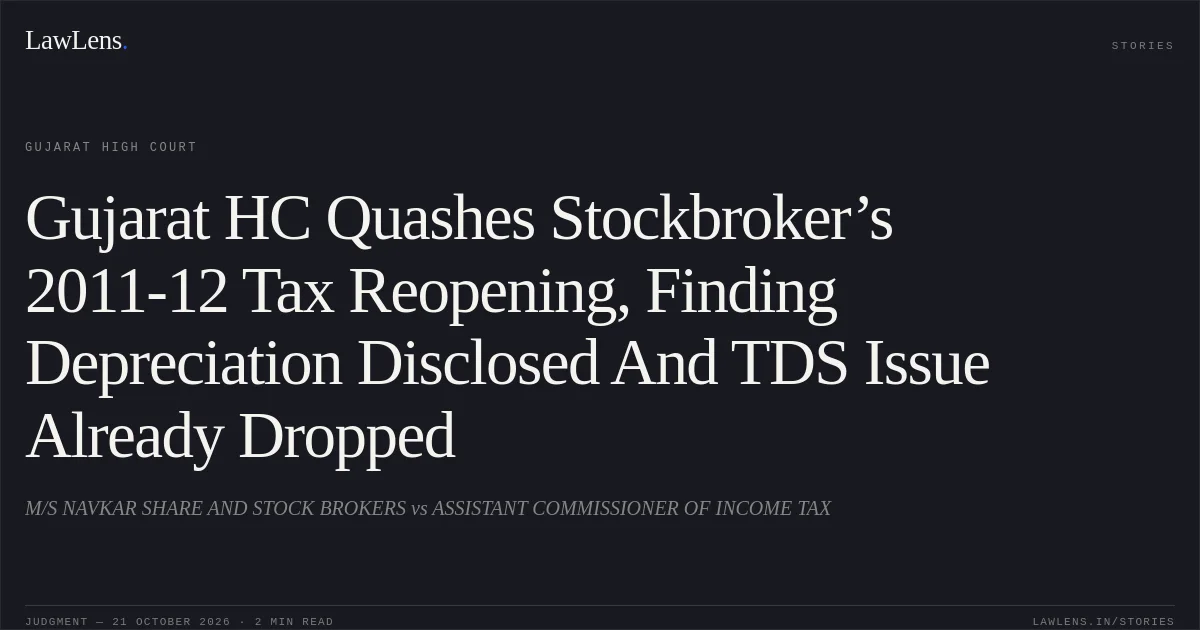
Source reference: pp. 2–3The Court found that the petitioner had disclosed the depreciation-related information in the scrutiny proceedings and that the Assessing Officer had dropped the TDS-related proceedings after the petitioner’s objection.
Source reference: pp. 4–5Issues
Whether the Assessing Officer could reopen the completed scrutiny assessment on the unabsorbed-depreciation issue when the relevant facts had been disclosed during the original assessment?
Source reference: pp. 2, 4–5Whether reopening was permissible on the TDS issue after the Assessing Officer had dropped proceedings on that issue, and in the absence of an omission or failure by the petitioner to disclose material facts?
Source reference: pp. 4–5Law Applied
Sections 147 and 148 of the Income Tax Act govern reassessment and the notice initiating it; Section 147 does not permit reassessment merely to review an issue already examined where the assessee fully and truly disclosed the material facts.
Source reference: p. 5The Court relied on Parshuram Pottery Works Company Limited v. ITO, 1977 (106) ITR 1, for the principle that, where reopening is sought after four years from the end of the assessment year, it is not permissible absent an omission or failure by the assessee to disclose fully and truly all material facts necessary for assessment; the decision also recognises the need for finality in legal proceedings and that stale issues should not be revived.
Source reference: p. 5Reasoning
The Court examined the scrutiny record and found that the petitioner had responded to the Assessing Officer’s inquiries, disclosed the relevant information concerning earlier years’ depreciation, and specifically clarified that depreciation was not claimed for the year under consideration.
Source reference: pp. 4–5The reassessment notice therefore sought to revisit matters disclosed in the original proceedings, rather than address a material fact omitted by the petitioner.
Source reference: pp. 4–5As to TDS, the Assessing Officer had already dropped proceedings after considering the petitioner’s objection, and the Court considered it impermissible to revive that issue through the impugned notice.
Source reference: p. 5Applying the rule in Parshuram Pottery Works, the Court concluded that the necessary failure to disclose material facts was absent.
Source reference: p. 5Holding
The Court held that the reassessment notice was an impermissible attempt to review the original assessment, as the petitioner had disclosed the relevant facts and the TDS issue had already been dropped.
It allowed the writ petition and quashed and set aside the notice dated 27 March 2018 and the order dated 15 June 2018.
Source reference: p. 6Acts & Sections Cited
6 provisions across 1 statute referred to in this judgment. Linked provisions open on LawLens.
Income Tax Act, 19616
Original Court PDF
M/S NAVKAR SHARE AND STOCK BROKERSvsASSISTANT COMMISSIONER OF INCOME TAX
Click to open original judgment
Original judgment, available to read, download and summarize on LawLens.in