Facts
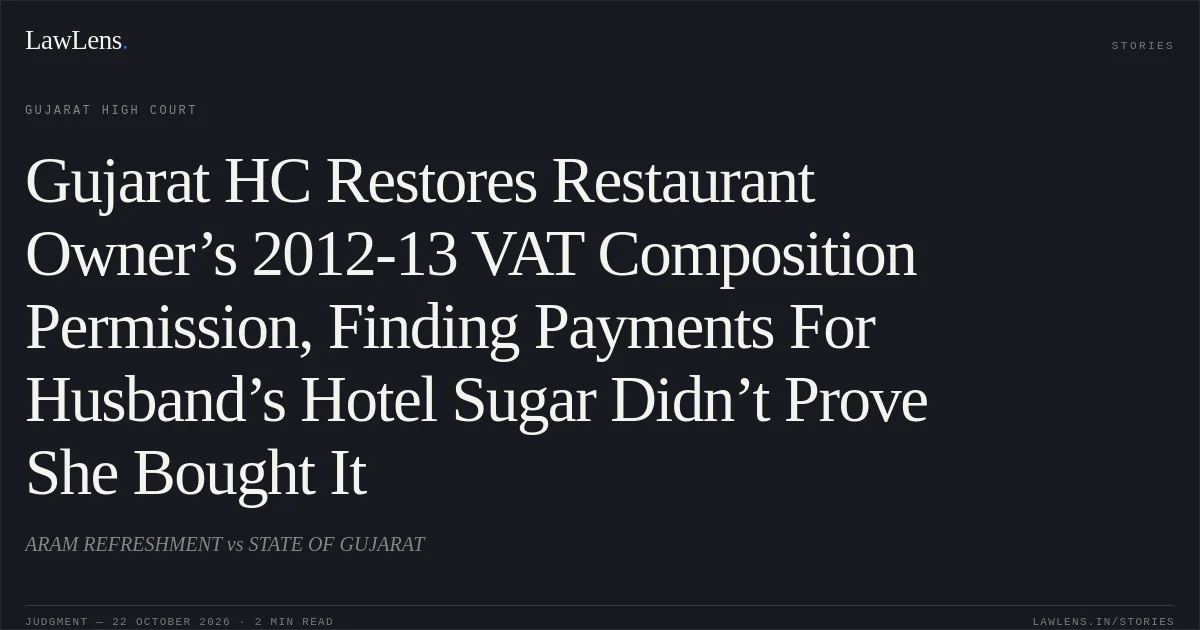
The appellant, a restaurant proprietor permitted to pay lump-sum tax under Section 14D of the Gujarat Value Added Tax Act, 2003, made payments totalling ₹22,000 for sugar sachets under four invoices.
Source reference: p. 3–5, 26–29One invoice was in the appellant’s name; the other three were in the name of Hotel Aram, a lodging business operated by her husband.
Source reference: p. 3–5, 26–29The appellant’s books recorded cash received from Hotel Aram and payments made to the supplier on Hotel Aram’s behalf, but did not record the sugar as the appellant’s purchases.
Source reference: p. 3–5, 26–29The tax authorities cancelled the appellant’s composition permission for alleged purchases from outside Gujarat. The Tribunal upheld cancellation but limited it to 4 June 2012–31 March 2013.
Source reference: p. 8–10The appellant appealed under Section 78 of the VAT Act.
Source reference: p. 2Issues
1. Whether the Tribunal was justified in confirming cancellation of the appellant’s composition permission for 2012–13.
Source reference: p. 2, 31–322. Whether purchasing tax-free goods from outside Gujarat warrants cancellation of composition permission under Section 14D of the VAT Act.
Source reference: p. 2Law Applied
Section 14D of the VAT Act permits qualifying dealers selling eatables to opt for composition tax, subject to prescribed conditions; Section 14D(2) applies Section 14(3) mutatis mutandis.
Source reference: p. 19–21Rule 28C(6) prohibits a dealer with composition permission from purchasing eatables or their raw materials in inter-State trade or commerce, or receiving them from an out-of-State branch or consigning agent, subject to the stated exception.
Source reference: p. 23–25Under Rule 28C(7), permission may be cancelled for contravention, after a reasonable opportunity to be heard.
Source reference: p. 25The Court held, on the facts, that payment through the appellant’s bank account did not establish that the appellant had made the prohibited purchases where the books recorded the payments as made on behalf of Hotel Aram and no purchase was debited to the appellant’s accounts.
Source reference: p. 30–32Reasoning
The invoices and payments were considered alongside the appellant’s ledger, which recorded corresponding cash receipts from her husband’s business and payments to the supplier on that business’s behalf.
Source reference: p. 26–30The Tribunal had rejected those entries on suspicion that they were created to avoid the composition conditions, but the Court found no evidentiary basis for treating them as sham or bogus.
Source reference: p. 30Because the appellant had not recorded the goods as purchases in her books, and the authorities had identified no other contravening purchases, the evidence did not support the finding that the appellant herself had purchased goods from outside the State in breach of Rule 28C(6).
Source reference: p. 30–32Holding
The Court answered the first issue in favour of the appellant, holding that the Tribunal was not justified in confirming cancellation of the composition permission for 4 June 2012–31 March 2013.
It declined to answer the second issue because it found that the appellant had not made the alleged purchases; whether the goods were tax-free was therefore immaterial.
Source reference: p. 32The appeal was allowed, with no order as to costs.
Source reference: p. 32Acts & Sections Cited
4 provisions across 1 statute referred to in this judgment. Each provision opens on LawLens.
Gujarat Value Added Tax Act, 2003.4
Original Court PDF
ARAM REFRESHMENTvsSTATE OF GUJARAT
Click to open original judgment
Original judgment, available to read, download and summarize on LawLens.in