Facts
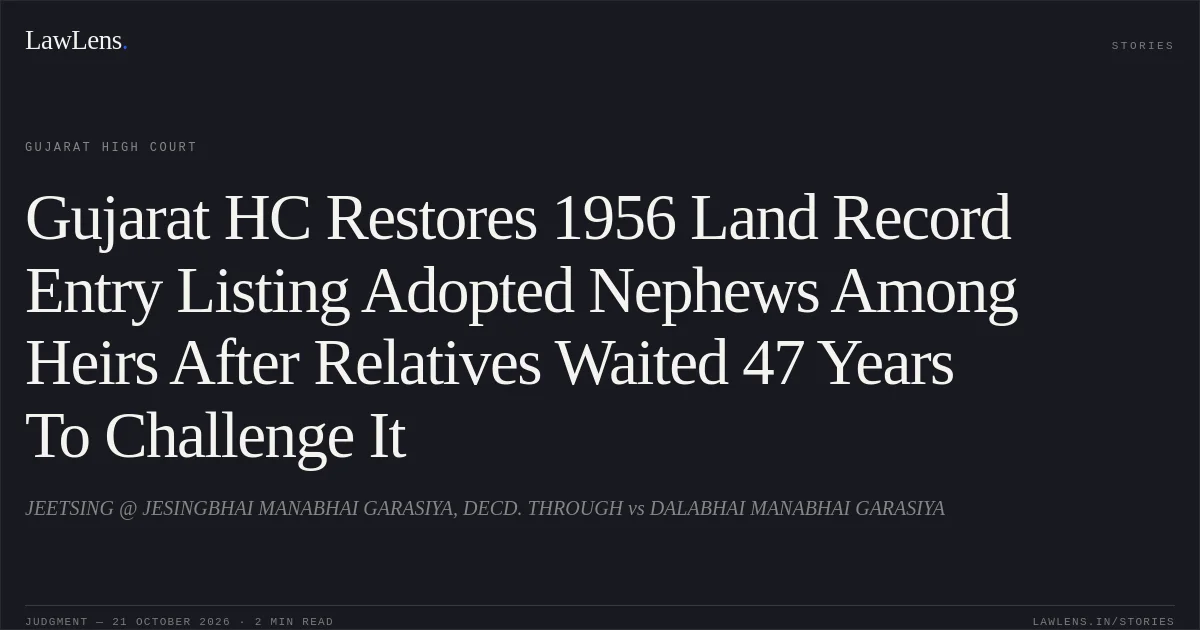
The petitioners and private respondents are descendants of Lalabhai. Following the death of Manabhai in 1956, Entry No. 203 dated 12 October 1956 was made in the revenue record for Survey Nos. 206, 209 and 210, recording the petitioners and other heirs of Manabhai.
Source reference: pp. 3–4, 8In 2003, the respondents challenged the entry; the Deputy Collector allowed their appeal on 24 June 2004 and cancelled it. The petitioners’ subsequent revenue challenges were rejected by the Collector and the Additional Secretary, Revenue Department (Appeals).
Source reference: pp. 3–4, 8Separately, the petitioners obtained a decree for partition, declaration and possession in Special Civil Suit No. 209 of 2004 on 15 May 2015. The respondents’ application to condone delay in appealing that decree was rejected on 20 July 2022, and they did not challenge that rejection.
Source reference: pp. 5–6, 9Issues
Whether the respondents’ challenge to Entry No. 203, brought approximately 47 years after its mutation, could be sustained despite the unexplained delay.
Source reference: pp. 8–9Whether the impugned revenue orders should stand in light of the civil court decree determining the parties’ rights in the lands.
Source reference: pp. 5–6, 9–10Law Applied
A challenge to a mutation entry must be brought within a reasonable time; what is reasonable depends on the circumstances, and delay must be satisfactorily explained.
Source reference: p. 8Mutation entries are maintained for fiscal purposes and do not themselves determine title; questions of right, title and interest are for the competent civil court to decide.
Source reference: p. 10The Court also exercised its jurisdiction under Article 226 of the Constitution to review the impugned revenue orders.
Source reference: p. 2Reasoning
The Court considered the 47-year interval between Entry No. 203 and the respondents’ challenge excessive. Their assertion that they obtained the relevant entries only in 2003 did not satisfactorily explain the delay, particularly given the parties’ family relationship and the entry’s recording of other heirs as well as the petitioners.
Source reference: pp. 8–9The Court further noted that the civil decree had determined the parties’ rights in the lands and that the respondents’ attempted appeal had not proceeded after their delay-condonation application was rejected. Since the revenue entry was fiscal in nature, the revenue authorities’ decision to cancel it could not displace the civil court’s determination of rights.
Source reference: pp. 9–10Holding
The Court allowed the petition, made the Rule absolute, and quashed the Additional Secretary’s order dated 29 December 2011 and the Collector’s order dated 27 January 2005.
It restored Entry No. 203 and made no order as to costs.
Source reference: p. 11Acts & Sections Cited
1 provisions across 1 statute referred to in this judgment. Linked provisions open on LawLens.
Bombay Land Revenue Code, 18791
Original Court PDF
JEETSING @ JESINGBHAI MANABHAI GARASIYA, DECD. THROUGHvsDALABHAI MANABHAI GARASIYA
Click to open original judgment
Original judgment, available to read, download and summarize on LawLens.in