Facts
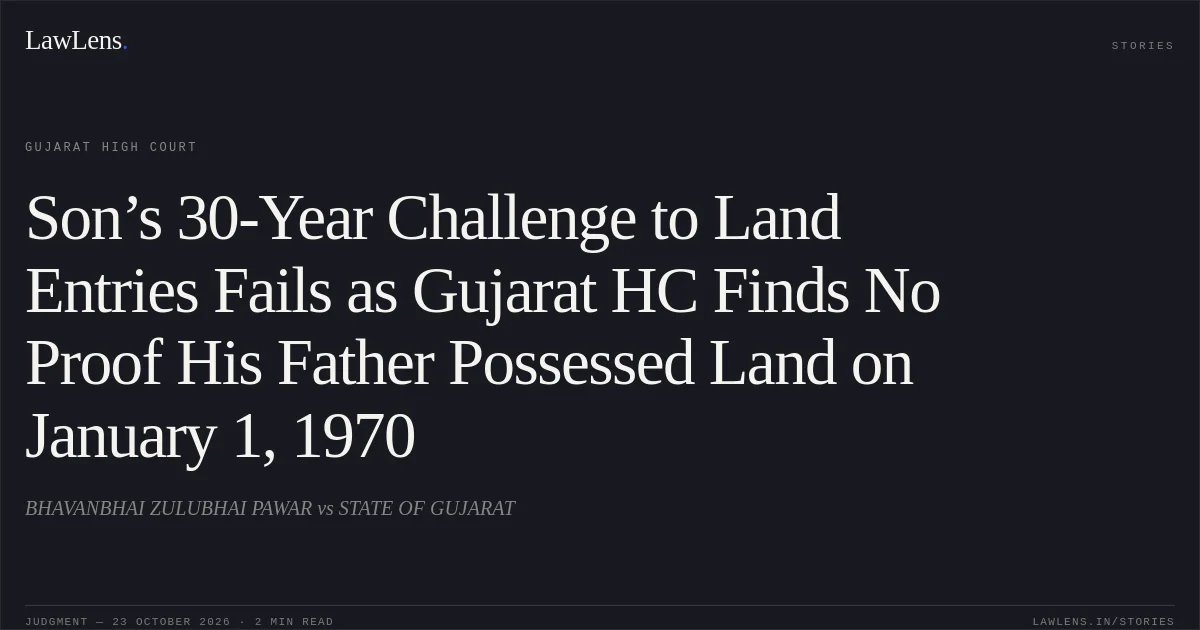
The petitioner challenged revenue entries made in 1971 recording Respondent Nos. 3 to 6 as occupants of Survey Nos. 38/1 and 38/2, Village Chikhoi, Taluka Ahwa, District Dang.
Source reference: paras. 3–5, 7–9; pp. 3–8The entries followed Government resolutions concerning grants of land to tribals in possession as of 1 January 1970.
Source reference: paras. 3–5, 7–9; pp. 3–8The petitioner asserted that his father had been in possession and that no notice under Section 135D of the Bombay Land Revenue Code had been issued to him.
Source reference: paras. 3–5, 7–9; pp. 3–8The petitioner disputed the entries in 2001, approximately 30 years after they were made.
Source reference: paras. 3–5, 7–9; pp. 3–8The Collector and the Special Secretary (Appeals) rejected his challenge; he then petitioned the High Court under Article 226.
Source reference: paras. 3–5, 7–9; pp. 3–8Issues
Whether the revenue entries were liable to be set aside because the petitioner’s father allegedly received no notice under Section 135D of the Bombay Land Revenue Code
Source reference: paras. 4–5; pp. 4–5Whether the petitioner was entitled to relief despite challenging the entries after approximately 30 years and failing to establish his father’s possession as of 1 January 1970
Source reference: paras. 8–10; pp. 7–8Law Applied
Section 135D of the Bombay Land Revenue Code was invoked in the petitioner’s contention that notice should have been given before mutation, while Section 211 was the provision under which he initially sought revenue review.
Source reference: paras. 3–5; pp. 3–5The Court applied the principle that a person challenging a mutation entry must approach the revenue authorities within a reasonable period and satisfactorily explain any delay; an unexplained, inordinate delay may defeat the challenge.
Source reference: para. 9; p. 8The Court also considered the Government resolutions dated 1 March 1970 and 31 May 1971, which provided for grants to tribals in possession of land as of 1 January 1970.
Source reference: para. 7; p. 6No judicial precedent was cited.
Source reference: no citationReasoning
The Court noted that the revenue records showed Respondent Nos. 3 to 6 as occupants, while the petitioner’s father’s name appeared only in the “other rights” column.
Source reference: para. 8; p. 7The petitioner produced no evidence establishing that his father possessed the lands on 1 January 1970.
Source reference: para. 10; p. 8Further, the petitioner’s father had not challenged the entries during his lifetime, and the petitioner raised his dispute only after about three decades without a satisfactory explanation for the delay.
Source reference: paras. 8–9; pp. 7–8Although the petitioner alleged that notice under Section 135D had not been given, the Court dismissed the challenge on the grounds of delay and failure to prove possession.
Source reference: no citationHolding
The Court held that the petitioner had not established his father’s possession of the lands as of 1 January 1970 and that the challenge, brought after approximately 30 years, lacked merit.
It dismissed the petition, discharged the Rule, and vacated any interim relief.
Source reference: para. 10; p. 8Acts & Sections Cited
2 provisions across 1 statute referred to in this judgment. Linked provisions open on LawLens.
Bombay Land Revenue Code, 18792
Original Court PDF
BHAVANBHAI ZULUBHAI PAWARvsSTATE OF GUJARAT
Click to open original judgment
Original judgment, available to read, download and summarize on LawLens.in