01Facts
The petitioners, as plaintiffs, sought probate of their mother’s registered will under Section 272 of the Indian Succession Act, 1925.
¶ 3–7After the proceedings were contested, they were converted into Special Civil Suit No. 6 of 2022.
¶ 3–7Following the framing of issues, the Trial Court dismissed the suit for non-prosecution under Order IX Rule 3 CPC on 22 November 2023.
¶ 3–7The petitioners’ restoration application, Civil Misc. Application No. 56 of 2023, was rejected on 13 December 2024, principally on the view that no further adjournment could be granted after three adjournments under Order XVII Rule 1 CPC.
¶ 3–7The petitioners challenged that rejection under Article 227 of the Constitution
¶ 3–702Issues
i.1. Whether the Trial Court erred in rejecting the petitioners’ application to restore the suit dismissed for non-prosecution, without considering the merits of the application.
¶ 7–9ii.2. Whether the High Court should exercise its supervisory jurisdiction under Article 227 to set aside that rejection and restore the suit.
¶ 11–1403Law Applied
Order IX Rule 3 CPC permits dismissal where neither party appears when the suit is called; Order IX Rule 4 provides a remedy following such dismissal, including the ability to bring a fresh suit, subject to its terms.
¶ 8Order XVII Rule 1 CPC regulates adjournments and discourages unnecessary delay, but the procedural limits on adjournments do not displace the court’s duty to advance substantial justice.
¶ 10–11In Sugandhi (Dead) v. P. Rajkumar, (2020) 10 SCC 706, the Supreme Court stated that procedural and technical requirements should not obstruct substantial justice where the opposing party suffers no serious prejudice
¶ 8, 10–11Provisions in the judgment · 1 · Linked ones open on LawLens
Indian Succession Act, 1925 Section 272
04Reasoning
The High Court found that the Trial Court rejected restoration on the general ground that it could not grant another adjournment after three adjournments, without considering the merits of the restoration application.
¶ 7The parties were close relatives, and the dispute arose from probate proceedings in which settlement discussions had taken place; the Court therefore did not regard the delay as necessarily unjustified.
¶ 9The respondents identified no serious prejudice from restoring the suit, and dismissal for non-prosecution left open the possibility of fresh proceedings, creating a risk of duplication.
¶ 11In these circumstances, the Court considered restoration with conditions preferable to permanently foreclosing adjudication.
¶ 8, 1205Holding
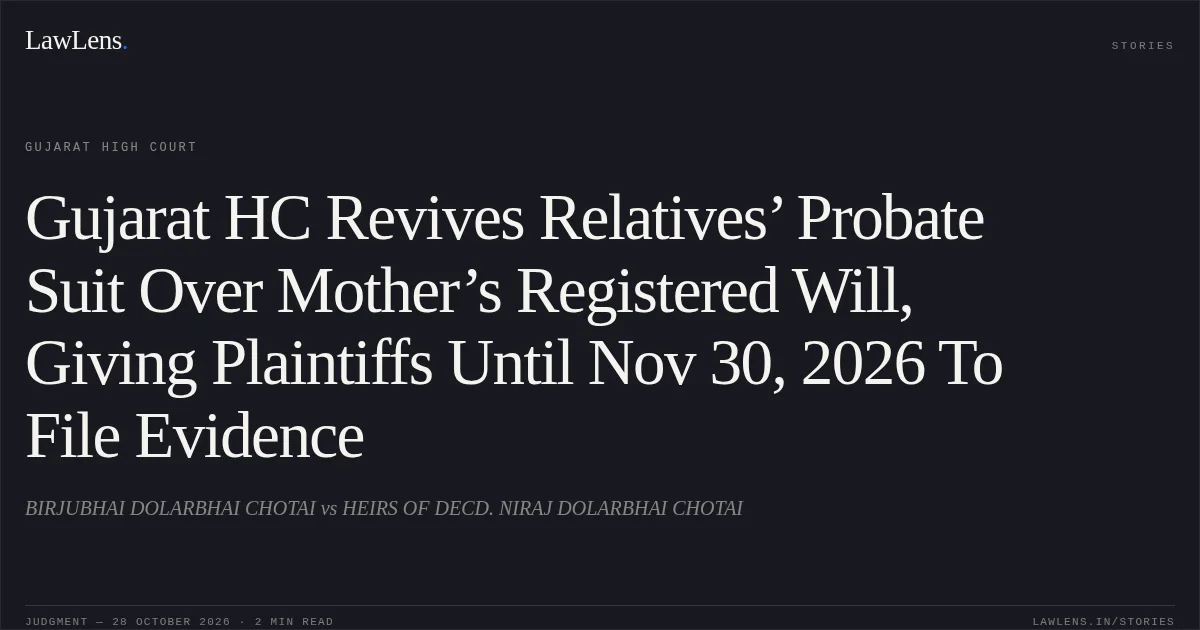
The High Court allowed the petition, quashed the order dated 13 December 2024, allowed the restoration application, and restored Special Civil Suit No. 6 of 2022.
¶ 13Respondents 1.1 and 1.2 were permitted to withdraw the Rs. 10,000 deposited as costs.
¶ 13.1The petitioners were directed to file their affidavits in lieu of examination-in-chief by 30 November 2026 and avoid unnecessary adjournments; the respondents were permitted to cross-examine them and any witnesses.
¶ 13.2–13.3Rule was made absolute to that extent.
¶ 14Original Court PDF
BIRJUBHAI DOLARBHAI CHOTAIvsHEIRS OF DECD. NIRAJ DOLARBHAI CHOTAI
Click to open original judgment
Original judgment, available to read, download and summarize on LawLens.in