01Facts
The petitioners operated licensed vegetarian and non-vegetarian restaurants in Prabhas Patan, Veraval, for approximately 35–40 years.
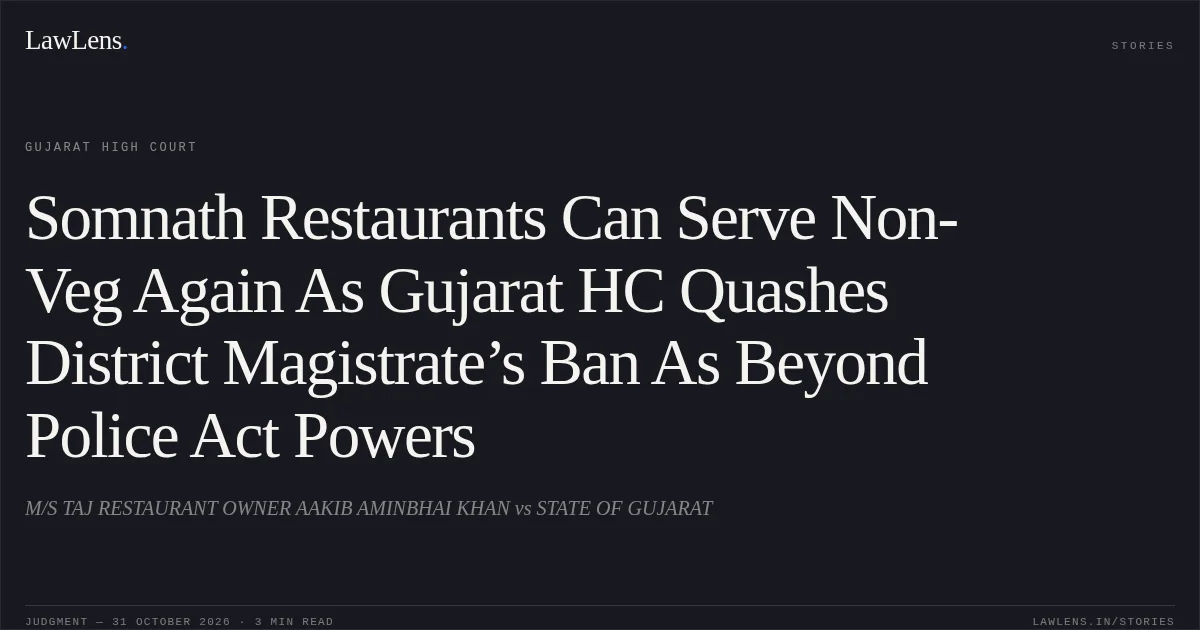
¶ 2–4.5 · pp. 2–7, 23–24The District Magistrate issued a preliminary notification on 10 July 2026 and a final notification on 10 August 2026 under the Gujarat Police Act, 1951, prohibiting the preparation, sale and storage of non-vegetarian food and eggs on specified routes and within the notified area around Somnath Temple.
¶ 2–4.5 · pp. 2–7, 23–24The petitioners challenged the final notification, contending that their establishments were beyond 500 metres from the temple, that the restriction unlawfully burdened their trade, and that the District Magistrate lacked authority to impose it.
¶ 2–4.5 · pp. 2–7, 23–24Some petitioners had also challenged a 2018 municipal resolution in separate pending proceedings.
¶ 2–4.5 · pp. 2–7, 23–24The present petition was heard finally at the admission stage after the parties consented to final hearing.
¶ 2–4.5, 8 · pp. 2–7, 23–2402Issues
i.Whether the District Magistrate had authority under Section 33, read with Section 36 of the Gujarat Police Act, 1951, to prohibit restaurants from serving non-vegetarian food on the specified routes
¶ 7.1 · p. 22ii.Whether the notification’s restriction on the petitioners’ trade was a reasonable and proportionate restriction under Article 19(6), or violated Article 19(1)(g) of the Constitution
¶ 9–10, 14 · pp. 24–26, 31–3203Law Applied
Article 19(1)(g) protects the right to practise a profession or carry on an occupation, trade or business, subject to reasonable restrictions imposed in the interests of the general public under Article 19(6).
¶ 9.1 · pp. 24–25The Court applied the principles in Chintaman Rao v. State of Madhya Pradesh, requiring restrictions to avoid arbitrary or excessive interference and to balance individual freedom with social control.
¶ 9.1 · pp. 24–25It applied the four-stage proportionality test—legitimate aim, suitability, necessity (including the availability of less restrictive alternatives) and balancing—drawn from Modern Dental College & Research Centre v. State of M.P. and reaffirmed in K.S. Puttaswamy v. Union of India.
¶ 14 · pp. 31–32The Court also considered Sections 33 and 36 of the Gujarat Police Act and the statutory definitions of places of public amusement and entertainment, concluding that the Act’s regulatory powers did not authorise a permanent prohibition on a lawful restaurant trade.
¶ 16 · pp. 33–35It referred to Mohd. Hanif Quareshi v. State of Bihar and State of Gujarat v. Mirzapur Moti Kureshi Kassab Jamat in considering religious sentiment, Article 25 and the reasonableness of restrictions.
¶ 12 · pp. 27–29The Court further noted the Food Safety and Standards Regulations concerning the location of meat shops near places of worship.
¶ 15 · pp. 32–33Provisions in the judgment · 7 · Linked ones open on LawLens
Gujarat Police Act, 1951. Section 2Section 33Section 36Section 37
Gujarat Provincial Municipal Corporations Act, 1949 Section 2Section 377Section 381
04Reasoning
The Court accepted that the petitioners were engaged in lawful, licensed trade on routes connecting religious sites, but held that the notification imposed a permanent restriction on serving non-vegetarian food.
¶ 7.3, 9.1 · pp. 23–24The stated basis—religious sentiment, particularly concerns about the open preparation or display of such food—did not establish that a complete prohibition was necessary or that less restrictive measures would be inadequate.
¶ 10–13 · pp. 25–30The Court found the restriction disproportionate and held that religious practice had to be harmonised with other fundamental rights.
¶ 10–13 · pp. 25–30Independently, it concluded that Section 33 empowered regulation in specified fields, not the imposition of a permanent dietary restriction on eating houses; the District Magistrate therefore acted beyond the statute.
¶ 16–17 · pp. 33–3605Holding
The Court held that the notification was beyond the District Magistrate’s statutory authority and violated Article 19(1)(g).
¶ 18 · p. 37It allowed the petition and quashed and set aside the notification dated 10 August 2026.
¶ 18 · p. 37The petitioners were directed to prevent public visibility of carcasses and food displays, maintain hygiene and proper waste disposal, avoid operating in open spaces, and transport carcasses in insulated refrigerated vans.
¶ 19 · pp. 37–38The State’s request to stay the judgment was refused.
¶ 20 · p. 38Original Court PDF
M/S TAJ RESTAURANT OWNER AAKIB AMINBHAI KHANvsSTATE OF GUJARAT
Click to open original judgment
Original judgment, available to read, download and summarize on LawLens.in