Facts
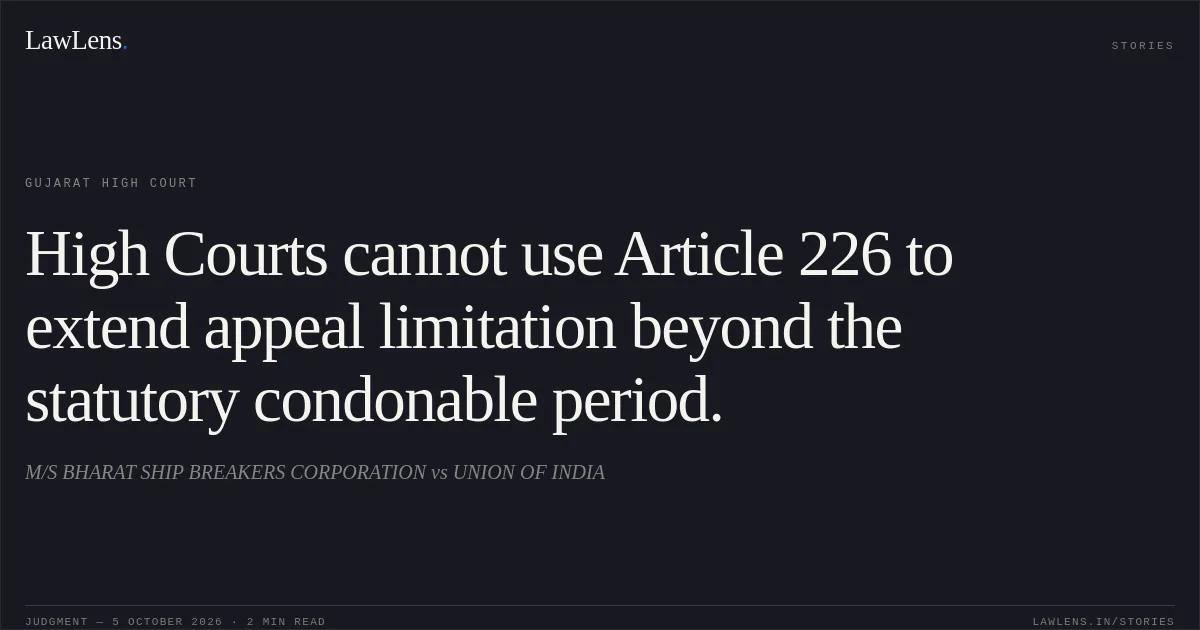
The petitioner challenged an order dated 18 June 2014 imposing a redemption fine of ₹2,00,000 and a penalty of ₹5,000 under the Customs Act, 1962.
Source reference: paras. 1, 3–4, 8; pp. 2–4After receiving the order on 11 July 2014, the petitioner filed an appeal on 21 November 2014.
Source reference: paras. 1, 3–4, 8; pp. 2–4The Commissioner (Appeals) dismissed the appeal as time-barred on 12 February 2016, and CESTAT dismissed the further appeal on 22 January 2019, holding that it could not condone the delay.
Source reference: paras. 1, 3–4, 8; pp. 2–4The petitioner then sought, under Article 226, to quash the original and appellate orders.
Source reference: paras. 1, 3–4, 8; pp. 2–4Issues
Whether the High Court could use its jurisdiction under Article 226 to grant relief where the statutory appeal was filed beyond the permitted period and the appellate authorities had no power to condone the delay further.
Source reference: paras. 7–10; pp. 4–6Whether the Commissioner (Appeals) and CESTAT’s dismissal of the appeal on limitation grounds warranted interference.
Source reference: paras. 6–8; pp. 3–4Law Applied
The Court applied the principle stated in Ravi Plumbing and Construction v. Union of India, 2026 (107) GSTL 28 (Gujarat), that the High Court should not ordinarily use Article 226 to bypass a statutory limitation period after the prescribed maximum period has expired; doing so may defeat the legislative scheme.
Source reference: para. 9; pp. 4–6It also relied on Oil and Natural Gas Corporation Ltd. v. Gujarat Energy Transmission Corporation Ltd., (2017) 5 SCC 42, as discussed in Ravi Plumbing, concerning respect for statutory limitation schemes.
Source reference: paras. 8–9; pp. 4–5The judgment further referred to M/s Singh Enterprise v. Commissioner of Central Excise, Jamshedpur, Appeal (Civil) No. 5949 of 2007, for the principle that an appellate authority’s power to condone delay is confined to the statutory limit.
Source reference: para. 9; p. 5The Court adopted Ravi Plumbing’s statement that, once the additional statutory period for filing an appeal has expired, Article 226 cannot be used to further extend limitation, absent an error in calculating or understanding the limitation period.
Source reference: para. 9; pp. 5–6Reasoning
The Court noted that the petitioner admitted filing its appeal belatedly and that it was filed approximately four months after receipt of the order, beyond the period the Court considered available for filing and condonation.
Source reference: paras. 7–8; p. 4The Commissioner (Appeals) and CESTAT had both rejected the appeal on limitation grounds, and the Court found no basis to interfere with those decisions.
Source reference: paras. 8–10; pp. 4–6Applying Ravi Plumbing, it held that Article 226 could not be used to circumvent the statutory time limit or provide a further extension of limitation.
Source reference: paras. 8–10; pp. 4–6Holding
The Court held that it could not exercise Article 226 jurisdiction to condone the delay in the circumstances of these petitions.
Both petitions were dismissed and the Rule was discharged.
Source reference: para. 10; p. 6Acts & Sections Cited
5 provisions across 3 statutes referred to in this judgment. Each provision opens on LawLens.
Customs Act,19622
Central Goods and Services Tax Act, 20171
Limitation Act, 19632
Original Court PDF
M/S BHARAT SHIP BREAKERS CORPORATIONvsUNION OF INDIA
Click to open original judgment
Original judgment, available to read, download and summarize on LawLens.in