Facts
The respondent’s land was acquired under the Land Acquisition Act, 1894, pursuant to a Section 4 notification dated 6 May 2010 and a Section 6 notification dated 31 March 2011.
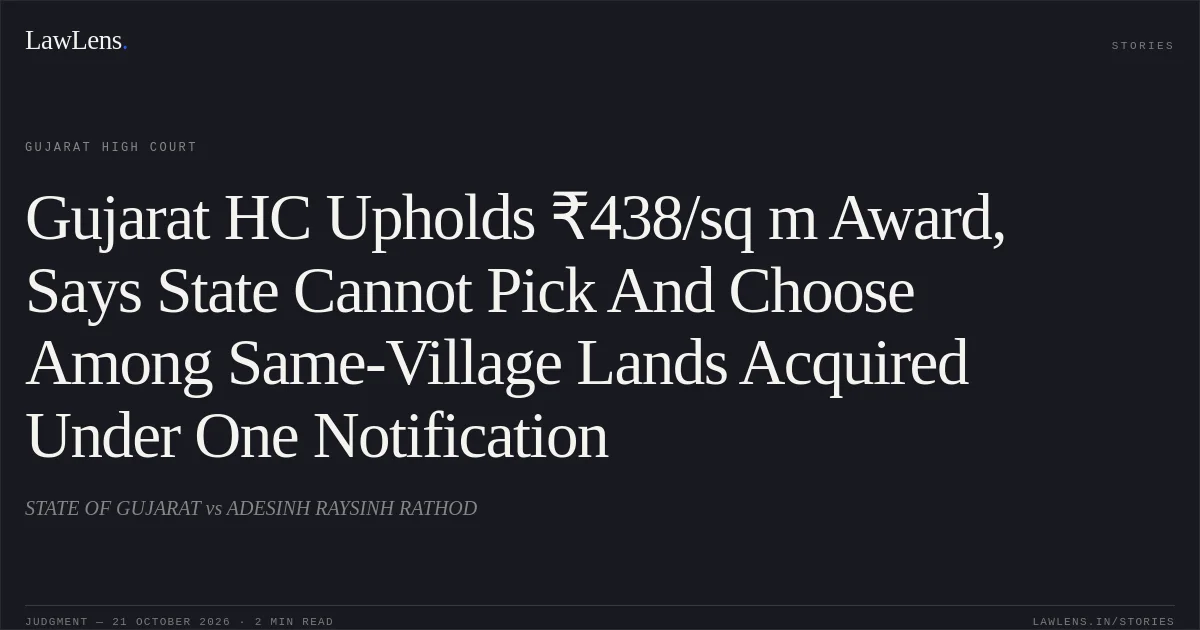
Source reference: para. 2, p. 1The Special Land Acquisition Officer awarded compensation at Rs.18.15 per sq. m.; on the claimant’s Section 18 reference, the Reference Court awarded additional compensation at Rs.438 per sq. m., relying on awards concerning adjoining lands.
Source reference: paras. 1–2, pp. 1–2The State appealed, contending that the comparable lands lacked similar potentiality.
Source reference: paras. 5–8, pp. 2–3The claimant relied on awards accepted by the State in other matters arising from the same notification and the same village; the State responded that those awards were not appealed because the amounts were below Rs.5 lakh.
Source reference: paras. 5–8, pp. 2–3Issues
Whether the State could challenge the compensation award in this case while accepting awards in other matters arising from the same notification and concerning land in the same village, based on the amount involved.
Source reference: paras. 6–10, pp. 2–5Whether the Reference Court’s award of additional compensation at Rs.438 per sq. m. should be interfered with on the State’s challenge to the comparability and potentiality of the lands.
Source reference: paras. 5, 9–10, pp. 2–5Law Applied
The Court considered Sections 4, 6 and 18 of the Land Acquisition Act, 1894, concerning acquisition notifications and reference proceedings.
Source reference: para. 2, p. 1Relying on Ali Mohammad Beigh v. State of Jammu and Kashmir, (2017) 4 SCC 717, and Surinder Ahuja v. State of Punjab, 2026 INSC 1068, including its discussion of Union of India v. Harinder Pal Singh, the Court applied the principle that, in project-wide acquisitions involving nearby, identical or similar lands acquired for the same purpose, landowners should not be treated differently without strong reasons.
Source reference: paras. 6, 9–10, pp. 2–5It held that the State could not adopt a “pick and choose” approach based on the smallness or largeness of the acquired land.
Source reference: paras. 9–10, pp. 2–5Reasoning
The State did not dispute that it had accepted awards in other matters arising from the same notification and relating to land in the same village; its explanation was that those awards involved amounts below Rs.5 lakh.
Source reference: paras. 8–9, pp. 3–4Applying the parity principle, the Court held that the State’s decision not to appeal those awards could not justify challenging this award merely because the claimant’s larger land area resulted in a higher total amount.
Source reference: paras. 9–10, pp. 3–5It therefore rejected the State’s challenge and found no basis to interfere with the Reference Court’s award.
Source reference: paras. 9–10, pp. 3–5Holding
The Court dismissed the State’s appeal as devoid of merit, leaving the Reference Court’s award of additional compensation at Rs.438 per sq. m. undisturbed.
The related civil application for stay was disposed of as not surviving following dismissal of the appeal.
Source reference: para. 11, p. 5Acts & Sections Cited
3 provisions across 1 statute referred to in this judgment. Linked provisions open on LawLens.
Land Acquisition Act, 18943
Original Court PDF
STATE OF GUJARATvsADESINH RAYSINH RATHOD
Click to open original judgment
Original judgment, available to read, download and summarize on LawLens.in