01Facts
The complainant, a married woman with two children, alleged that after meeting accused Parth Panchal on Facebook, he photographed her and, by threatening to circulate the photographs, forced her to have sexual intercourse at hotels in 2019.
¶ 1–3, 5–9 · pp. 1–3She also alleged that accused Kishan Chauhan later sought sexual favours by blackmailing her.
¶ 1–3, 5–9 · pp. 1–3She lodged an FIR on 7 May 2022.
¶ 1–3, 5–9 · pp. 1–3The Sessions Court acquitted both accused of offences under Sections 376(2)(n), 354D, 506(1) and 114 of the IPC, finding the relationship consensual and the allegation against accused no. 2 unproved.
¶ 1–3, 5–9 · pp. 1–3The complainant appealed against the acquittals under Section 413 of the BNSS.
¶ 1–3, 5–9 · pp. 1–302Issues
i.1. Whether the Sessions Court was justified in acquitting the accused, or whether its findings warranted appellate interference
¶ 13 · p. 6ii.2. Whether the complainant’s testimony established that the sexual relationship was non-consensual and that the accused blackmailed or criminally intimidated her
¶ 16–20 · pp. 6, 9–11iii.3. Whether the evidence established the allegation that accused no. 2 demanded sexual favours
¶ 20 · p. 1103Law Applied
Section 413 of the Bharatiya Nagarik Suraksha Sanhita, 2023 (corresponding to Section 372 of the CrPC) provides for a victim’s appeal against acquittal.
¶ 1 · p. 1In an appeal against acquittal, the appellate court should respect the reinforced presumption of innocence; interference is warranted in exceptional cases involving compelling circumstances or a perverse judgment, and not merely because another view is possible.
¶ 15 · p. 6A complainant’s sole testimony may support conviction if reliable and trustworthy, but it must inspire confidence; Rai Sandeep v. State (NCT of Delhi) explains the “sterling witness” standard, including consistency and freedom from material doubt.
¶ 16–17 · pp. 6–8Krishna Kumar Malik v. State of Haryana likewise holds that materially inconsistent or unreliable testimony may require independent corroboration and cannot, by itself, sustain conviction.
¶ 18 · p. 8The Court also referred to Prasant v. State of NCT of Delhi and Samadhan v. State of Maharashtra in addressing the distinction between a failed consensual relationship and sexual violence involving coercion or absence of consent.
¶ 19 · p. 11Provisions in the judgment · 8 · Linked ones open on LawLens
Bharatiya Nagarik Suraksha Sanhita, 2023 Section 413
Code of Criminal Procedure, 1973 Section 372Section 313Section 164Section 161
Indian Penal Code, 1860 Section 376Section 506Section 114
04Reasoning
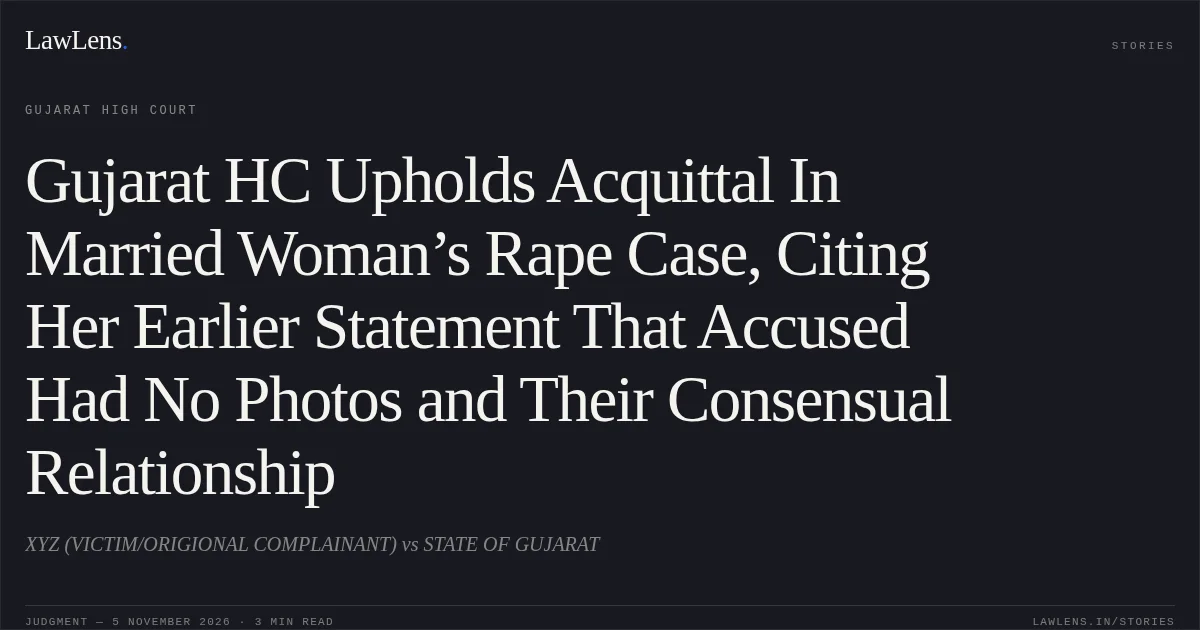
The Court found that the complainant’s account was undermined by her prior statements and conduct. She had earlier stated that she fell in love with accused no. 1 and that he did not possess photographs or videos of her; she also acknowledged that no such material was found on his phone.
¶ 19 · pp. 9–11The Court considered the delay in reporting the alleged 2019 incidents, the absence of evidence of continuing threats or harassment, and call records which it viewed as consistent with a consensual relationship.
¶ 19 · pp. 9–11On this record, it held that her testimony did not meet the standard of a wholly reliable or “sterling” witness and did not prove rape or criminal intimidation beyond reasonable doubt.
¶ 19 · pp. 9–11As to accused no. 2, the Court relied on the dispute between him and the complainant’s husband over parking shortly before the FIR and the absence of incriminating material, and concluded that the allegation of a demand for sexual favours was not established.
¶ 20 · p. 11It found no perversity in the trial court’s assessment warranting appellate interference.
¶ 21 · p. 1105Holding
The High Court held that the trial court was justified in acquitting both accused and that no substantial or compelling ground existed to interfere with the acquittals.
¶ 21 · p. 11Both appeals were dismissed at the admission stage.
¶ 22 · p. 12Original Court PDF
XYZ (VICTIM/ORIGIONAL COMPLAINANT)vsSTATE OF GUJARAT
Click to open original judgment
Original judgment, available to read, download and summarize on LawLens.in