Facts
The petitioner challenged, under Articles 226 and 227 of the Constitution, the order of the Special Secretary, Revenue Department (“SSRD”) dated 8 July 2008/3 July 2008 in Revision Application No. 5 of 2008 and the order of the Prant Officer dated 2 May 2007, concerning alleged breach of the Gujarat Prevention of Fragmentation and Consolidation of Holdings Act, 1947 (“Fragmentation Act”).
Source reference: para. 1The disputed sale deed in favour of the petitioner was executed on 20 May 2006, within the period later specified by the amended Section 9(4) of the Fragmentation Act.
Source reference: para. 4During the pendency of the petition, the State issued Notification dated 14 July 2026 pursuant to Gujarat Ordinance No. 2 of 2026, inserting, inter alia, Section 9(4), which provided for deemed regularisation of specified transfers or partitions and abatement of pending proceedings.
Source reference: paras. 3, 7, 9The respondents relied on prior civil and revenue proceedings and asserted that the sale consideration had been received and possession had been delivered under the registered sale deed.
Source reference: paras. 5, 11Issues
Whether the transfer effected by the sale deed dated 20 May 2006 fell within the retrospective period covered by Section 9(4) of the Fragmentation Act and, consequently, whether the pending proceedings for breach of the Act stood abated.
Source reference: paras. 4, 7–10, 12Whether the matter should be remanded to the competent revenue authority to determine the applicability of the amended provision, or whether the High Court could directly give effect to the statutory abatement.
Source reference: paras. 3, 11–12Whether the impugned revenue orders were liable to be quashed and set aside upon such abatement.
Source reference: para. 13Law Applied
The Court applied Articles 226 and 227 of the Constitution, conferring writ and supervisory jurisdiction over the impugned revenue orders.
Source reference: para. 1It relied on the amended Section 9(4) of the Fragmentation Act, under which a transfer or partition contrary to the Act made on or after 29 January 1948 but on or before 31 March 2026 is deemed to have been regularised without penalty or premium, and all pending proceedings before any officer or authority in respect of such transfer or partition abate.
Source reference: paras. 9–10The Court also referred to amended Section 5(4), empowering the State Government to declare a standard area for any class of land in any local area by notification.
Source reference: para. 9Applying Peter Augustine v. K.V. Xavier, 2025 INSC 771, the Court held that remand is not routine and should not be ordered where it serves no useful purpose or would unnecessarily prolong litigation and create multiplicity of proceedings.
Source reference: para. 12Reasoning
The Court found that the impugned transaction was effected on 20 May 2006, which falls within the statutory period beginning on 29 January 1948 and ending on 31 March 2026.
Source reference: paras. 4, 10, 12Since Section 9(4) deemed transfers within that period to be regularised and expressly mandated abatement of all pending proceedings concerning them, the pending Fragmentation Act proceedings were no longer legally sustainable.
Source reference: paras. 9–10, 12The Court rejected the State’s request for remand because the relevant dates and nature of the transaction were undisputed, and remanding the matter would serve no useful purpose, prolong the dispute, and defeat the statutory objective of bringing pending proceedings to an end.
Source reference: paras. 3, 11–12The Court also observed that the transaction appeared bona fide and that the original landowners had received the consideration; any surviving civil dispute regarding title or other civil rights was left open for adjudication by the competent civil court.
Source reference: paras. 11, 14Holding
The petition was allowed.
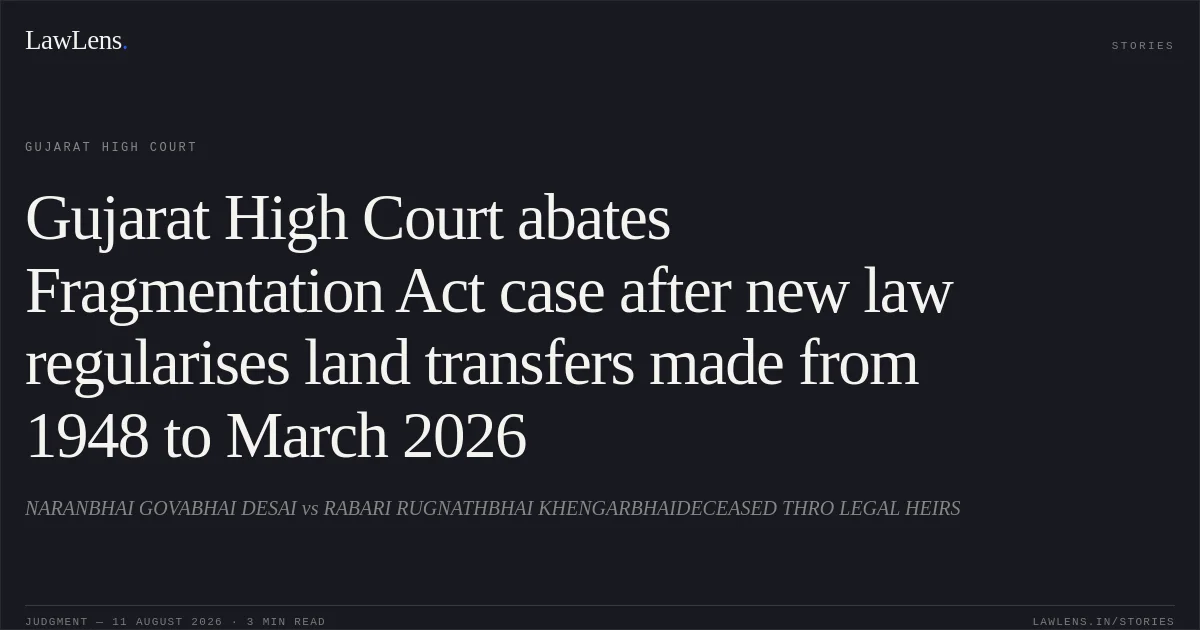
The Court held that, by virtue of Section 9(4) of the Fragmentation Act as introduced through the Notification dated 14 July 2026, the proceedings initiated against the petitioner’s 20 May 2006 transaction stood abated.
Source reference: para. 13The orders of the Prant Officer and the SSRD were quashed and set aside.
Source reference: para. 13The Court clarified that it had not adjudicated the parties’ underlying civil rights, which remained open for determination by the competent court on the basis of the evidence and documents.
Source reference: para. 14Acts & Sections Cited
3 provisions across 1 statute referred to in this judgment. Each provision opens on LawLens.
Original Court PDF
NARANBHAI GOVABHAI DESAIvsRABARI RUGNATHBHAI KHENGARBHAIDECEASED THRO LEGAL HEIRS
Click to open original judgment
Original judgment, available to read, download and summarize on LawLens.in