Facts
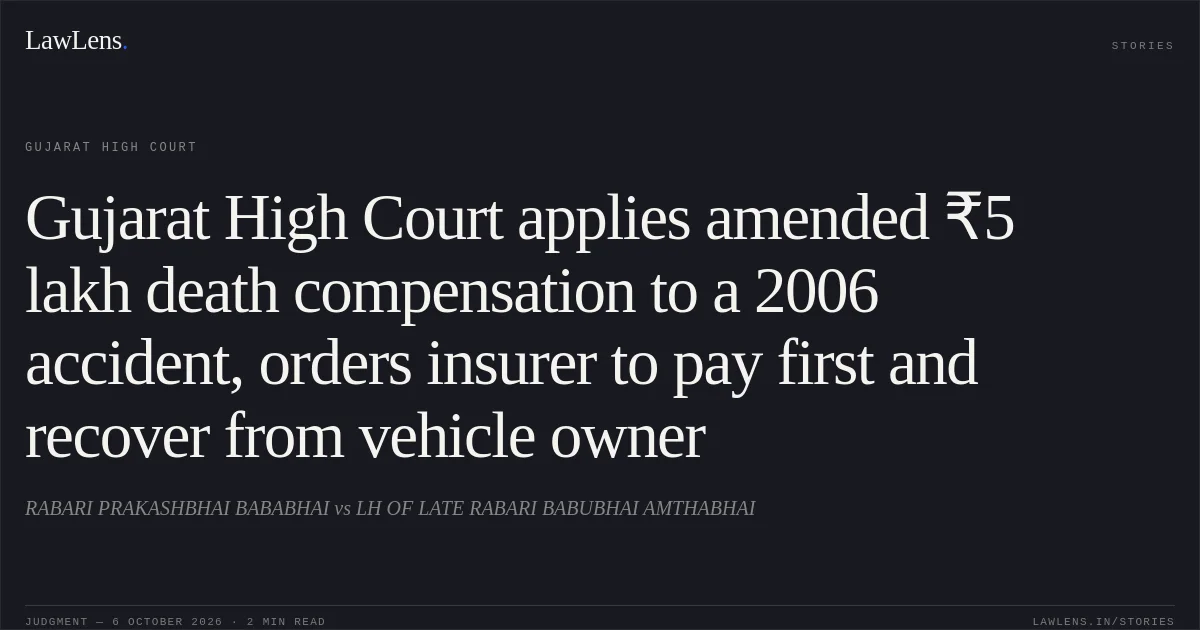
On 16 February 2006, the deceased was travelling in a Chhakdo Rickshaw carrying castor seeds and beans when it overturned; he later died from his injuries.
Source reference: para. 2–2.4The claimant sought compensation under Section 163A of the Motor Vehicles Act, 1988.
Source reference: para. 2–2.4The Tribunal awarded ₹3,74,100 with interest but exonerated the insurer, treating the deceased as a gratuitous passenger in a goods vehicle.
Source reference: para. 2–2.4The claimant appealed.
Source reference: para. 2–2.4Issues
Whether the insurer should first satisfy the compensation award and then recover the amount from the vehicle owner, although the deceased was treated as a gratuitous passenger in a goods vehicle.
Source reference: para. 4–7Whether the claimant was entitled to fixed compensation of ₹5,00,000 under Section 164, despite the accident having occurred before that provision came into force.
Source reference: para. 7–9Law Applied
Under the Motor Vehicles Act, 1988, an insurer may ordinarily avoid indemnifying the insured where a gratuitous passenger travels in a goods vehicle contrary to the policy; however, applying Saju P. Paul, Manuara Khatun, and Shamanna, a court may direct the insurer to satisfy the award first and recover the amount from the insured in the same proceedings, particularly to prevent third-party claimants from being deprived of compensation on policy-related technicalities.
Source reference: para. 5–6The Court relied on New India Assurance Co. Ltd. v. Urmila Halder, 2024 JX (SC) 1154, for the proposition that the beneficial fixed-compensation provision in Section 164 may apply retrospectively where no specific bar prevents the benefit from being given to the claimant.
Source reference: para. 8–9Reasoning
The Tribunal had relied on the FIR to find that the deceased was a gratuitous passenger, despite the driver’s testimony denying that account; the Court also noted that the policy was in force and the deceased was a third party.
Source reference: para. 4Applying the authorities on “pay and recover,” the Court held that the insurer should satisfy the award first and then recover from the owner, rather than leave the claimant to pursue the owner directly.
Source reference: para. 5–7It further applied Urmila Halder to the amended Section 164 provision and enhanced the compensation to the statutory fixed amount of ₹5,00,000.
Source reference: para. 8–10Holding
The appeal was allowed to the stated extent.
The award was modified to grant ₹5,00,000, with interest at 7.5% per annum from the claim-petition date until realization, excluding 356 days attributable to delay in filing the appeal.
Source reference: para. 10.1–10.6The insurer was directed to deposit the amount, after credit for any sum already deposited, within eight weeks; it may recover the payment from the vehicle owner by executing the judgment.
Source reference: para. 10.1–10.6The Tribunal was directed to disburse the deposited amount to the claimant after verification and compliance with the prescribed procedure.
Source reference: para. 10.1–10.6Acts & Sections Cited
4 provisions across 1 statute referred to in this judgment. Each provision opens on LawLens.
Motor Vehicles Act, 19884
Original Court PDF
RABARI PRAKASHBHAI BABABHAIvsLH OF LATE RABARI BABUBHAI AMTHABHAI
Click to open original judgment
Original judgment, available to read, download and summarize on LawLens.in