Facts
The respondent-importer claimed refund of Special Additional Duty (“SAD”) paid on imported goods under Notification No. 102/2007-Cus., which granted exemption/refund where the imported goods were subsequently sold in the domestic market on payment of applicable sales tax/VAT.
Source reference: p.4Notification No. 93/2008-Cus. amended the refund conditions by requiring the claim to be filed within one year from the date of payment of SAD.
Source reference: p.5The Customs authorities rejected the respondent’s refund claims as time-barred, and the Commissioner (Appeals) upheld the rejection.
Source reference: p.5On appeal, the CESTAT allowed the respondent’s claims by its common order dated 23 October 2024, relying, inter alia, on the Delhi High Court’s decisions in Pioneer India Electronics Pvt. Ltd. v. Union of India and Sony India Pvt. Ltd. v. Commissioner of Customs, as well as the Larger Bench decision in Ambey Sales v. CC, Ludhiana.
Source reference: pp.6–8The Revenue challenged the CESTAT’s decision under Section 130 of the Customs Act, 1962.
Source reference: p.2Issues
Whether the CESTAT was justified in holding that the orders passed by the Commissioner (Appeals), rejecting the SAD refund claims, were legally unsustainable.
Source reference: pp.2–3Whether the one-year limitation prescribed by Notification No. 93/2008-Cus. for filing a SAD refund claim could validly run from the date of payment of SAD.
Source reference: pp.2–3, 13–17Whether the CESTAT failed to give proper effect to Notification No. 102/2007-Cus. governing refund of SAD paid under Section 3(5) of the Customs Tariff Act, 1975.
Source reference: pp.2–3Whether the CESTAT failed to give proper effect to Notification No. 93/2008-Cus., which substituted the refund-claim condition in Notification No. 102/2007-Cus. by prescribing a one-year period.
Source reference: pp.2–3, 13–16Law Applied
Section 27(1) of the Customs Act, 1962 prescribes a one-year limitation for an application seeking refund of duty or interest, calculated from the date of payment of such duty or interest.
Source reference: pp.9–10Section 3(5) of the Customs Tariff Act, 1975 authorises levy of additional customs duty, including SAD, while Section 3(8) concerns the applicability of provisions of the Customs Act to such additional duty.
Source reference: pp.7–8, 14Notification No. 102/2007-Cus., issued under Section 25(1) of the Customs Act, granted exemption/refund of SAD paid on imported goods intended for subsequent sale, subject to conditions including payment of applicable sales tax/VAT, disclosure in sale invoices, and filing of a refund claim.
Source reference: pp.10–13Notification No. 93/2008-Cus. substituted the relevant condition by requiring the refund claim to be filed within one year from payment of SAD.
Source reference: p.13Following Pioneer India Electronics, Sony India, Pee Gee International, and the Larger Bench decision in Ambey Sales, the Court held that a subordinate notification could not impose a limitation period for SAD refund where Section 27 did not itself apply to SAD in the relevant manner; prescribing such a period would affect a substantive right and amount to amending the statute without legislative authority.
Source reference: pp.6–8, 14–17Reasoning
The Court treated the refund under Notification No. 102/2007-Cus. as conditional relief available upon subsequent sale of the imported goods and payment of applicable sales tax/VAT, rather than as an ordinary refund governed directly by Section 27 from the date of import-duty payment.
Source reference: pp.10–13, 15–16Although the original notification required the importer to file a refund claim, it did not prescribe a one-year period calculated from payment of SAD.
Source reference: pp.10–13Notification No. 93/2008-Cus. attempted to introduce that limitation.
Source reference: no citationThe Court held that Section 27’s one-year limitation could not be extended to SAD merely through subordinate legislation because SAD was not covered by Section 27 in the manner contended by the Revenue.
Source reference: pp.14–17Such prescription would impermissibly curtail the importer’s substantive entitlement to seek refund and effectively amend the governing statutory scheme through a notification.
Source reference: pp.15–17The Court therefore found no error in the CESTAT’s reliance on Ambey Sales and the relevant Delhi High Court authorities.
Source reference: p.18Holding
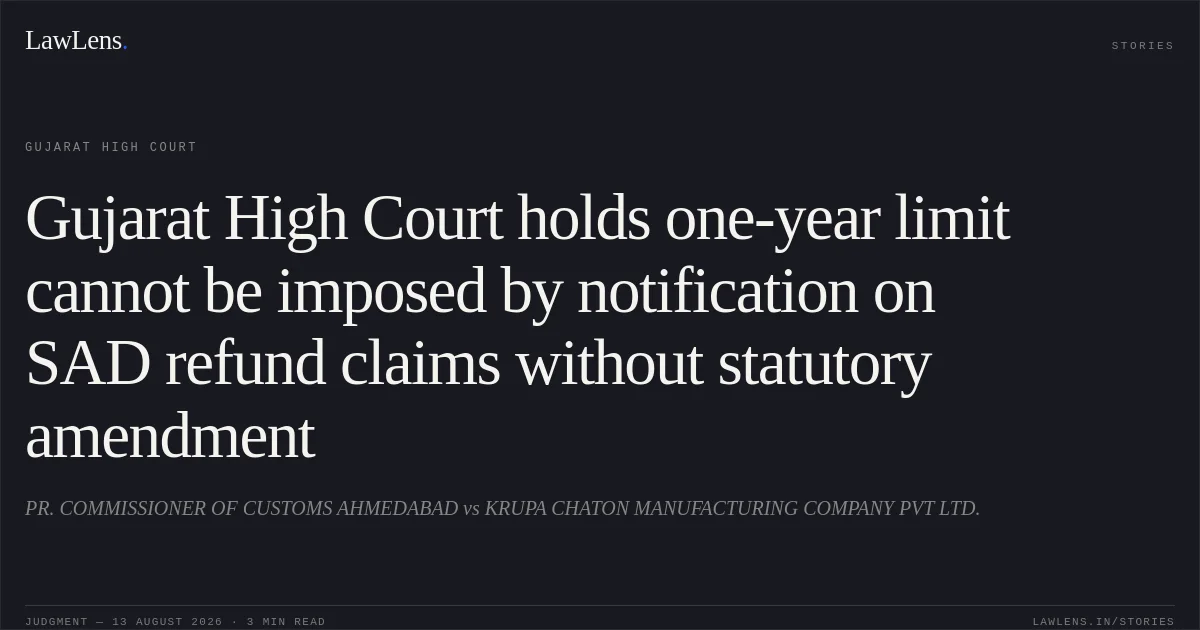
The Gujarat High Court held that the one-year period prescribed by Notification No. 93/2008-Cus. could not validly be applied to SAD refund claims from the date of payment of SAD.
The CESTAT was justified in setting aside the orders rejecting the respondent’s claims as time-barred, and no substantial question of law arose from the CESTAT’s order.
Source reference: pp.18–19The Revenue’s appeal under Section 130 of the Customs Act, 1962 was accordingly dismissed.
Source reference: p.19Acts & Sections Cited
5 provisions across 2 statutes referred to in this judgment. Each provision opens on LawLens.
Customs Act,19623
Original Court PDF
PR. COMMISSIONER OF CUSTOMS AHMEDABADvsKRUPA CHATON MANUFACTURING COMPANY PVT LTD.
Click to open original judgment
Original judgment, available to read, download and summarize on LawLens.in