Facts
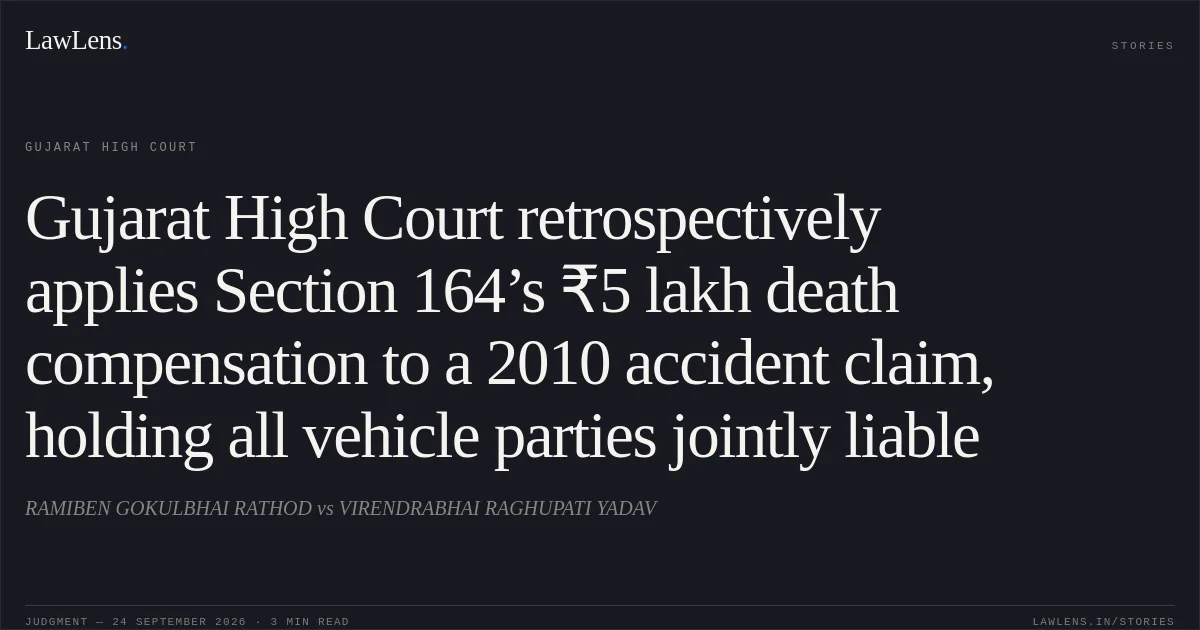
On 28 June 2010, Gokulbhai Mangabhai Rathod was travelling in an autorickshaw when it collided with a tempo allegedly being driven rashly and negligently.
Source reference: pp. 1–2; paras. 1–2.4He sustained fatal injuries and died at the spot. An FIR was registered at Bardoli Police Station.
Source reference: pp. 1–2; paras. 1–2.4The claimant filed a compensation petition under Section 163A of the Motor Vehicles Act, 1988, claiming ₹5,00,000.
Source reference: pp. 1–2; paras. 1–2.4The Motor Accident Claims Tribunal partly allowed the claim and awarded ₹2,89,500 with 9% interest, while apportioning negligence between the vehicles and exonerating the tempo driver, owner and insurer from liability.
Source reference: pp. 1–2; paras. 1–2.4, 7–8The claimant challenged that decision in the present appeal.
Source reference: pp. 1–2; paras. 1–2.4, 7–8Issues
Whether, in a claim under Section 163A of the Motor Vehicles Act, the Tribunal could apportion liability between the vehicles on the basis of respective negligence and thereby exonerate the tempo driver, owner and insurer?
Source reference: pp. 3–5; paras. 5–8Whether the compensation payable for the deceased’s death should be enhanced to ₹5,00,000 under the statutory compensation framework, notwithstanding that the accident occurred before the subsequent statutory enhancement?
Source reference: pp. 6–7; paras. 9–10Whether the claimant was entitled to interest at 9% per annum from the date of the claim petition until realization?
Source reference: p. 7; para. 10Law Applied
Section 163A of the Motor Vehicles Act provides a special, no-fault mechanism for compensation on a structured-formula basis and, by virtue of Section 163A(2), the claimant need not plead or establish wrongful act, neglect or default of the vehicle owner or any other person.
Source reference: p. 3; para. 4The Supreme Court’s decision in Raj Kumar Das (D) Thr. LRs v. National Insurance Company, 2026(0) AIJEL-SC 77051, was relied upon for the principle that negligence need not be proved in a Section 163A claim and that the inquiry is limited to whether the injury or death is reasonably connected with the use of the motor vehicle.
Source reference: pp. 3–5; para. 6The Court also relied on New India Assurance Co. Ltd. v. Urmila Halder, 2024 SCC OnLine SC 4983, which treated the enhanced fixed compensation under Section 164 as beneficial legislation capable of retrospective application where no specific bar exists.
Source reference: pp. 6–7; para. 9The Court further applied the principle that motor accident claims are decided on the preponderance of probabilities and do not require proof beyond reasonable doubt.
Source reference: p. 4; para. 6Reasoning
The Court held that the FIR and other material undisputedly established the involvement of both the tempo and the autorickshaw in the accident.
Source reference: p. 5; para. 8However, because the claim was founded on Section 163A, the claimant was not required to prove negligence, and the Tribunal’s exercise of apportioning negligence between the vehicles was legally irrelevant.
Source reference: p. 5; para. 8Consequently, the Tribunal could not exonerate the tempo driver, owner and insurer on the ground that the autorickshaw driver was negligent.
Source reference: p. 5; para. 8Applying the beneficial-legislation principle recognised in Urmila Halder, the Court held that the compensation should be computed at the enhanced statutory amount of ₹5,00,000, while retaining the Tribunal’s award of 9% interest from the date of the claim petition.
Source reference: pp. 6–7; para. 10Holding
The appeal was allowed to the stated extent.
The Tribunal’s judgment was set aside insofar as it exonerated opponents Nos. 2 and 3.
Source reference: p. 7; paras. 10.1–10.3All opponents were held jointly and severally liable to pay ₹5,00,000 to the claimant, together with interest at 9% per annum from the date of the claim petition until realization.
Source reference: p. 7; paras. 10.1–10.3The Insurance Company was directed to deposit the entire compensation and accrued interest before the Tribunal within eight weeks.
Source reference: p. 7; paras. 10.4–10.6The Tribunal was directed to disburse the amount to the claimant after due verification and deduction of applicable court fees.
Source reference: p. 7; paras. 10.4–10.6Acts & Sections Cited
5 provisions across 1 statute referred to in this judgment. Each provision opens on LawLens.
Motor Vehicles Act, 19885
Original Court PDF
RAMIBEN GOKULBHAI RATHODvsVIRENDRABHAI RAGHUPATI YADAV
Click to open original judgment
Original judgment, available to read, download and summarize on LawLens.in