Facts
The petitioner challenged Rules 32 and 81 of the Central Motor Vehicles Rules, 1989 as ultra vires the Motor Vehicles Act, 1988, and sought a direction restraining the Regional Transport Authority, Ahmedabad, from recovering any amount beyond the prescribed regular fee.
Source reference: p.1During hearing, the challenge to Rule 32 was withdrawn because of its amendment with effect from 29 December 2016.
Source reference: p.2The remaining challenge concerned the note appended to Serial No. 11 of Rule 81, which prescribed an additional fee of ₹50 for each day’s delay after expiry of a vehicle’s certificate of fitness, over and above the regular fee of ₹200 for grant or renewal of the certificate.
Source reference: pp.2–3The petitioner contended that the levy was punitive in substance, lacked statutory authority, and had no correlation with any additional service rendered by the authorities.
Source reference: pp.2–3The Court considered the decisions of the Madras, Karnataka and Rajasthan High Courts, which had struck down similar levies.
Source reference: pp.3–6Issues
1. Whether the levy of an additional fee of ₹50 per day for delay in renewing a certificate of fitness after its expiry was a valid fee authorised by Sections 64(o) and 211 of the Motor Vehicles Act, 1988, or was punitive in nature and beyond the rule-making power.
Source reference: pp.12–16, 20–232. Whether the impugned provision in Rule 81, framed under the Central Motor Vehicles Rules, 1989, was ultra vires the Motor Vehicles Act, 1988.
Source reference: pp.15–18, 23–243. Whether the respondents could recover any additional amount beyond the prescribed regular fee while processing delayed renewal applications.
Source reference: pp.1–3, 24–25Law Applied
The Court applied Sections 39 and 56 of the Motor Vehicles Act, 1988, under which a transport vehicle must possess a valid certificate of fitness to be treated as validly registered and lawfully operated on public roads.
Source reference: pp.12–15Section 64(o) authorises the Central Government to prescribe fees for specified matters, including the grant and renewal of certificates of fitness, while Section 211 permits fees only for applications, certificates, tests and other matters involving the rendering of services by authorities under the Act.
Source reference: pp.20–22The Court relied on Gaurav Kumar v. Union of India, holding that a delegated authority must act within the express limits of the parent statute and cannot create substantive liabilities or disabilities not contemplated by it.
Source reference: pp.7–9, 16–18It also applied Ahmedabad Urban Development Authority v. Sharadkumar Jayantikumar Pasawalla, which holds that the power to impose a fee must be specific and cannot be inferred by implication.
Source reference: pp.8–9Although a regulatory fee need not involve mathematical quid pro quo, it must have a reasonable relationship with the service or regulatory activity undertaken by the authority.
Source reference: pp.9–12The Court further relied on State of U.P. v. Vam Organic Chemicals Ltd., holding that a levy unconnected with the cost or administration of regulation cannot be imposed as a regulatory fee.
Source reference: pp.18–19Sections 210C and 199B were interpreted as operating within the statutory scheme of offences and penalties and not as authorising the creation of a new penalty for delayed renewal of a fitness certificate.
Source reference: pp.20–23Reasoning
The Court distinguished the valid regular fee for grant or renewal of a fitness certificate from the impugned ₹50-per-day additional levy.
Source reference: no citationGrant or renewal involves inspection, testing and certification, and therefore bears a reasonable relationship to services rendered by the authorities.
Source reference: pp.12–14By contrast, the daily additional charge was imposed solely because the application was filed after expiry; the provision did not identify any additional service, administrative cost or regulatory activity corresponding to the amount charged.
Source reference: p.14The use of the expression “delay,” together with the Government’s stated objective of deterring late renewal and promoting compliance, demonstrated that the levy was punitive rather than compensatory or regulatory.
Source reference: pp.18–20Sections 39 and 56 already prohibited the operation of a vehicle without a valid fitness certificate, and operating such a vehicle could attract the statutory consequences under the Act; however, the Act did not make delayed renewal itself an offence or authorise the Central Government to impose a new fine for it.
Source reference: pp.13–16, 20–23Section 211, being confined to fees connected with services, could not be used to impose a penalty in the guise of an additional fee.
Source reference: p.20–22Accordingly, the delegated legislation exceeded the authority conferred by the parent Act.
Source reference: no citationHolding
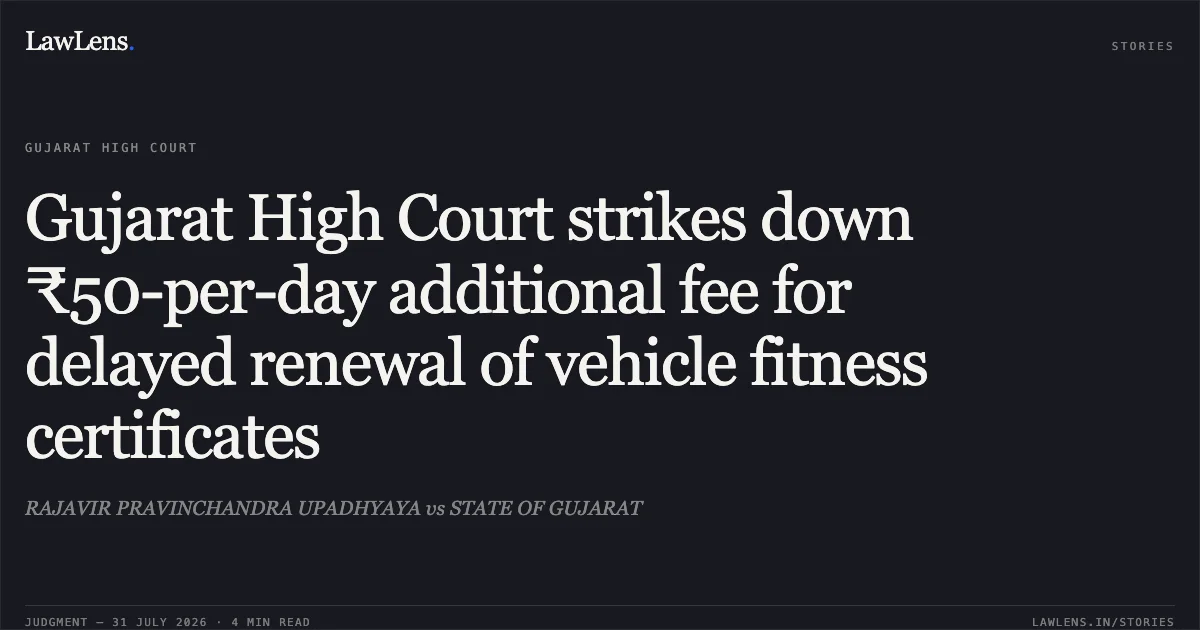
The Gujarat High Court allowed the petition and held that Rule 81 of the Central Motor Vehicles Rules, 1989 was ultra vires the Motor Vehicles Act, 1988 to the extent that it authorised an additional fee of ₹50 for each day’s delay after expiry of a certificate of fitness.
The impugned note appended to the relevant entry of Rule 81 was declared inoperative, and the respondents were directed not to levy or recover the additional daily charge while considering delayed applications for renewal of fitness certificates.
Source reference: pp.23–25The challenge to Rule 32 was treated as withdrawn.
Source reference: p.2The connected Civil Application for directions was disposed of accordingly.
Source reference: p.26Acts & Sections Cited
38 provisions across 2 statutes referred to in this judgment. Each provision opens on LawLens.
Motor Vehicles Act, 1988
Advocates Act, 19611
Original Court PDF
RAJAVIR PRAVINCHANDRA UPADHYAYAvsSTATE OF GUJARAT
Click to open original judgment
Original judgment, available to read, download and summarize on LawLens.in